

TL;DR:
- Gloss enhancement is a single-stage polish that boosts paint gloss, depth, and clarity without removing deep defects. It improves light reflection by leveling minor surface irregularities and is ideal for dull, well-maintained vehicles preparing for protective coatings. Proper surface prep and post-polish protection are critical for achieving lasting, high-quality results.
Gloss enhancement is defined as a single-stage machine polish that increases paint gloss, color depth, and clarity while reducing minor surface defects. The process does not remove deep scratches or swirl marks. It sits between a standard detail wash and a full paint correction in terms of intensity and cost. For car owners whose paint has lost its luster but shows no serious defects, a paint enhancement service, the recognized industry term, delivers a sharper, more refined finish without the time and expense of multi-stage correction.
What is gloss enhancement and how does it work on paint?
Gloss enhancement is a professional detailing technique that uses a single-stage polish with mild abrasives to refine the paint surface, boost light reflectance, and restore depth and clarity. The process is also called paint enhancement in the detailing industry. Both terms describe the same service: a light polishing treatment designed to improve appearance without addressing structural paint defects.
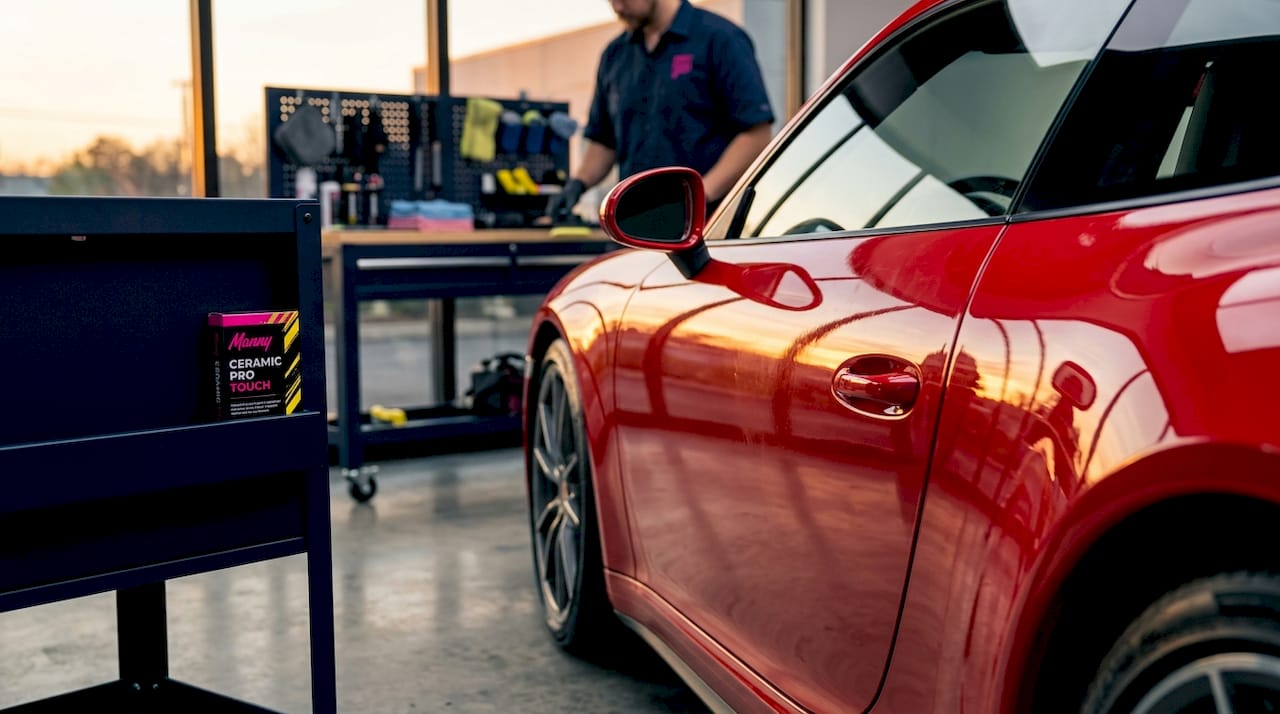
Gloss depends on surface roughness. The smoother the surface, the more uniformly light reflects off it, and the higher the perceived gloss. Uneven or contaminated surfaces scatter light in multiple directions, which is why neglected paint looks flat and dull. A gloss enhancement method works by leveling minor surface irregularities through polishing, which increases specular light reflection and restores that wet, deep look.
The role of gloss enhancers in this process is to combine mild abrasion with filling agents. Products like CarPro Essence Xtreme combine nano quartz, resins, and fine abrasives to enhance gloss and fill minor imperfections simultaneously. This dual action is what separates a quality gloss enhancer from a simple spray wax.
Key technical factors that determine gloss quality include:
- Surface roughness: Smaller roughness values produce higher gloss due to more uniform light reflection
- Pigment dispersion: Evenly distributed pigment particles create a more consistent color depth
- Particle size uniformity: Finer, more uniform particles in the paint film improve light reflectance and produce a more brilliant finish
- Coating thickness and leveling: A well-leveled coating surface reduces micro-texture that scatters light
Pro Tip: Inspect the paint under a single-point light source, such as a shop light or the sun at a low angle, before starting any gloss enhancement. This reveals surface texture and contamination that flat overhead lighting will miss.
How does gloss enhancement differ from paint correction?
Gloss enhancement and paint correction are not interchangeable services. Choosing the wrong one wastes money and can leave you disappointed with the result. The distinction comes down to paint condition and the depth of defects present.
Gloss enhancement uses a single-stage polish with light abrasives for a quicker, less labor-intensive refinement. It works on paint that has lost clarity and depth but does not carry significant scratches, swirl marks, or oxidation. Paint correction, by contrast, uses multi-stage polishing with progressively finer abrasives to physically remove those deeper defects from the clear coat. Swirl marks and scratches require paint correction for actual removal. A gloss enhancement can make them temporarily less visible by filling them, but it will not eliminate them.
| Feature | Gloss enhancement | Paint correction |
|---|---|---|
| Stages | Single-stage | Multi-stage |
| Abrasive level | Mild | Moderate to heavy |
| Defects addressed | Minor dullness, light oxidation | Swirls, scratches, heavy oxidation |
| Time required | 2 to 4 hours | 6 to 16+ hours |
| Cost | Lower | Higher |
| Result durability | Moderate | High when sealed |
| Best for | Paint with minor defects | Paint with visible damage |
When to choose gloss enhancement:
- Paint looks dull or flat but has no visible scratches under direct light
- You want to prepare the surface for a ceramic coating or sealant application
- You need a cost-effective refresh between full correction cycles
- The vehicle is relatively new and has been maintained consistently
Pro Tip: Check your paint under a paint correction inspection light before booking any service. What looks like dullness in shade can reveal heavy swirl damage under direct light, which means correction, not enhancement, is the right call.
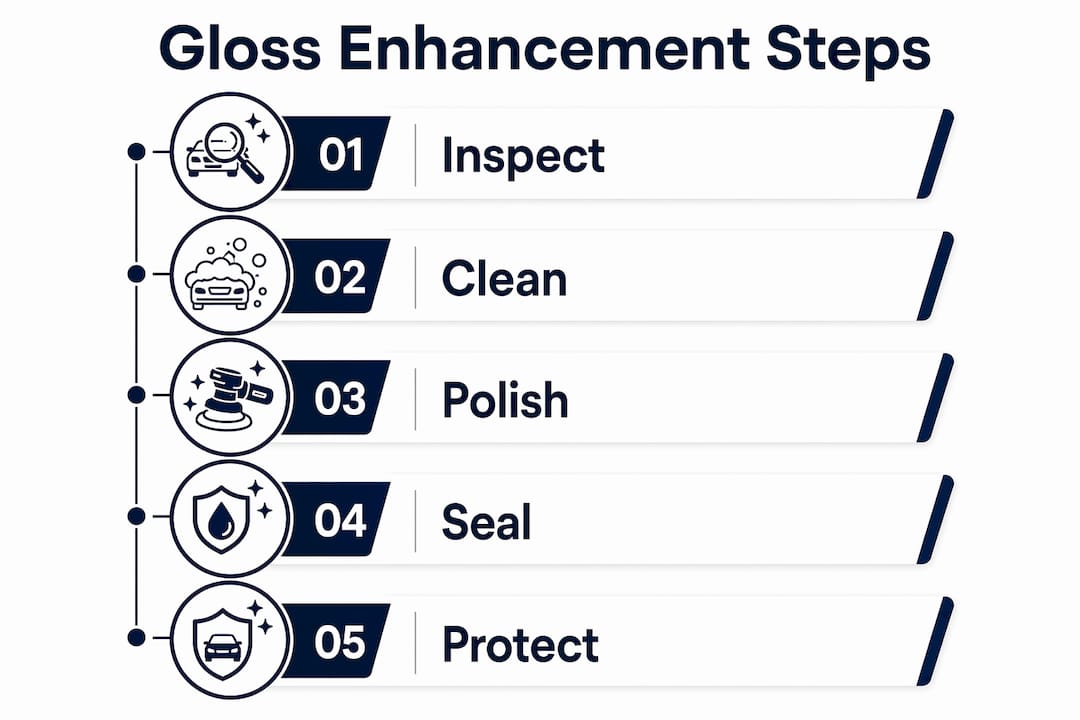
Step-by-step gloss enhancement method for best results
Achieving a consistent, lasting result from a gloss enhancement service depends as much on preparation as it does on the polishing step itself. Skipping prep is the most common reason results look patchy or fade quickly.
-
Thorough wash and decontamination. Wash the vehicle with a pH-neutral shampoo, then perform a chemical decontamination using an iron remover and a tar remover. Follow with a clay bar treatment to pull bonded contaminants from the paint surface. Contamination left on the surface before polishing causes uneven gloss and reduces durability.
-
Surface inspection. Work under a focused light source to map the paint condition. Identify any areas with deeper scratches or swirl marks that will not respond to a single-stage polish. Flag those areas for the client or note them for a future correction service.
-
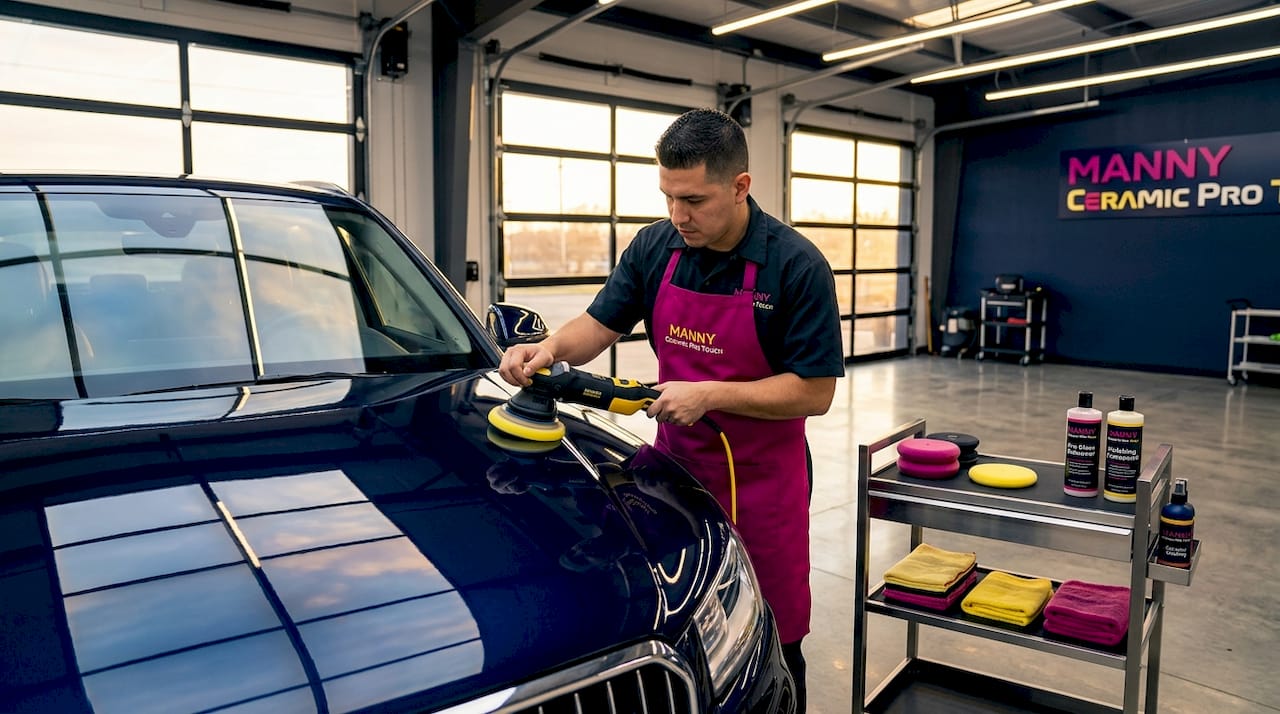
Machine polishing. Use a dual-action polisher with a medium-cut foam or microfiber pad. Apply a single-stage polish or dedicated gloss enhancer product in small sections. Work at a moderate speed, using overlapping passes to level the surface evenly. Wipe residue with a clean microfiber towel after each section.
-
Panel wipe-down. After polishing, wipe all panels with an isopropyl alcohol (IPA) solution to remove any polish oils or fillers. This step is critical before applying any protective coating, as residual oils can prevent proper bonding.
-
Apply a sealant or coating. A gloss enhancement service commonly includes a spray sealant or ceramic coating application in the same visit. Products like a SiO2-based spray sealant lock in the polished surface and add UV resistance and hydrophobic properties. For longer-term protection, a full ceramic coating applied at this stage extends the results significantly.
-
Final inspection under natural light. Move the vehicle outside and inspect under natural daylight. Natural light reveals any missed sections, high spots in the sealant, or areas where the polish did not fully level the surface.
Pro Tip: Apply the sealant in a shaded area or indoors. Direct sunlight causes sealants to flash too quickly, leading to uneven coverage and difficult removal.
Benefits and limitations of gloss enhancement for paint maintenance
The benefits of gloss enhancement are real and measurable, but they apply to a specific range of paint conditions. Understanding both sides helps you set accurate expectations before committing to the service.
Benefits:
- Improved visual depth and clarity. Polishing levels minor surface texture and removes light oxidation, producing a sharper, more reflective finish that makes color appear richer and more saturated.
- Surface preparation for coatings. A polished, clean surface bonds more effectively with ceramic coatings and sealants. Applying a coating over unpolished paint traps surface irregularities and reduces the coating’s optical performance.
- Cost-effective maintenance. Gloss enhancement costs significantly less than a full paint correction and can be repeated periodically to maintain appearance between correction cycles.
- Faster turnaround. A typical service takes two to four hours, making it practical for regular maintenance without extended vehicle downtime.
Limitations:
- Gloss enhancement will not remove swirl marks, scratches, or oxidation that has penetrated the clear coat. Those defects require multi-stage paint correction.
- Results depend heavily on prep quality. A poorly decontaminated surface produces patchy, short-lived gloss.
- Durability is moderate. Without a quality sealant or ceramic coating applied afterward, the polished surface will degrade faster from UV exposure and washing.
- Gloss enhancement is not a permanent fix. It fits into a long-term paint care schedule rather than replacing it.
Gloss enhancement works best as part of a structured paint care plan. Treat it as a periodic refinement step, not a one-time solution, and pair it with a durable protective coating to extend the results.
For owners of luxury or high-value vehicles, pairing gloss enhancement with a high-gloss finish protection strategy is the most effective way to maintain appearance over time. The polish restores the surface; the coating preserves it.
Key takeaways
Gloss enhancement delivers measurable improvements in paint clarity and depth when applied to paint with minor defects, but it requires proper surface prep and post-polish protection to produce lasting results.
| Point | Details |
|---|---|
| Core definition | Gloss enhancement is a single-stage polish that boosts clarity, depth, and gloss without correcting deep defects. |
| Science of gloss | Lower surface roughness produces higher gloss; polishing and gloss enhancer products improve light reflectance. |
| Enhancement vs. correction | Use gloss enhancement for dull paint; use paint correction when swirl marks or scratches are visible. |
| Prep determines results | Decontamination and surface leveling before polishing have more impact on durability than the polish itself. |
| Protection extends results | Applying a sealant or ceramic coating after polishing locks in gloss and adds UV and environmental resistance. |
What I’ve learned from doing this work on high-value vehicles
Most clients who come to Mannyceramicprotouch asking about gloss enhancement have already tried a spray detailer or a quick wax and been disappointed. They describe the result as “not lasting” or “not as deep as it used to look.” The issue is almost never the product. It’s the prep.
The single most underestimated step in any gloss enhancement method is decontamination. Iron particles, tar deposits, and bonded road film sit on top of the clear coat and physically prevent a polish from making full contact with the paint surface. You can use the best single-stage polish on the market and still get a mediocre result if the surface is contaminated. I have seen this consistently across vehicles of every age and price point.
The second misconception I encounter regularly is that gloss enhancement and paint correction are the same thing at different price levels. They are not. Gloss enhancement improves what is already there. Paint correction removes what should not be there. If a client’s paint has visible swirl marks under a shop light, no amount of single-stage polishing will make those disappear. Managing that expectation clearly, before the work starts, is part of doing this job properly.
My honest recommendation for any enthusiast maintaining a vehicle they care about: schedule a gloss enhancement once or twice a year as part of a structured care plan, always follow it with a quality sealant or coating, and get a proper paint correction done when the paint actually needs it. Trying to use enhancement as a substitute for correction is how paint gets worse over time, not better. The science of surface roughness and gloss is clear on this point. Treatments that only add surface shine without smoothing the underlying texture produce short-lived results on dull paint.
— Emmanuel
Protect your paint beyond the polish

A gloss enhancement service is one of the most effective ways to restore your vehicle’s paint appearance, but the results last longer when backed by the right protection. At Mannyceramicprotouch, every paint enhancement service is paired with a tailored protection strategy designed for the specific vehicle and its condition. For clients who want results that hold up over months rather than weeks, advanced options like ceramic coating packages and Liquid PPF solutions provide the durability that a sealant alone cannot match. If you are ready to move beyond a basic detail and invest in long-term paint preservation, contact Mannyceramicprotouch to schedule a consultation.
FAQ
What is gloss enhancement in car detailing?
Gloss enhancement is a single-stage machine polish that increases paint gloss, color depth, and clarity while reducing minor surface defects. It does not remove deep scratches or swirl marks, which require multi-stage paint correction.
How long does a gloss enhancement last?
Results typically last two to four months without protection, but applying a quality sealant or ceramic coating after polishing can extend the finish significantly longer. Surface prep quality and post-polish protection are the primary factors that determine durability.
Can gloss enhancement remove swirl marks?
Gloss enhancement will not remove swirl marks or scratches. These defects require paint correction services that use multi-stage polishing with progressively finer abrasives to physically reduce or eliminate them from the clear coat.
What products are used in gloss enhancement?
Common gloss enhancement products include single-stage polishes, dedicated gloss enhancer compounds like CarPro Essence Xtreme, and finishing pads used with a dual-action polisher. A spray sealant or SiO2-based coating is typically applied afterward to protect the polished surface.
Is gloss enhancement worth it for a new car?
A new vehicle with factory paint in good condition benefits from gloss enhancement as a preparation step before applying a ceramic coating or paint protection film. It removes any light surface contamination from transport and delivery and creates an optimal bonding surface for protective products.