

TL;DR:
- High net worth car care involves specialized maintenance and protection techniques tailored to preserve the performance and value of luxury and exotic vehicles. It emphasizes the importance of following manufacturer schedules, using OEM parts, and implementing advanced protection like PPF and ceramic coatings to maximize longevity and resale value. Consistent expert detailing, precise diagnostics, and disciplined maintenance habits are essential for long-term asset preservation.
High net worth car care is the specialized practice of preserving luxury and exotic vehicles through tailored protection technologies, precision maintenance protocols, and expert detailing. Unlike standard vehicle upkeep, this discipline addresses the complex engineering, advanced materials, and significant financial value embedded in cars like the Ferrari SF90, Rolls-Royce Phantom, or Lamborghini Urus. Paint protection film (PPF), ceramic coatings, ADAS calibration, and manufacturer-specific service intervals are the core pillars of this approach. Owners who treat their vehicles as long-term assets, not just transportation, consistently achieve better resale outcomes and longer-lasting finishes. This guide covers each pillar in detail so you can make informed decisions about protecting what you own.
What high net worth car care actually means for luxury owners
High net worth car care, known in the industry as premium vehicle preservation, is defined by one principle: every maintenance decision must protect both the mechanical integrity and the financial value of the vehicle. Standard car care focuses on keeping a vehicle running. Premium vehicle care focuses on keeping it performing, looking, and appraising at its highest possible level over time. The distinction matters because luxury and exotic vehicles use materials, systems, and engineering tolerances that standard service centers are not equipped to handle.
Modern luxury vehicles incorporate carbon fiber body panels, carbon ceramic brake systems, advanced driver assistance systems (ADAS), and proprietary software architectures. A Porsche 911 GT3 RS, for example, uses carbon fiber reinforced polymer components that require specific cleaning agents to avoid surface degradation. A Bentley Bentayga’s air suspension system demands OEM-grade fluid and calibrated diagnostic tools for accurate servicing. These are not edge cases. They are the baseline expectations for any vehicle in this category.
The financial stakes reinforce the need for specialized care. A luxury car maintenance checklist built around OEM procedures and documented service history directly influences resale value in the secondary market. Buyers of pre-owned exotic vehicles scrutinize service records the way investors scrutinize financial statements. Gaps in documentation translate to price reductions, sometimes significant ones.
What are the best paint protection options for luxury cars?
The core decision in premium paint protection is understanding which type of damage you are guarding against: physical impact or chemical contamination. PPF and ceramic coatings address fundamentally different threats, and selecting the right solution depends on how and where you drive.
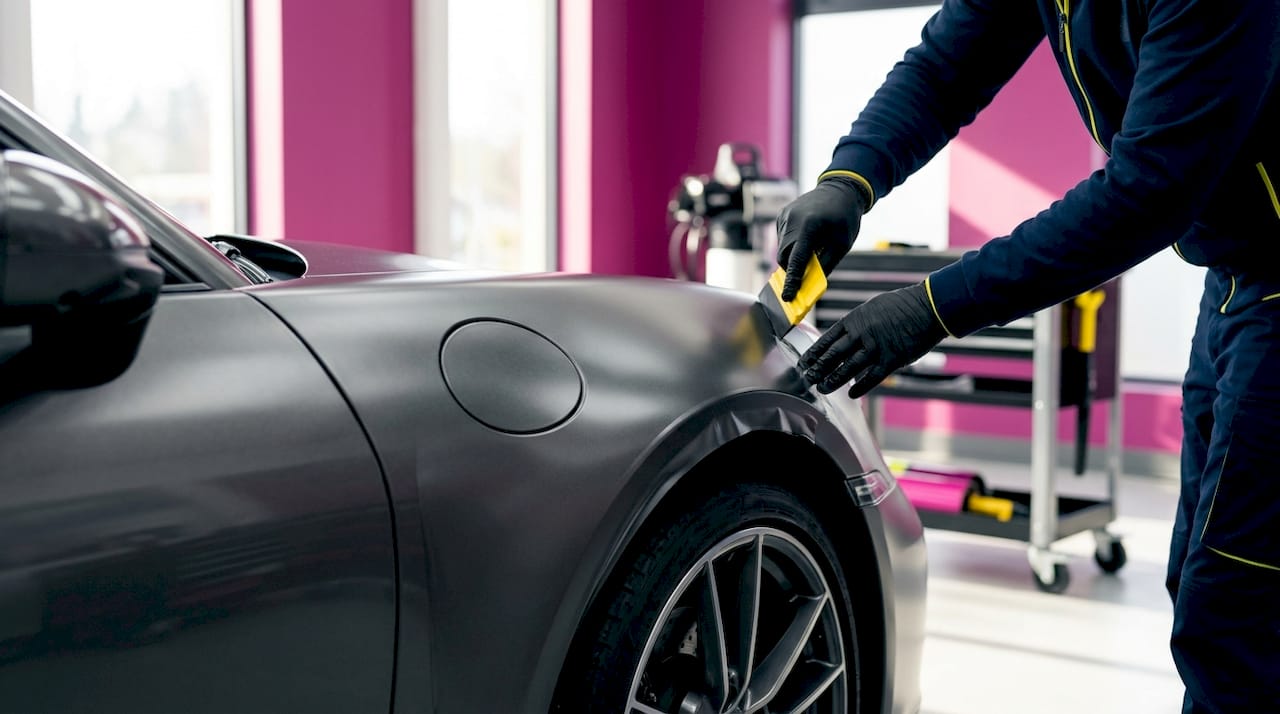
Paint protection film is a thermoplastic urethane layer applied directly to the vehicle’s painted surfaces. It absorbs physical impacts from road debris, rock chips, and minor abrasions. High-quality PPF products also carry self-healing properties, meaning light surface scratches disappear with heat exposure. PPF durability ranges from 8 to 12 years, making it the longer-lasting physical barrier of the two options.
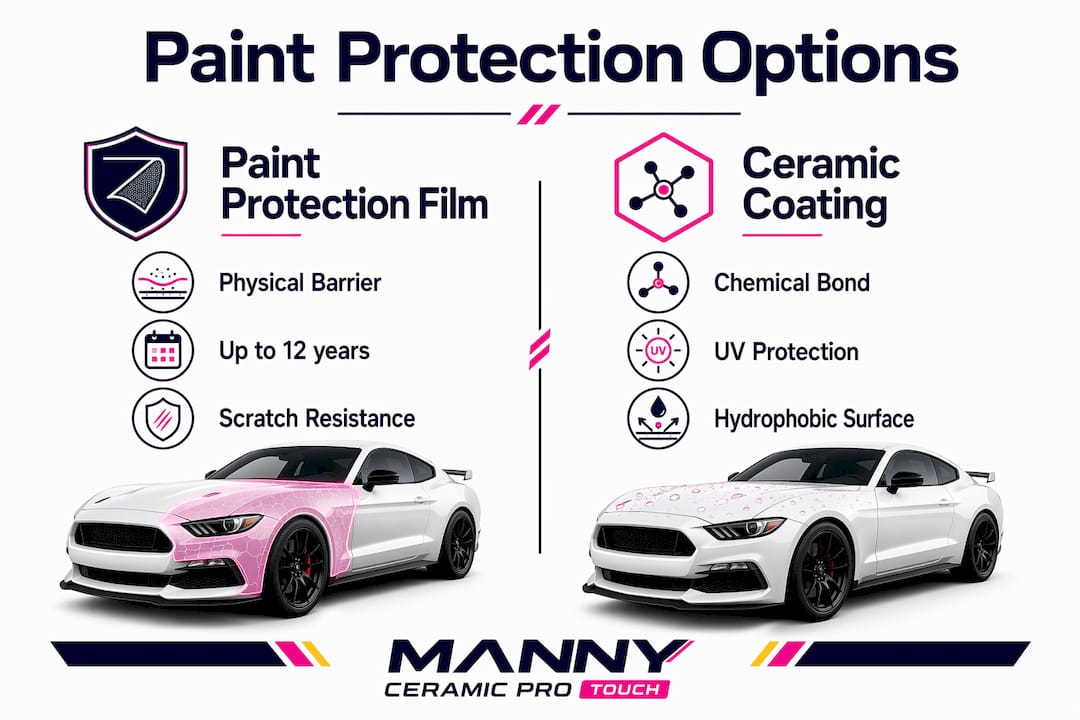
Ceramic coatings operate differently. They bond chemically to the paint surface and create a hydrophobic, UV-resistant layer that repels water, bird droppings, industrial fallout, and road grime. Ceramic coatings last 2 to 9 years depending on product grade and maintenance behavior. They do not absorb physical impacts, but they significantly reduce the effort required to keep a vehicle clean and protected from environmental contamination.
The most effective approach combines both. Ceramic coating applied over PPF extends the film’s lifespan, adds hydrophobic properties, and makes routine cleaning far easier. Professional installers recommend applying the ceramic coat 7 to 30 days after PPF installation to allow the film to cure fully. Combined protection packages range from $3,500 to $6,500 and represent the highest-level paint preservation available for new vehicles.
| Protection Type | Primary Function | Durability | Best For |
|---|---|---|---|
| Paint Protection Film (PPF) | Physical impact resistance, self-healing | 8–12 years | Rock chips, road debris, daily driving |
| Ceramic Coating | Chemical resistance, hydrophobic gloss | 2–9 years | UV protection, contamination, ease of cleaning |
| Combined PPF + Ceramic | Full-spectrum protection | 8–12 years (extended) | Maximum long-term preservation |
Pro Tip: Avoid automatic brush car washes entirely after any protective coating is applied. Harsh soaps and brush washes can reduce ceramic coating lifespan by half, erasing a significant portion of your protection investment.
How does following manufacturer schedules preserve luxury car value?
Manufacturer-specific maintenance intervals are engineered to match the precision tolerances and advanced safety systems built into luxury vehicles. Deviating from these intervals, even by a few hundred miles or weeks, introduces risk that compounds over time. The engineering teams at BMW M, Mercedes-AMG, and McLaren design service schedules around specific wear rates, fluid degradation curves, and software update cycles. Following those schedules exactly is not optional for owners who want peak performance and full resale value.
Using genuine OEM parts is equally non-negotiable. Aftermarket components may fit physically, but they rarely meet the metallurgical or tolerance specifications of original parts. A brake rotor that is 0.2mm thinner than spec on a Porsche Taycan Turbo S will affect braking distance in ways that are imperceptible until they are not. Documented use of OEM parts also signals to future buyers that the vehicle was maintained to factory standards, which service documentation confirms as a direct resale value differentiator in the luxury segment.
Modern luxury and exotic vehicles also require software updates and ADAS sensor recalibrations as part of routine maintenance. These are not optional add-ons. They are functional requirements that keep safety systems operating within designed parameters. Skipping a software update on a vehicle with adaptive cruise control or lane-keeping assist can degrade system accuracy without triggering any warning light.
- Schedule all service appointments at authorized dealers or OEM-certified independent shops.
- Request itemized invoices for every service visit and store them with the vehicle’s title documents.
- Confirm that all software updates are applied at each service interval.
- Verify that ADAS sensors are recalibrated after any windshield replacement or front-end work.
- Use only manufacturer-specified fluids, filters, and brake components.
Pro Tip: Build a digital service folder using a cloud storage platform like Google Drive or Dropbox. Photograph every invoice and calibration report. Buyers in the luxury pre-owned market respond to organized documentation the same way they respond to a clean Carfax report.
What advanced diagnostics do exotic vehicles actually require?
Advanced diagnostics for exotic vehicles extend well beyond oil pressure readings and fault code scans. Modern high-performance cars carry sensor arrays, camera systems, and software modules that require purpose-built diagnostic equipment and trained technicians to service correctly. ADAS calibration is the most frequently overlooked requirement among luxury car owners, and the consequences of skipping it range from false alerts to complete system deactivation.
The following systems require regular expert inspection and calibration on most exotic and luxury vehicles:
- Adaptive cruise control radar modules: Require recalibration after any front bumper removal, collision repair, or sensor cleaning procedure.
- Lane departure and lane-keeping cameras: Windshield replacement triggers mandatory recalibration on vehicles from Audi, BMW, Mercedes-Benz, and Volvo.
- Blind-spot monitoring sensors: Rear bumper work or sensor replacement requires static and dynamic calibration to restore full detection range.
- 360-degree camera systems: Lens cleaning and software alignment checks prevent image distortion that affects parking accuracy.
- Battery management systems (BMS) in hybrid and EV models: Require periodic health assessments to monitor cell degradation and optimize range.
The cost of missed calibrations is not abstract. A Mercedes-AMG One required over $44,000 in maintenance work after just 115 miles of use, illustrating how extreme the labor and component costs can be for hyper-exotic vehicles. Owning vehicles at this level demands planning for disproportionate upkeep expenses, and that planning starts with choosing technicians who carry the right equipment and OEM training certifications.
How does expert detailing protect luxury car finishes long-term?
Expert detailing for luxury vehicles is a structured preservation process, not a cosmetic service. The products, techniques, and frequency of detailing directly affect how long a vehicle’s paint, leather, and trim materials hold their condition. Climate and environment play a significant role in determining which protocols are appropriate for your specific situation.
The following detailing practices form the foundation of responsible luxury car care:
- pH-neutral soap and two-bucket wash method: Prevents swirl marks and chemical etching on clear coat surfaces.
- Microfiber wash mitts and drying towels: Eliminate the abrasion risk that standard sponges and chamois cloths introduce.
- Iron decontamination treatments: Remove embedded metallic particles from brake dust before they oxidize and stain paint.
- Clay bar decontamination: Extracts bonded surface contaminants that washing alone cannot remove, preparing the surface for coating application.
- UV-protective ceramic spray toppers: Extend the life of primary ceramic coatings between annual maintenance appointments.
Climate is a variable that many owners underestimate. UV radiation in South Florida accelerates clear coat oxidation faster than in northern states. Salt air in coastal cities like Fort Lauderdale and Miami introduces corrosive compounds that attack exposed metal and degrade rubber seals. Paint protection solutions tailored to regional climates, such as those developed for Dubai’s extreme heat and sand conditions, demonstrate how environment-specific product selection produces measurably better outcomes than generic detailing protocols.
Long-term storage also requires attention. Climate-controlled garages, battery maintainers for vehicles stored more than two weeks, and tire cradles that prevent flat-spotting on low-profile performance tires all contribute to preserving the vehicle’s condition between drives.
Pro Tip: Schedule a ceramic coating inspection every 12 months. A trained technician can identify hydrophobic degradation before it leads to paint contamination, extending the effective life of your protection investment.
Key takeaways
Luxury vehicle preservation requires combining physical protection, precision maintenance, and environment-aware detailing to protect both the finish and the financial value of the asset.
| Point | Details |
|---|---|
| PPF vs. ceramic coating | PPF blocks physical impacts for 8–12 years; ceramic coatings resist chemical damage for 2–9 years. |
| Combined protection value | PPF and ceramic coating packages ($3,500–$6,500) deliver the highest long-term paint preservation. |
| OEM maintenance compliance | Manufacturer service intervals and genuine parts directly protect reliability and resale value. |
| ADAS calibration is mandatory | Skipping sensor recalibration after repairs degrades safety system accuracy and can void warranties. |
| Detailing method matters | pH-neutral soaps, microfiber tools, and climate-specific products prevent premature finish degradation. |
What I’ve learned from working with high-value vehicles every day
After working with luxury and exotic vehicles at Mannyceramicprotouch, one pattern stands out clearly. Owners who invest in premium protection at the point of purchase, and then neglect the maintenance behaviors that sustain that protection, consistently see diminished returns. A $5,000 PPF and ceramic coating package applied to a McLaren 720S delivers its full value only when the owner avoids automatic washes, uses the right cleaning products, and schedules annual inspections. The protection is only as good as the habits that follow it.
The second observation is about provider selection. Many owners assume that any detailing shop can maintain a ceramic coating or inspect a PPF installation. That assumption is costly. Technicians who lack OEM training and proper diagnostic tools introduce risk at every service visit. The car preservation workflow for a vehicle like a Porsche 911 Turbo S or a Bentley Continental GT requires a level of precision that only comes from experience with those specific platforms.
My honest recommendation is to view protection and maintenance as a single, continuous investment rather than two separate decisions. The technology available today, from self-healing PPF to multi-year ceramic coatings, is genuinely impressive. But technology does not replace discipline. The owners who get the best long-term results are the ones who stay current with evolving protection options and hold their service providers to the same standards they apply to every other aspect of their financial lives.
— Emmanuel
Protect your luxury vehicle with Mannyceramicprotouch
Mannyceramicprotouch specializes in advanced surface preservation for luxury, exotic, and high-value vehicles in Fort Lauderdale and the surrounding South Florida area. The studio offers Liquid PPF solutions and traditional paint protection film installations, along with professional ceramic coating packages engineered for long-term gloss and contamination resistance. Every vehicle receives a tailored protection strategy, not a volume-based service. Clients receive warranty coverage, detailed maintenance guidance, and access to technicians trained specifically in luxury and exotic vehicle care. If you own a vehicle worth protecting, Mannyceramicprotouch delivers the precision and discretion that ownership at this level demands.
FAQ
What is high net worth car care?
High net worth car care is the specialized maintenance and protection of luxury and exotic vehicles using tailored technologies like PPF, ceramic coatings, and OEM-compliant service protocols. The goal is to preserve both the vehicle’s performance and its financial value over time.
How long does paint protection film last on a luxury car?
PPF lasts 8 to 12 years on luxury vehicles when professionally installed and properly maintained. Avoiding automatic brush washes and using pH-neutral soaps extends the film’s effective lifespan.
Is ceramic coating worth it for exotic vehicles?
Ceramic coating is worth the investment for exotic vehicles because it provides UV protection, chemical resistance, and hydrophobic properties that reduce contamination and simplify cleaning. Combined with PPF, it represents the most complete paint protection available.
Why does ADAS calibration matter for luxury car owners?
ADAS sensor calibration maintains the accuracy of safety systems like adaptive cruise control, lane assist, and blind-spot monitoring. Skipping calibration after repairs can cause false alerts, reduced system performance, or complete feature deactivation.
How does service history affect luxury car resale value?
Documented service history aligned with OEM schedules is a direct resale value differentiator in the luxury segment. Buyers treat complete, organized service records as proof of responsible ownership, which supports asking price and reduces time on the market.