

Yes, you can polish a ceramic coated car, but polishing is abrasive, and the coating is the first thing it wears away. A coating is typically only 1 to 3 microns thick, so a polish that is strong enough to remove a defect is often strong enough to remove the protection over it. Whether it is worth doing depends on the defect, the polish, and whether you are prepared to re-coat the panel afterward.
This guide explains what polishing actually does to a coating, the few situations where it makes sense, how a careful detailer approaches it, and what to do instead when the paint simply looks dull.
TL;DR
- Polishing a ceramic coating is possible, but it works by abrading material. It thins or strips the coating in the area you polish.
- Polish a coated car only for a specific problem: high spots, bonded stains, etch marks, or visible swirls and haze.
- If you must, use a dual-action polisher at low speed, a soft foam pad and an ultra-fine finishing polish with minimal or no abrasives.
- For routine gloss, wash with pH-neutral products and use a ceramic maintenance spray. Skip wax and skip abrasive polish.
- Treat any corrective polish as a protection decision: inspect the panel afterward and re-coat where the coating is gone.
Table of Contents
- What polishing does to a ceramic coating
- When polishing a coated car makes sense
- When not to polish
- How to polish a ceramic coated car with the least loss
- Why wax and abrasive polish are the wrong follow-up
- What to do instead of polishing
- Our perspective
- Restoring protection after correction
- How to choose who works on your coated car
- FAQ
- Sources
What polishing does to a ceramic coating
A ceramic coating is a thin, semi-permanent layer bonded to the clear coat. Its job is to sit between the paint and everything that would otherwise touch the paint: wash media, road film, bird droppings, UV light and water minerals.
Polish is built to do the opposite of preserving a layer. Abrasive car polishes are designed to remove scratches, swirls, oxidation and other clear coat damage, which is why using them on a coating can strip it. The polish levels the surface by mechanically sanding material smooth. Whatever sits on top of the clear coat, coating included, is part of what gets leveled.
Two points are worth separating:
- A light finishing polish may refine the surface and thin the coating slightly.
- An aggressive compound will strip the coating completely, and the panel then needs a full re-application.
How much coating a given pass removes is not a fixed number. It depends on the polish, the pad, the pressure, the machine speed and how thick the coating was applied. One published explanation notes that a quick polish can remove the coating in the polished area without establishing any universal figure for how much is lost per pass. Treat anyone who quotes a precise percentage with caution.
The manufacturers of coatings acknowledge the trade-off. One coating maker’s FAQ says a treated surface can be polished when necessary, but is harder to polish. Car and Driver’s testing guide advises avoiding aggressive polishing after curing unless you intend to remove or reapply the coating, and notes that removal usually requires abrasion such as machine polishing.
When polishing a coated car makes sense
Most coated cars never need to be polished. The cases that justify it are specific, and each one has a different level of urgency.
High spots from application
High spots are patches of coating that were not leveled and wiped properly during installation. They look like dark, rainbow-like or streaky areas. They are best handled early, before the coating fully cures, and by the installer. Polishing is one of the accepted fixes for high spots that have hardened.

Bonded stains and etching
Bird droppings, bug remains and acidic contaminants can etch through the coating into the clear coat if left to bake in the Florida sun. Once etched, washing will not fix it. The mark is a depression in the surface, and removing it means leveling the area around it. That is a recognized reason to polish, with the understanding that the coating in that spot goes too.
Swirl marks and haze
A coating makes paint harder to mar, but it does not make it immune. The Society of Collision Repair Specialists has said that mineral deposits, scratches and swirl marks can still affect coatings, and that abrasive removal of deposits takes the coating off at the same time. Its point is that coatings are not a cure-all. Improper washing and hard water can still create defects.
If swirls are your concern, read how coatings help prevent swirl marks and what swirl mark removal actually involves before deciding.
When the coating itself has failed
If the coating no longer beads water, feels rough, or looks uneven, polishing may be the first step of a planned removal and re-coat. In that case you are not trying to save the coating. You are preparing the paint for a new one.
When not to polish
| Situation | Polish? | Better move |
|---|---|---|
| Car looks a little dull after weeks without washing | No | Proper wash, then a ceramic maintenance spray |
| Light dust, water spots on the surface | No | Rinse and dry; use a pH-neutral wash |
| Fresh bird dropping, tar or sap | No | Remove promptly with gentle products, no hard rubbing |
| Etched bird dropping mark | Maybe | Professional assessment of depth |
| Visible swirls across several panels | Maybe | Plan on a correction and a fresh coating |
| Deep scratch you can catch with a fingernail | Usually not | Polishing will not fix it; paint repair or protection film needed |
The last row matters. Polishing only removes shallow defects in the clear coat. A scratch that has gone through the clear coat cannot be buffed out, and repeated polishing just thins the paint you are trying to protect.
How to polish a ceramic coated car with the least loss
This is for context rather than a weekend project on a high-value car. Paint thickness varies from panel to panel and edges burn through quickly. On exotic and luxury cars, we recommend that this step is done by a trained professional with a paint thickness gauge.
The approach experts describe is conservative:
- Wash and decontaminate gently. Avoid aggressive products or excessive force. Coating makers say to wash with recommended products and remove bird droppings, tar and sap promptly.
- Inspect under proper light. Mark the affected panels and confirm the defect is in the surface, not under it.
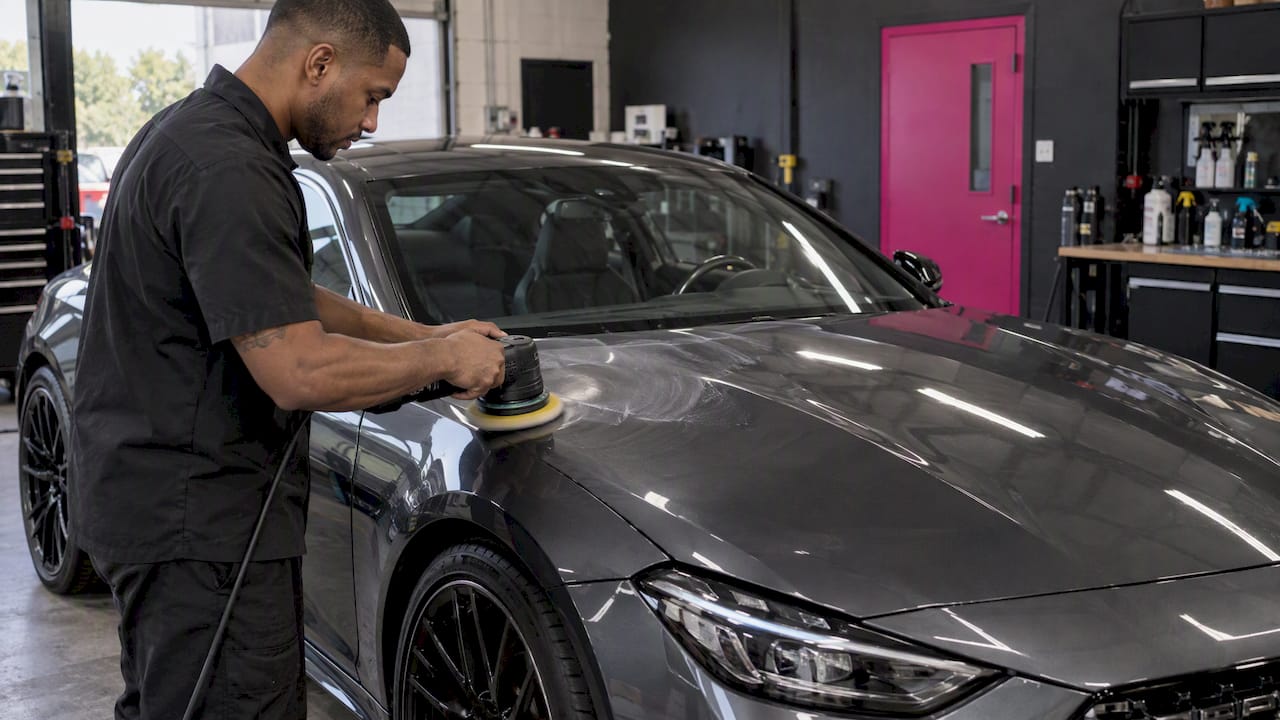
- Choose the least aggressive option. A dual-action polisher at low speed, a soft foam pad and an ultra-fine finishing polish with minimal or no abrasives is the standard recommendation.
- Work a small section. Keep passes light, check the result after each, and stop as soon as the defect is gone.
- Wipe down and inspect. Look at water behavior on the polished area. If it no longer beads or sheets like the rest of the car, the coating is thinned or gone there.
- Restore protection. Decide panel by panel whether to top the area with a maintenance product or apply new coating.
That last step is the one most owners skip. One protection-focused view puts it well: polishing should be treated as a protection decision. You scope the affected panels, inspect the result, and decide whether protection must be restored instead of assuming the original coating is still there.
Why wax and abrasive polish are the wrong follow-up
Owners who want more shine often reach for wax. On a coated car, wax is unnecessary and will not bond to the coating. It can also mask the slick, hydrophobic behavior you paid for, making the coating look as if it has failed when it has not.
Abrasive polish is worse, for the reasons covered above. Preparation polishing belongs before the coating goes on, not after. That is why we spend the most time on the paint before any product touches it. Our guides on preparing a car for coating and the checklist before ceramic application explain what that preparation involves, and why surface preparation matters shows how much of the final finish is decided before the coating is applied.
What to do instead of polishing
For most coated cars, the right answer to “how do I restore the shine” is maintenance, not abrasion.
- Wash by hand with a pH-neutral shampoo. Maintaining the coating with pH-neutral washes is the baseline. Avoid friction brushes and harsh detergents, which scratch paint and can wear on coating performance.
- Use a ceramic maintenance spray on a regular schedule. Regular ceramic sprays help rejuvenate the coating and enhance its hydrophobic effect. Coating makers sell dedicated topper and maintenance products: one is formulated to maintain the protection and finish quality of its coatings, and another can fill coating defects and improve gloss.
- Deal with contamination quickly. Bird droppings and sap are the usual cause of etching. The sooner they come off, the less likely you will ever need to polish.
- Dry with clean microfiber. Most swirls on coated paint come from wash and dry technique, not from the road.
A coating’s maintenance products tested by a manufacturer can be quite durable. Gtechniq states that its compatible maintenance products were tested for 100 wash cycles without coating damage. Check what your installer or coating maker approves, and follow it.
Our perspective
We get this question from owners of Bentleys, Ferraris, Lamborghinis and other high-value cars, and the answer we give is always about the paint underneath, not just the coating on top.
A coating is not a license to stop caring for the finish, and it is not a reason to reach for a polisher at the first sign of dullness. In our experience, most of the “my coating failed” calls come down to three things: contamination left on too long, a wash routine that scratches, or a surface that was not fully corrected before the coating went on. Polishing on top of a coating hides none of those causes. It just thins the layer you already paid for.

Our process is quality-first and not volume-based. That means we correct the paint before coating, measure what we are working with, and tell the owner honestly when a panel needs correction and re-coating and when it simply needs a proper wash. If a defect needs polishing, we scope it panel by panel, explain what protection is lost in that area, and restore it rather than leave bare paint exposed in Fort Lauderdale sun and salt air.
For a luxury car, the goal is long-term preservation. Every time paint is abraded, there is less of it. The best polish is the one you do not need to do twice.
— Emmanuel
Restoring protection after correction
If your coated car has swirls, etching or a tired coating, the cleanest path is a professional assessment: we inspect the finish, correct only what needs correcting, and re-apply protection so the repaired area matches the rest of the car. Our ceramic paint protection work and auto detailing services for luxury and exotic vehicles are built around exactly this kind of tailored plan.

If the real problem is rock chips and deeper scratches, which polishing cannot fix, our paint protection services in Fort Lauderdale include Liquid PPF to shield the paint where it is most exposed. Contact us through our site to book an inspection for your vehicle.
How to choose who works on your coated car
Whoever polishes a coated car should be able to answer a few questions plainly. Ask them before you hand over the keys, and see our list of questions to ask ceramic coating experts for more.
- Do you measure paint thickness before and after? A gauge tells them how much clear coat is left to work with.
- What is the least aggressive method you will test first? A test spot should come before any full-panel work.
- What happens to the coating in the polished area? A good answer says it is thinned or removed and explains how it will be restored.
- What will you use to re-protect the panel? Look for a clear plan, not a vague promise to “seal it up.”
- How should I wash the car afterward? The answer should be specific, and should rule out brushes and automatic washes.
Be cautious of anyone who says polishing will not affect the coating at all, or who offers a heavy cut on a coated car as a quick fix. Our view on why cheap protection is a poor fit for luxury cars applies here: a shortcut on a high-value finish is rarely cheaper in the end.
FAQ
Is it okay to polish a ceramic coated car?
It is possible, but not something to do casually. Polishing is abrasive and removes coating along with the defect, so it makes sense only for specific problems such as high spots, etching or swirls. Plan to re-protect the area afterward.
Should you wax a ceramic coated vehicle?
No. Wax is unnecessary on a coated surface and will not bond to the coating. Use a pH-neutral wash and a ceramic maintenance spray instead.
Can you buff out scratches on a ceramic coating?
Only shallow ones that sit in the clear coat, and the coating in that spot is lost in the process. A scratch deep enough to catch a fingernail will not buff out and needs paint repair. Protection film can help prevent the next one.
How do I polish a ceramic coating without removing it?
You cannot guarantee that, but you can limit the loss. Experts suggest a dual-action polisher at low speed, a soft foam pad and an ultra-fine finishing polish with little or no abrasive. Test a small area first, and on a luxury or exotic car, have a professional with a paint thickness gauge do it.
What should I do if my coated car looks dull?
Start with a proper hand wash and decontamination, then apply a ceramic maintenance spray. Dullness is usually a layer of dirt or mineral film on the coating, not damage to the paint. If it persists after that, have the finish inspected before anyone polishes it.
Sources
- Can You Polish Ceramic Coatings?
- FAQs: Crystal Serum Ultra
- Best Ceramic Coatings for 2026, Tested (Car and Driver)
- SCRS corrects common industry misconceptions on ceramic coatings (Repairer Driven News)
- Auto Ceramic Coating instructions
- Can You Use Car Wax and Polish On Ceramic Coating
- Polishing a Ceramic-Coated Car: What Happens?
- Reload 2.0
- Essence Plus