

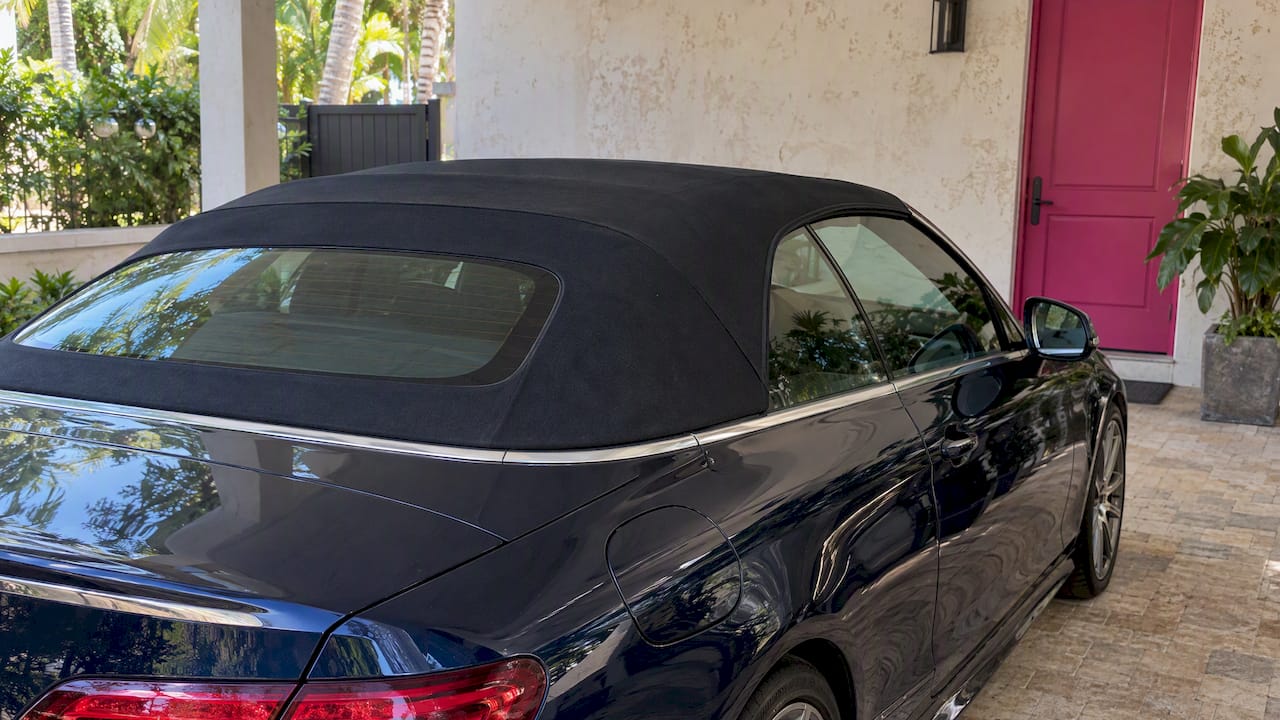
Convertible top coating is a protectant applied to a clean, dry soft top to restore water and stain repellency and add UV protection. It is not the same product as the ceramic coating used on paint. Fabric and vinyl roofs are flexible and, in the case of cloth, porous, so they need chemistry designed to bond to that kind of surface. This guide explains what a top coating does, how fabric and vinyl differ, how to prepare and apply one, how often to renew it, and how to protect everything around the roof.
TL;DR
- A convertible top coating is a fabric or vinyl protectant, not a paint-grade ceramic coating. Match the product to your roof material.
- Only apply it to a top that is completely clean and completely dry. Coating over dirt or soap residue traps contamination and weakens the bond.
- Expect to renew it often. Consumer protectant guidance runs from every 6 to 8 weeks in harsh weather to at least once a year, depending on the product and exposure.
- Avoid spinning-brush car washes, pressure washers and harsh degreasers on a soft top.
- Paint, glass and trim around the roof are where long-term coatings and paint protection film do their best work. That is where we focus.
Table of Contents
- What a convertible top coating actually does
- Fabric vs. vinyl: choose the product for your roof
- Why car wash soap and paint coatings do not belong on the roof
- Step by step: preparing a soft top for coating
- How to apply a fabric top coating
- How long does convertible roof protection last?
- Washing a coated soft top
- Can a coating restore a faded or damaged top?
- Perspective: protect the roof, then protect what surrounds it
- Protecting a convertible in Fort Lauderdale
- Book a consultation for your convertible
- FAQ
- Sources
What a convertible top coating actually does
A soft top lives in the harshest position on the car. It faces direct sun, rain, bird droppings and tree sap all day, and it flexes every time the roof goes up and down. A coating gives that surface a sacrificial, water-shedding layer so liquids bead instead of soaking in, and so UV exposure does less damage to the material.
The goals differ by material:
- Cloth (fabric) tops, sometimes called canvas, have a visible woven texture. Fabric protectant documentation describes products meant to restore water and stain repellency and add UV protection.
- Vinyl tops are smooth or embossed-grain and slick. They do not absorb water the way cloth does, so the priority is a UV protectant that guards against fading, drying and cracking.
A top coating does not repair a damaged roof. It slows wear on a roof that is in sound condition.
Fabric vs. vinyl: choose the product for your roof
Before you buy anything, identify your top. Look at the surface in daylight. A visible weave means fabric. A smooth or pebbled, plastic-like finish means vinyl. Your owner’s manual or a dealer can confirm it if you are unsure, and the material matters because the two respond to different products.
| Fabric (cloth) top | Vinyl top | |
|---|---|---|
| Surface | Visible woven texture | Smooth or embossed grain |
| Main risk | Soaking, staining, mildew, water repellency wearing off | Fading, drying, cracking |
| What the coating is for | Water and stain repellency plus UV protection | UV protection |
| Cleaning approach | Dedicated top cleaner, soft brush, thorough rinse | Dedicated top cleaner, gentle wipe |
| Common mistake | Using car shampoo or a degreaser | Using household cleaners that dry the material |
Some cleaners are formulated to work on both. Meguiar’s product documentation says its convertible-top cleaner is made for vinyl and fabric tops and is meant to lift contaminants and stains without hard scrubbing. Still, always check that a protectant lists your specific material.
Why car wash soap and paint coatings do not belong on the roof
Two shortcuts cause most roof problems.
Ordinary car shampoo. The Porsche Club of America’s convertible care guidance recommends a dedicated convertible-top cleaner rather than regular car-wash shampoo, because leftover soap can dry in the fabric threads and contribute to degradation.
Paint-grade ceramic coating. Ceramic coatings for paint are designed to cure into a hard, rigid layer on a hard, rigid substrate. A soft top flexes and, if it is cloth, absorbs. We do not treat those as interchangeable, and we would not tell an owner a paint coating belongs on their fabric roof. Use a product made and labeled for convertible tops there, and keep the ceramic work for the paint, glass and trim.
If you are comparing the two types of protection on the rest of the car, our complete paint protection guide walks through the options.

Step by step: preparing a soft top for coating
Preparation decides how well any top coating performs. Applying product over contamination traps dirt under the layer and reduces the protective bond, so do not rush this part.
- Inspect first. Look for tears, holes, frayed stitching or seams that are lifting. If damage is significant, have it repaired before you clean or coat. A coating will not fix it.
- Park in the shade and let the top cool. Product dries unevenly on a hot surface.
- Rinse loose debris. Use a gentle stream from a hose. Avoid pressure washers on soft tops.
- Apply a dedicated convertible-top cleaner to the wet surface and work it in with a soft brush or microfiber, using light circular motions. Stiff household brushes can damage the stitching. The Porsche Club of America says stiff brushes should not be used on these tops, although some manufacturers may approve soft horsehair brushes. Check your manual.
- Rinse thoroughly. Soap left behind interferes with the protectant that goes on next. Keep rinsing until the water runs clear and there are no suds.
- Let the top dry completely. Blot excess moisture with a clean microfiber towel rather than dragging it across the weave, then allow plenty of air-drying time. Our piece on safe drying technique explains why blotting beats wiping on delicate surfaces.
If the top has bird droppings or tree sap on it, clean those off right away. They stain fabric quickly, and waiting makes removal harder.
How to apply a fabric top coating
Product instructions differ, so the label on your specific protectant wins over any general guide. The common pattern looks like this.
- Mask the surroundings. The Porsche Club of America advises masking paint, trim and glass to prevent overspray. Painter’s tape and plastic sheeting work well.
- Confirm the roof is fully dry. Applying protectant before the fabric is dry is the most common reason a coating fails.
- Apply in light, even coats. One maker’s fabric protectant instructions call for three light coats and drying time between them, and say to allow about 24 hours for it to dry completely. Other products call for two coats a set number of minutes apart. Follow your label.
- Mind the temperature. Some products need warm weather to cure properly, so read the minimum temperature on the label. In South Florida this is rarely an issue, but afternoon heat and direct sun can make a product flash too fast, so work in the shade.
- Keep the top dry while it cures. Avoid rain, sprinklers and closing the roof over a damp interior until the label says it is safe.
- Pull the tape and check the paint. Wipe any stray overspray off glass and paint immediately, before it dries.
One point from a maker of fabric coatings is worth repeating: the surface should be completely clean and dry, and the product should air-dry fully. CARPRO’s fabric coating guidance also advises avoiding wax or silicone-containing shampoos beforehand, because they can temporarily affect hydrophobic performance.
When vinyl differs
Vinyl does not need the soaking, multi-coat treatment fabric does. A UV-focused vinyl protectant is typically wiped on thinly and evenly, then buffed so it does not leave a greasy film that attracts dust. Follow the label, and never put a fabric waterproofing product on vinyl or the reverse.

How long does convertible roof protection last?
Shorter than most people expect, and shorter than paint coatings. Guidance varies by product and by how much the car is exposed:
- Some care guidance suggests reapplying protectant every 6 to 8 weeks depending on weather exposure, with a weekly check for debris, sap, bird droppings or water pooling.
- The Porsche Club of America suggests considering a protectant if none has been applied in a year or more. That is a floor, not a target.
- A fresh coat before winter or extended storage helps guard against moisture, mold and UV exposure while the car sits.
A simple way to know when it is time: pour a little water on a clean top. If it beads and rolls off, the repellency is working. If it darkens and soaks in, the coating has worn and the top needs a fresh application.
Fort Lauderdale owners face a particular combination of intense UV, frequent afternoon rain and salt-laden humid air, so lean toward the more frequent end of the range and check the top after storms. If the car is stored for part of the year, our winter car care guidance covers storage prep that applies equally to seasonal owners.
Washing a coated soft top
A good coating is easy to defeat with bad washing habits.
- Skip automatic washes with spinning brushes. They can abrade the fabric and catch stitching. Touchless systems are gentler, but some convertible manuals still advise hand washing only, so check yours.
- No pressure washer on a soft top.
- Avoid harsh degreasers and household detergents. They can strip a fabric’s factory water repellent and dry out vinyl.
- Use lukewarm water, a dedicated top cleaner and a soft brush or microfiber.
- Rinse everything, then blot dry.
Owners often ask whether a cloth-top convertible can go through a car wash at all. The safest answer is to follow the vehicle manufacturer’s instruction in your owner’s manual, because it varies by model and roof construction. If the manual allows a touchless wash, use that and avoid brush systems.
Can a coating restore a faded or damaged top?
No. A coating can improve water behavior and, on a lightly worn top, make the surface look more uniform, but it does not rebuild fibers, close tears or reverse heavy fading.
Use this rough decision guide:
| Condition | What to do |
|---|---|
| Clean top, water no longer beads | Clean, dry, recoat |
| Light surface fading, no damage | Deep clean, then protect, and expect modest improvement |
| Frayed stitching, small tears, seam separation | Repair first, then clean and protect |
| Holes, widespread cracking, leaks through the fabric | Consult an automotive upholstery or convertible-top shop about repair or replacement |
If you are unsure, a convertible-top specialist can tell you quickly whether the top is worth treating.
Perspective: protect the roof, then protect what surrounds it
We are asked about convertible tops often, usually by owners who have just spent real money on a car and want to keep it that way. Our honest view is that the roof is only one part of a convertible’s exposure, and it is the part with the shortest protection cycle.
A fabric or vinyl top needs a purpose-made protectant, renewed regularly. That is routine maintenance, and an owner who is comfortable with it can handle it. What the roof coating does not do is protect the painted surfaces, glass and trim that sit beside the roof and take the same sun, salt and rain. Those are long-term assets, and long-term protection is what our studio is built around.
On a convertible, the surfaces we think matter most are:
- Paint, especially the rear deck, trunk lid and the edges where the roof meets the body, where water and debris collect. A professionally applied ceramic coating helps the finish resist environmental damage. For high-impact areas, liquid paint protection film adds a protective layer against rock chips and scratches.
- Glass, including the rear window, which is vulnerable to hazing and water spotting. See how a glass coat works.
- UV exposure overall. Open-top cars see more of it, and our article on UV protection for luxury finishes explains why that matters for paint and clear coat.
Our approach is quality first and tailored to the vehicle, not volume work. We start by looking at how the car is used, stored and driven, then recommend protection that fits. Preparation is a large part of that, and our guide to prepping a car for coating shows what a careful process involves.
— Emmanuel
Protecting a convertible in Fort Lauderdale
If you own a Bentley, Ferrari, Lamborghini, Rolls-Royce or another high-value convertible, here is how we would sequence protection:
- Roof first, with the right product. Have the top cleaned and treated with a protectant made for its material. Keep a renewal schedule.
- Paint correction and coating for the body. Remove swirls and defects before sealing the paint, so the coating locks in a better finish. Cure times matter, so read about how long a ceramic coating takes to cure before you plan when the car comes back to you.
- Liquid PPF on high-wear panels where chips and scratches are most likely.
- Glass protection for better visibility in rain.
- A maintenance plan that fits how you drive and store the car.
A convertible with the top down also collects more debris on the interior and the paint behind the roof line. Cover or close the roof when parking outdoors under trees, since sap and droppings land on an exposed top first.
Book a consultation for your convertible
We protect luxury, exotic and high-value vehicles with ceramic coatings, liquid PPF, paint correction and glass protection. If you drive a convertible, tell us the make, model, roof material and how the car is stored, and we will recommend a protection plan for the painted and glass surfaces, and tell you plainly what the roof needs. Learn more about our paint protection services in Fort Lauderdale or contact the studio to schedule an evaluation.
FAQ
What do you use on a convertible top?
Use a dedicated convertible-top cleaner made for your roof material, a soft brush or microfiber, and a protectant labeled for fabric or vinyl. Avoid regular car shampoo, degreasers and household cleaners, which can leave residue or strip existing repellency.
Can you take a cloth top convertible through a car wash?
Avoid washes with spinning brushes, which can abrade the fabric and stitching. Some owner’s manuals allow touchless washes and some require hand washing only, so follow the manual for your model. Hand washing with a top-specific cleaner is the safest method.
Can I use ceramic coating on a soft top?
Use a product designed for convertible tops rather than a paint coating. Soft tops are flexible and, with cloth, porous, so they need chemistry made for that surface. Ceramic coating is best used on the paint, glass and trim around the roof.
How often should I reapply convertible top protectant?
It depends on the product and your exposure. Some guidance suggests every 6 to 8 weeks in harsh weather, and no less than yearly. Do a water test: if water stops beading, recoat.
Can a faded or torn convertible top be fixed with a coating?
No. A coating helps a sound top resist water and UV, but it cannot close tears or repair frayed stitching. Have damage repaired first, then clean and protect the top.
Sources
- Eight Tips to Take Care of Your Porsche Convertible, Porsche Club of America
- Convertible Top Cleaner, Meguiar’s
- RAGGTOPP Convertible Top Fabric Cleaner & Protectant Kit, Wolfstein’s
- CQUARTZ Fabric 2.0, CARPRO