

TL;DR:
- Swirl marks are microscopic scratches in the clear coat caused by improper washing and drying techniques. Coatings reduce dirt adhesion and friction but do not fully prevent swirl formation if cleaning methods are careless. Proper preparation, correct washing habits, and using suitable protection types are essential for long-lasting swirl resistance and flawless paint.
Swirl marks are one of the most frustrating forms of paint damage a car owner deals with, and coatings are one of the most misunderstood solutions. Many owners apply a ceramic coating expecting a bulletproof shield, only to find swirls reappearing after just a few washes. Understanding how coatings prevent swirl marks, and what they actually cannot do, is what separates a car that holds its finish for years from one that looks dull within months. This guide covers the real mechanics, the right techniques, and the decisions that matter most.
Table of Contents
- Key takeaways
- What swirl marks are and why they form
- How coatings protect paint and reduce swirl formation
- Washing and drying techniques that actually prevent swirl marks
- Preparing the paint surface before applying a coating
- Comparing coating types and maintaining long-term swirl resistance
- My take on coatings and swirl prevention
- Protect your paint the right way with Mannyceramicprotouch
- FAQ
Key takeaways
| Point | Details |
|---|---|
| Coatings reduce friction, not force | Coatings make dirt release easier during washing, lowering abrasive contact on the clear coat. |
| Washing technique still drives results | Even coated cars develop swirl marks when owners use single-bucket washing or dirty mitts. |
| Paint correction comes first | Coating over existing swirl marks locks them in permanently, requiring full coating removal before re-polishing. |
| Coating types vary in performance | Graphene and ceramic coatings offer different levels of swirl resistance, durability, and maintenance needs. |
| Prevention beats correction every time | Addressing swirl risk before and after coating application is far less costly than polishing correction work later. |
What swirl marks are and why they form
Swirl marks are microscopic scratches concentrated in the clear coat layer of your vehicle’s paint. They are not deep gouges. Under direct light or a single-point light source, they appear as circular or web-like patterns radiating outward from a central point. On dark-colored vehicles, especially black and dark blue, they become extremely visible and give the paint a dull, hazy appearance instead of the sharp reflective finish the car came with from the factory.
The primary causes of swirl marks are almost always related to contact during washing and drying. Here is where most damage actually occurs:
- Dirty wash mitts: A mitt loaded with grit from a previous pass drags abrasive particles across the clear coat with every stroke, cutting micro-scratches into the surface.
- Single-bucket washing: Rinsing your mitt in the same water you wash with reintroduces dirt to the paint repeatedly throughout the process.
- Circular scrubbing motions: Washing in circular patterns concentrates scratches in overlapping arcs, creating the classic swirl pattern visible under lights.
- Dry wiping: Running a cloth or towel across dry paint, even a soft one, deposits enough friction and trapped particles to cause visible marring over time.
- Automated car washes: The rotating brushes in tunnel washes are among the most aggressive contributors to swirl damage on any vehicle.
The key distinction worth knowing is that swirl marks differ from deep scratches in one practical way. Deep scratches penetrate through the clear coat and into the base coat or primer. Swirl marks live entirely within the clear coat. That matters because the clear coat is what coatings bond to. Understanding that distinction shapes how you think about what a coating can and cannot protect against.
How coatings protect paint and reduce swirl formation
The phrase “scratch-resistant coating” is technically accurate but widely misread. Coatings do not form a physical barrier thick enough to stop an abrasive particle from cutting into the surface. What they do is act as a chemical friction reducer, making it significantly harder for dirt and contaminants to bond to the paint in the first place.
Here is what that means in practical terms. A coated surface is hydrophobic, meaning water beads and sheets off rather than clinging. When water carries dirt particles across an uncoated surface, that dirt sticks. On a coated surface, the same dirt releases more freely. During washing, coatings reduce dirt adhesion, which translates directly into less abrasive contact when your mitt makes a pass. Less contact under friction equals fewer micro-scratches introduced per wash.
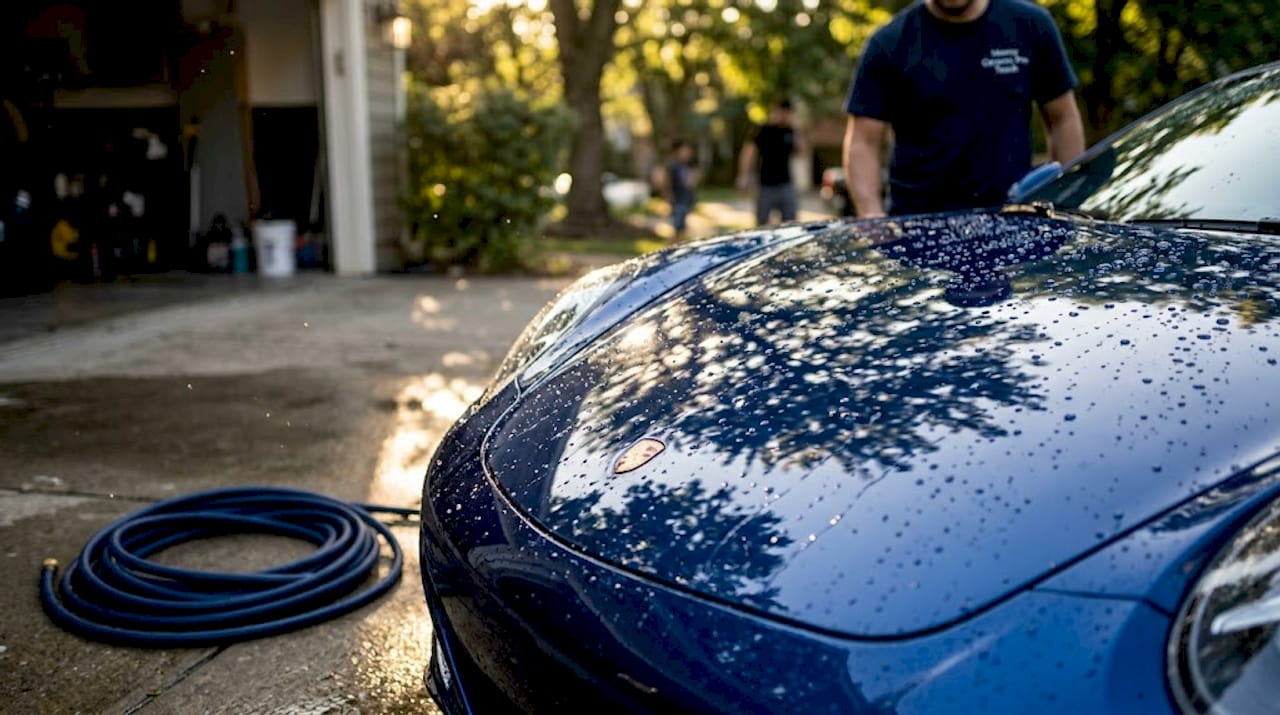
The measured benefits of coatings are real and worth knowing. Ceramic coatings extend protection by two to five years and reduce wash time by 20 to 50 percent due to their hydrophobic and dirt-repellent surface properties. Gloss improvements are also documented, with coatings delivering a gloss increase of 10 to 20 Gloss Units, which helps the paint appear deeper and more reflective while masking minor surface imperfections.
That said, the limitations are equally important to understand:
- Coatings do not add meaningful thickness to the clear coat. The protective layer a ceramic coating deposits is measured in microns.
- A coated car washed with a dirty mitt will still develop swirl marks. Wrong washing methods cause swirl marks even on fully coated surfaces.
- Coatings wear down over time, especially without proper maintenance washes.
- No consumer-grade coating fully eliminates swirl risk from physical contact.
Pro Tip: Before evaluating how well your coating is performing, assess your washing routine first. In most cases where coated cars still show swirl marks, the cause is technique, not product failure.
The benefits of car coatings are real and meaningful. The point is to use coatings as part of a protection system, not as a replacement for careful handling.
Washing and drying techniques that actually prevent swirl marks
No coating maximizes its potential if the maintenance routine introduces constant abrasion. The washing and drying process is where most swirl marks originate, and changing those habits delivers immediate, measurable results regardless of what coating is on the car.
Follow this approach consistently:
- Pre-rinse and snow foam: Begin every wash with a thorough rinse to remove loose surface contaminants. Apply a snow foam or pre-wash product and let it dwell for several minutes before contact. This loosens bonded dirt so your mitt encounters far less resistance during the contact wash phase.
- Set up a two-bucket system with grit guards: Fill one bucket with shampoo solution and one with clean rinse water. After each panel pass, rinse the mitt in the rinse bucket before reloading with shampoo. Grit guards and two-bucket washing prevent dirt transfer back onto the paint and are one of the most effective swirl mark prevention techniques available to any car owner.
- Use quality microfiber wash mitts: Synthetic microfiber mitts with deep pile trap dirt particles within the fibers rather than dragging them. Inspect and replace mitts that have accumulated debris or show wear in the pile.
- Wash in straight lines, not circles: Work panel by panel using straight, overlapping strokes from top to bottom. This technique confines any micro-scratches to a linear pattern far less visible than the circular arcs that define classic swirl marks.
- Rinse frequently: Do not let shampoo dry on the panel. Work in sections, especially in warm or direct-sun conditions, to prevent residue from bonding.
- Dry with soft microfiber and blot, never rub: Use a high-quality plush microfiber drying towel and lay it on the panel, pressing gently. Blotting rather than rubbing during the drying phase dramatically reduces friction on the clear coat surface. A forced-air blower is an even better option for drying coated vehicles.
Pro Tip: Dedicate separate mitts and towels to different vehicle areas. Never use the same mitt on the lower panels and door sills that you use on the hood and roof. Lower panels collect road grit and brake dust at far higher concentrations.
Coated or not, these habits are what keep a finish clean and mark-free over the long term. The coating makes each wash safer by reducing how much dirt bonds to the surface, but it does not offset careless technique.
Preparing the paint surface before applying a coating
Coating over swirl marks is one of the most costly mistakes in paint protection. Applying coating over imperfections locks them in place permanently. Removing them later requires stripping the coating first, then polishing, then reapplying. That process multiplies both time and cost significantly.
Before any coating goes on, the paint surface needs to be in the best condition possible. Here is the preparation workflow:
- Inspect under proper lighting: Use a single-point LED inspection light or detailing swirl light to reveal surface condition accurately. Natural sunlight and standard shop lights miss a significant portion of fine swirl marks.
- Decontaminate the surface: Clay bar the entire vehicle after washing to remove bonded contaminants like rail dust, tree sap residue, and industrial fallout. These particles sit above the clear coat and interfere with both polishing and coating adhesion.
- Perform paint correction: Using a dual-action (DA) polisher with the least aggressive compound and pad combination first, work through stepwise paint correction to safely remove swirl marks. Increase aggressiveness only when lighter options prove insufficient.
- Follow up with a finishing polish: After compound work, refine the surface with a light finishing polish and a soft foam pad to restore clarity and prepare the clear coat for bonding.
- Panel wipe before coating: Use an isopropyl alcohol (IPA) solution to remove all polish oils from every panel. Coating adhesion requires a completely clean, oil-free surface.
| Step | Purpose |
|---|---|
| Inspection under LED light | Reveals swirl marks and surface defects invisible in diffuse light |
| Clay bar decontamination | Removes bonded surface particles before polishing begins |
| Compound and DA polisher | Removes swirl marks and deeper oxidation from the clear coat |
| Finishing polish | Refines the surface and removes light haze from compounding |
| IPA panel wipe | Eliminates polish oils to allow proper coating adhesion |
Skipping any of these steps produces a coating that seals in problems rather than preserving a flawless surface. The quality of the result depends almost entirely on the quality of the preparation.
Comparing coating types and maintaining long-term swirl resistance
Not all coatings perform the same way, and choosing the right product matters for ongoing swirl mark resistance. Understanding the differences helps you make an informed decision and set realistic expectations.
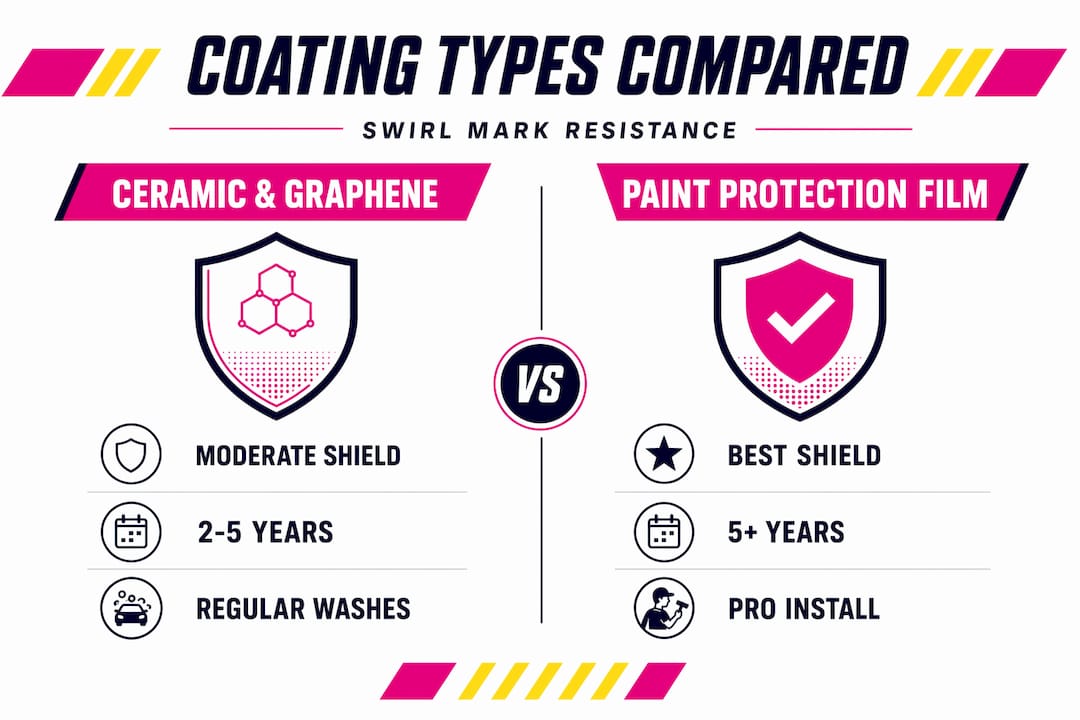
| Protection type | Swirl resistance | Durability | Maintenance |
|---|---|---|---|
| Ceramic coating | Moderate, improves wash safety | 2 to 5 years | Regular maintenance washes needed |
| Graphene coating | Higher than ceramic, resists wipe abrasion | 3 to 5 years | Similar to ceramic, slightly more water spot resistant |
| Paint protection film (PPF) | Highest available, self-healing properties on premium grades | 7 to 10 years | Periodic washing and sealant top-ups |
| Liquid PPF | Very high, combines coating and film properties | 2 to 4 years | Maintenance washes and annual inspection recommended |
Graphene coatings provide durable protection against the micro-scratches caused by washing and wiping, making them a strong option for owners who want more resistance than a standard ceramic coating delivers. Paint protection film, particularly self-healing variants, sits at the top of the protection pyramid. It absorbs physical impact rather than just reducing friction.
For owners who want to maintain coating performance over time, these practices extend durability significantly:
- Use pH-neutral, coating-safe shampoos for every maintenance wash. Alkaline products strip coating properties faster.
- Apply a coating booster or ceramic spray topper every three to six months to restore hydrophobic performance.
- Avoid automatic car washes entirely. Even touchless washes use high-pressure water with detergents that degrade coating bonds over time.
- Schedule an annual inspection with a professional detailer to assess coating condition and address any areas showing wear.
For a more detailed look at PPF vs ceramic coating, understanding where each option fits your driving habits and vehicle value is worth the time.
My take on coatings and swirl prevention
I have worked with hundreds of vehicles across ceramic coatings, graphene coatings, and Liquid PPF applications. The single most consistent finding is this: owners who invest in premium coatings and then return to lazy wash habits are the ones calling back months later asking why their paint looks dull again.
Coatings shifted how I think about detailing. They genuinely changed the maintenance equation by making dirt easier to remove and surfaces easier to clean safely. The combination of coating and careful washing is what delivers real, lasting swirl resistance. Neither element works in isolation.
What I find frustrating is the industry messaging that sells coatings as total protection solutions without explaining the technique side. An owner who learns the two-bucket method, invests in quality mitts, and stops using the tunnel wash will see more improvement in their paint condition than someone who applies a $200 coating and continues old habits. That is not an exaggeration. I have seen it too many times.
My strongest advice is to check signs your car needs coating before committing to an application. Correcting first, coating second, and maintaining consistently after is the only sequence that produces results worth paying for. Prevention is always less expensive than correction.
— Emmanuel
Protect your paint the right way with Mannyceramicprotouch
At Mannyceramicprotouch, every protection service starts with a thorough paint inspection and correction process before a single drop of coating is applied. That means no swirl marks get sealed under the finish, and the coating bonds to a surface prepared to perform at its highest level.

Whether you are considering ceramic coating packages for long-term gloss and swirl resistance, or exploring Liquid PPF solutions for maximum protection against physical contact damage, Mannyceramicprotouch offers tailored protection plans built around your vehicle’s specific needs. Every service is backed by professional-grade products and hands-on expertise. Reach out today to schedule a consultation and get a protection plan that actually delivers.
FAQ
Do coatings completely prevent swirl marks?
No. Coatings reduce friction and minimize dirt adhesion during washing, which lowers swirl risk, but they do not eliminate it. Washing technique remains the most critical factor in swirl mark prevention.
What is the best coating type for swirl mark resistance?
Graphene and ceramic coatings both improve swirl resistance compared to unprotected paint. Paint protection film offers the highest level of physical protection, including self-healing properties on premium grades.
Should I remove swirl marks before applying a coating?
Yes, always. Applying a coating over existing swirl marks locks them into the clear coat permanently. Removing them later requires stripping the coating first, then performing paint correction before reapplying.
How does the two-bucket method reduce swirl marks?
The two-bucket method keeps your wash mitt clean by rinsing it in a dedicated bucket of clean water before reloading with shampoo. This prevents dirt from being dragged back across the paint, which is a leading cause of swirl mark formation.
How often should a ceramic coating be reapplied?
Ceramic coatings typically last two to five years depending on maintenance quality and environmental exposure. Applying a ceramic booster spray every three to six months extends performance and helps maintain hydrophobic properties between full reapplication cycles.