

An iron remover and a clay bar do different jobs. Iron remover is a chemical that dissolves embedded metal particles without touching the paint. Clay is a mechanical tool that physically shears off bonded contamination, including things iron remover cannot dissolve. In most decontamination routines, you wash first, use the iron remover second, then clay whatever is still bonded to the paint.
This guide explains what each product removes, how to tell which one your paint needs, where tar remover fits, and when the job is better left to a professional.
TL;DR
- Iron remover dissolves ferrous particles (brake dust, rail dust, industrial fallout). Clay lifts bonded material such as overspray, tree sap mist and leftover grit.
- The usual order is wash, iron remover, tar remover if needed, then clay with proper lubricant, then a final rinse and dry.
- Clay is not a substitute for iron remover. Dragging clay over embedded iron can leave more micro-scratching.
- Gritty or rough paint after a wash is the practical sign you need to decontaminate. Most vehicles benefit from a chemical step every few months, adjusted for use and climate.
- On a coated or high-value vehicle, decontamination is the prep step that decides how the finish looks afterward, so it is worth having done correctly.
Table of Contents
- What each product actually does
- Which goes first: clay or iron remover?
- Where tar remover fits
- Do you still need clay after iron remover?
- The disadvantages of clay
- What can I use instead of iron remover?
- How often should you use iron remover?
- Safety and common mistakes
- Our perspective
- When to have a professional handle it
- FAQ
- Sources
What each product actually does
Iron remover: chemical decontamination
Brake pads and rotors shed tiny ferrous particles. They land on paint, wheels and glass, embed in the clear coat and can start to oxidize into small orange rust specks. Autotrader’s detailing guide describes iron remover as the product that targets those embedded particles from brake pads and rotors before they bloom into orange spots.
Professional-grade products are built for exactly this. Meguiar’s describes its iron removing spray as a ready-to-use, non-abrasive chemical treatment for iron-based contamination, industrial fallout, rail dust and iron oxides. Non-abrasive is the key point: nothing rubs against the paint. You spray it on, let it dwell, and rinse.
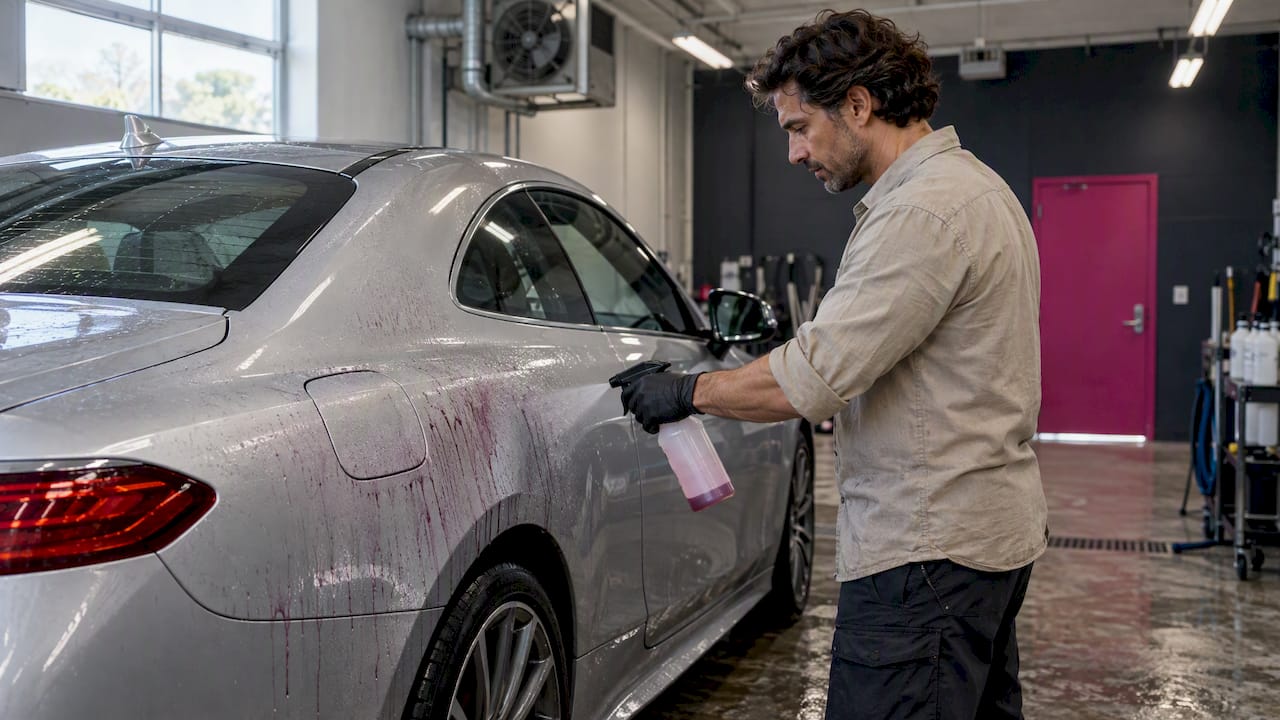
Most iron removers change color as they react, usually to purple or red. That is a convenient visual check of how much iron was on the surface. The smell is strong, so work in a ventilated area. Autotrader advises wearing nitrile gloves and working somewhere well ventilated because of the sulfur odor.
Clay: mechanical decontamination
A detailing clay bar (or a clay towel or mitt) works by contact. With a lubricant, the clay glides over the paint and picks up what is sitting on top of the clear coat. Meguiar’s describes professional detailing clay as a non-abrasive method, used with lubricant, for removing bonded contamination including overspray, industrial fallout, water spots, tar and tree-sap mist.

Clay does not dissolve anything. It shears and traps. That is why it handles things iron remover cannot, such as paint overspray, and also why it carries a risk iron remover does not: it touches the paint.
Side-by-side comparison
| Iron remover | Clay bar or clay towel | |
|---|---|---|
| Type of action | Chemical, dissolves ferrous particles | Mechanical, lifts bonded material |
| Contact with paint | None while it works | Direct, needs lubricant |
| Best for | Brake dust, rail dust, industrial fallout, orange specks | Overspray, tree sap mist, water spots, residue left after chemicals |
| Main risk | Strong odor, product left to dry on surface | Marring if used without enough lube or when not needed |
| Where it goes in the process | After the wash, before clay | After chemical steps |
| Safe on wheels | Many are designed for wheels too | Not typically used on wheels |
Which goes first: clay or iron remover?
Chemical first, mechanical second. The reasoning is simple. If you clay first, you drag the clay across particles that are still sharp and still embedded. Rodney Tatum of Detailed Image notes that clay alone may not remove all embedded iron filings, and that forcing clay over them can cause more severe micro-scratching.
If you use the iron remover first, the metal is already gone, and the clay only has to deal with what is left. Autotrader makes the same distinction: iron and tar removers dissolve contamination first, then clay handles the remaining bonded material. Detailed Image’s guide on decontamination frequency says the same thing: iron removers dissolve metal particles from brake dust and industrial pollution, then clay removes what remains.

A side benefit is that the clay stays cleaner and lasts longer. Detailed Image’s practitioner guidance on tar removers says combining chemical removal with clay can reduce marring and extend the life of the clay bar.
A sensible order of work
- Wash the vehicle thoroughly. Loose dirt and road film should be gone before any decontamination product goes on.
- Apply iron remover to cool, shaded paint. Follow the product’s dwell time and never let it dry on the surface. Watch for the color change.
- Rinse completely. Wheels, wheel arches and door jambs collect the most iron, so do not skip them.
- Treat tar if you see it. See the next section.
- Clay only what still feels rough. Use plenty of lubricant and a light touch. Fold or replace clay that picks up grit.
- Wash again and dry. This removes lubricant and residue.
- Protect the paint. Decontaminated paint is bare paint, and it should not be left without wax, sealant, a ceramic coating or liquid PPF.
If you want a deeper look at how clay is handled on high-value cars, see our guide to the clay bar process for luxury vehicles.
Where tar remover fits
People searching this topic often also ask about iron vs tar remover. They solve different problems.
- Iron remover targets embedded ferrous particles from brakes and industrial fallout.
- Tar remover targets road tar and can also help with tree sap and sticker adhesive, according to Autotrader’s guide.
Tar is easy to spot as black dots along the rocker panels and behind the wheels. Subtler hydrocarbon buildup is harder to see. Detailed Image’s Rodney Tatum writes that tar remover is useful for more than visible tar, including that subtle buildup on lower panels behind the wheels.
The same guidance also presents tar remover as a possible chemical alternative where you would rather avoid clay, including on matte finishes. That matters for owners of satin or matte paint, where any mechanical rubbing can change the look of the finish.
For a closer look at the tar side, read our page on removing road tar from car paint.
Do you still need clay after iron remover?
Not always. The honest answer depends on what the paint feels like after the chemical step.
After washing, drying and iron removal, run the back of your fingertips over the paint, ideally inside a thin plastic sandwich bag so you can feel small bumps more easily. If the surface is smooth, clay may add little. If it still feels rough or gritty, something bonded is still there, and clay is the right tool.
Clay is more likely to be needed when:
- The car has been parked near construction, a rail line or a body shop (overspray and fallout).
- Water spots or tree sap mist have baked onto the paint.
- You are preparing for polish, a ceramic coating or liquid PPF, where the surface must be as clean as possible for the product to bond.
- The car is new to you and its history is unknown.
Clay is more likely to be skippable when:
- The car is garaged, washed regularly, and mostly shows brake dust.
- The paint is matte or satin and you want to limit contact.
- You decontaminated recently and the paint still feels smooth.
The disadvantages of clay
Clay is effective and has been a staple of detailing for decades, but it has real drawbacks:
- Marring risk. Detailed Image’s May 2026 guide warns that unnecessary or poorly lubricated clay use increases marring risk because the clay physically contacts the paint.
- It can drag particles. Used over embedded iron, clay may leave finer scratches than the contamination itself.
- It is a one-way tool. Once a bar is dropped or heavily loaded with grit, it has to be discarded or replaced.
- It follows a correction step. Light marring from clay often calls for a polish afterward, which is why clay and paint correction are frequently planned together on premium cars.
On dark, soft-clear-coat or recently corrected paint, these drawbacks matter more. That is one reason our process leans on chemical decontamination first and uses clay selectively. Our guide to paint decontamination walks through the full picture.
What can I use instead of iron remover?
There is no true substitute for a product that dissolves iron. Clay can remove some surface-level iron, but as noted above, it may not get all of it and can scratch in the process. What you can use alongside iron remover, or in cases where only a portion of contamination is present:
- Clay, towel or mitt for bonded material that sits on top of the clear coat.
- Tar remover for tar, sap and adhesive.
- Acidic wheel or surface cleaners in situations where the manufacturer’s directions call for them. These are product-specific. One detailing supplier’s guidance for an acid surface cleanser, for example, says to spot-test it, use it on cool surfaces in shade and keep it away from trim and matte finishes. That is guidance for that product, not a rule for every iron remover, so always read the label of the one you own.
How often should you use iron remover?
There is no single schedule. The Detailed Image decontamination guide suggests a chemical decontamination every few months for most vehicles, adjusted for how the car is driven, the climate, how it is stored and how much brake dust it sees. Clay is then used only as needed.
The same guide offers a practical test: if the paint feels rough or gritty after a wash, decontamination may be due.
Factors that shorten the interval:
- Daily driving in stop-and-go traffic, which means more brake dust.
- Outdoor parking, near industrial areas, rail lines or construction.
- Light-colored paint, where orange specks show up sooner.
- Vehicles with high-friction or performance brake pads.
Factors that lengthen it:
- Garage storage and limited mileage.
- A ceramic coating or liquid PPF, which can make contamination sit on the surface rather than bonding as easily. You still need to decontaminate, but the products release more easily.
If you want to confirm your vehicle’s condition before deciding, paint inspection shows what is on the paint and how deep it goes. Our checklist of signs your car needs detailing is a quick way to spot the early signals.
Safety and common mistakes
- Never let iron remover dry on the paint. Work one section at a time, especially in Florida heat and sun, and rinse within the dwell time the label gives.
- Work in shade on a cool surface. Hot panels make products flash dry.
- Ventilate and glove up. The sulfur smell is strong, and nitrile gloves protect your skin.
- Keep products off unprotected trim and matte finishes unless the label says they are safe.
- Do not skip lubricant when claying. A dry or barely wet clay surface is the fastest route to marring.
- Do not reuse a dropped bar. Grit embedded in the clay will scratch.
- Do not stop at decontamination. Stripped, bare paint needs protection the same day.
Our perspective
We see decontamination as the step that decides whether a protection job succeeds or fails. A ceramic coating or liquid PPF bonds to the surface beneath it. If iron particles or bonded residue are still in the clear coat, they get sealed in, and the finish will never look as deep as it should.
That is why we do not treat it as a routine add-on. We inspect the paint first, decide which contaminants are actually present, and use the least aggressive method that clears them. On many vehicles that means chemical decontamination and a measured, lubricated clay pass only where the paint still feels rough. On delicate or high-value finishes it can mean no clay at all.
Our work is not volume-based. A luxury or exotic vehicle gets a tailored plan, not a standard routine, because each finish, color and history calls for a different approach. If you are deciding whether to do this yourself, the question to ask is not which product is better, but how much risk you are willing to take with the paint you are trying to preserve.
— Emmanuel
When to have a professional handle it
DIY decontamination works well on a daily driver you are comfortable washing. It is a poorer fit when:
- The car is a Bentley, Rolls-Royce, Lamborghini, Ferrari or similar, where paint is thin, soft or expensive to correct.
- You plan to apply a ceramic coating or liquid PPF and need the surface truly clean.
- You see paint transfer, heavy overspray or embedded contamination you cannot identify.
- The paint is matte, satin or freshly corrected.
At Manny’s Ceramic Pro Touch, decontamination is part of the preparation for liquid PPF and ceramic coatings, with a process built around the specific vehicle. You can read how we prepare a car for coating, or look at our ceramic paint protection and liquid PPF versus traditional PPF pages to see what protection follows a proper decontamination.

If you own a luxury or high-value vehicle in Fort Lauderdale and want the paint decontaminated, corrected and protected in one plan, contact Manny’s Ceramic Pro Touch to discuss your vehicle and request a quote.
FAQ
Should I use iron remover or a clay bar first?
Use iron remover first. It dissolves embedded metal particles chemically, so the clay does not have to drag over them. After rinsing, clay whatever still feels rough. This order reduces marring and helps the clay last longer.
Can I use a clay bar instead of iron remover?
Not as a full replacement. Clay may not remove all embedded iron filings, and forcing it over them can cause more severe micro-scratching. Clay is best for bonded surface contamination like overspray and sap mist, while iron remover handles ferrous particles.
What is the difference between iron remover and tar remover?
Iron remover dissolves ferrous particles from brake pads, rotors and industrial fallout. Tar remover targets road tar, and can also help with tree sap and adhesive. If you see black spots behind the wheels, you need tar remover. If you see tiny orange specks, you need iron remover.
How often should I iron remove my car?
For most vehicles, a chemical decontamination every few months is a reasonable starting point. Adjust it for mileage, climate, storage and brake-dust exposure. If the paint feels gritty after a wash, it is time.
Do I need to clay after using iron remover?
Only if the paint still feels rough after the iron remover is rinsed off and the car is washed and dried. If it feels smooth, clay may be unnecessary. If you are about to apply a coating or PPF, a lubricated clay pass is common preparation.
Sources
- Meguiar’s Iron Removing Spray product page
- Meguiar’s Professional Detailing Clay product page
- Autotrader: Exterior Car Detailing, 14 Steps
- Detailed Image: Decontamination, Why Iron Removers?
- Detailed Image: How Often Should You Decontaminate Your Car?
- Detailed Image: Tar remover guidance
- Detailed Image: Acid surface cleanser product page