



TL;DR:
- Environmental damage protection involves legal, technical, and operational measures that prevent harm to ecosystems and property. It relies on principles like precaution, prevention, and the polluter pays, emphasizing proactive action and thorough documentation. Physical barriers and protective coatings are essential for safeguarding assets from environmental threats like acid rain and UV damage.
Environmental damage protection is defined as the set of legal, technical, and operational measures used to prevent, mitigate, and remediate harm to ecosystems, natural assets, and built property from ecological risks. This discipline covers everything from soil contamination at construction sites to acid rain degrading a vehicle’s finish. Legal frameworks like the “polluter pays” doctrine and the precautionary principle now shape how businesses and individuals manage environmental liability. Understanding these frameworks is no longer optional. Regulatory pressure is rising, financial exposure is real, and the cost of inaction consistently exceeds the cost of prevention.
What is environmental damage protection under the law?
Environmental damage legally includes significant harm to protected species, natural habitats, water bodies, or soil that poses material risks to human health or ecosystems. That definition matters because it sets the threshold for when legal liability begins. Damage does not need to be catastrophic to trigger remediation obligations. Contamination entering a food chain or a water supply qualifies, even when caused by a single localized spill.
Three primary damage categories appear across major legal frameworks:
- Protected species and habitats: Any significant adverse effect on the conservation status of a species or its habitat, including disruption of breeding, feeding, or migration patterns.
- Water bodies: Pollution of surface water, groundwater, or coastal water that degrades ecological or chemical status beyond baseline conditions.
- Soil contamination: Introduction of substances that create a direct or indirect risk to human health, measured against land-use context and exposure pathways.
The UK’s 2015 Environmental Damage Regulations and the EU Environmental Liability Directive both use the concept of “significant adverse effect” as the legal trigger. Harm to habitats and organisms plus soil and water contamination that harms humans are the core categories. Operators bear primary responsibility for remediation, regardless of whether the damage was intentional.
Pro Tip: Document baseline environmental conditions at your site before operations begin. This record becomes your primary defense if a regulator claims your activity caused pre-existing damage.
What are the core principles guiding eco damage prevention?
The four pillars of environmental protection are precaution, prevention, rectifying pollution at the source, and the polluter pays principle. These principles guide legislation and conservation efforts internationally. Each one shifts responsibility toward the operator and away from the public or the state.
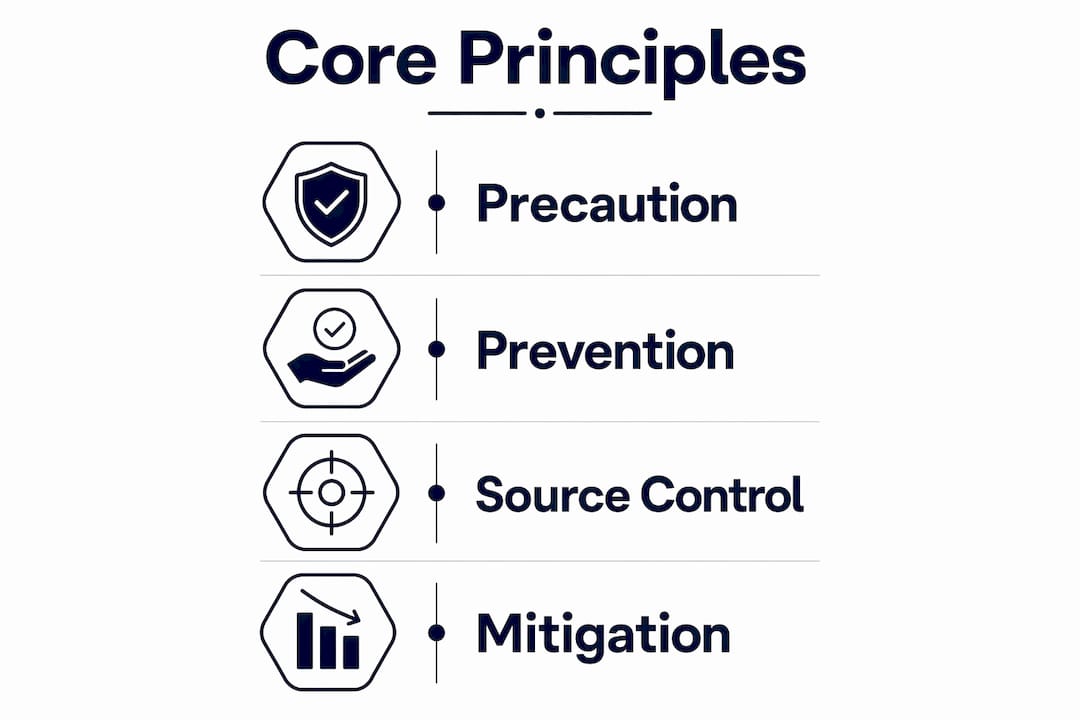
The table below shows how each principle applies in practice:
| Principle | Core requirement | Business implication |
|---|---|---|
| Precaution | Act before harm is fully proven | Assess risks before starting operations |
| Prevention | Stop damage before it occurs | Install controls and monitoring systems |
| Rectify at source | Address pollution where it originates | Do not transfer waste or risk to another site |
| Polluter pays | The party causing damage funds cleanup | Maintain insurance and financial reserves |
The precautionary principle requires acting before harm is fully proven, shifting protection from reactive to proactive. This is a significant policy evolution. Businesses can no longer wait for confirmed damage before acting.
Alongside these four pillars, the mitigation hierarchy provides an operational sequence. The mitigation hierarchy follows four steps: avoid, minimize, restore, and offset. Avoidance is the most cost-effective stage. Retrospective restoration and offsets carry higher costs and greater liability exposure. Applying this sequence at the planning stage of any project reduces both environmental harm and financial risk.
Pro Tip: Map your operations against the mitigation hierarchy before project approval. Avoidance decisions made early cost a fraction of restoration efforts made after damage occurs.
How can individuals and businesses implement environmental protection measures?
Effective eco damage prevention starts with a formal risk assessment. The “polluter pays” liability applies regardless of intent, so detailed documentation is the first line of defense. A risk assessment identifies exposure pathways, quantifies potential harm, and creates a paper trail that demonstrates due diligence.
The core steps for building a protection program are:
- Conduct a site-specific environmental risk assessment. Identify all potential sources of contamination, affected receptors, and pathways between them.
- Develop an Environmental Protection Plan (EPP). This document outlines procedures, responsibilities, and response protocols for each identified risk.
- Integrate the EPP into daily operations. Static plans without ongoing management fail to maintain compliance. Assign ownership of each procedure to a named team member.
- Train all relevant staff. Workers who handle materials, operate equipment, or manage waste must understand their specific responsibilities under the plan.
- Schedule regular audits. Quarterly reviews catch procedural drift before it becomes a compliance failure.
Beyond internal planning, financial protection is a separate but equally important layer. Environmental liability insurance covers cleanup costs and financial risks related to pollution and contamination that standard commercial policies exclude. This coverage is critical for contractors, industrial operators, and any business working near sensitive ecosystems.
Key mitigation techniques that support these steps include:
- Secondary containment systems around fuel and chemical storage
- Sediment controls such as silt fences and sediment basins at construction sites
- Spill response kits staged at high-risk locations
- Water quality monitoring at discharge points
- Vegetation buffers between operations and waterways
For vehicle owners, environmental threats to automotive finishes follow a similar logic. Acid rain, bird droppings, industrial fallout, and UV radiation all cause measurable surface degradation. Protective coatings and films are the automotive equivalent of secondary containment: they intercept the damaging agent before it reaches the substrate.
Pro Tip: Review your insurance policy annually against your current operations. Environmental liability coverage limits that were adequate three years ago may not reflect your current exposure.

What does environmental damage protection look like in practice?
Real-world applications of environmental safety practices show how principles translate into measurable outcomes. The following examples illustrate the range of contexts where protection programs deliver results.
- Construction site soil protection: A contractor installs sediment basins and impermeable liners around concrete washout areas. This prevents alkaline runoff from entering adjacent waterways and avoids a regulatory notice that would halt the project.
- Industrial water management: A manufacturing facility installs real-time water quality sensors at its stormwater discharge point. Early detection of elevated chemical levels triggers an internal response before the contamination reaches a protected waterway.
- Community conservation integration: Businesses operating near protected habitats partner with local conservation groups to monitor species populations. This collaboration provides independent verification of compliance and builds community trust.
- Automotive surface preservation: Vehicle owners apply Liquid Paint Protection Film (Liquid PPF) and ceramic coatings to guard against acid rain, UV degradation, and chemical fallout. This is a direct application of the prevention principle: intercept the damaging agent before it contacts the asset.
The financial case for proactive protection is clear. Cleanup costs, regulatory fines, and reputational damage from an environmental incident consistently exceed the cost of prevention. Artisan protective finishes for high-value surfaces follow the same economic logic: the cost of a quality protective layer is a fraction of the cost of refinishing or replacing a damaged component.
At the national scale, Canada’s 2026 strategy invests $3.8 billion to protect lands and waters, aiming to conserve 30% of lands and waters by 2030. That commitment shows how the importance of environmental protection is now embedded in government fiscal planning, not just regulatory compliance.
| Protection context | Primary threat | Key measure |
|---|---|---|
| Construction sites | Soil and water contamination | Sediment controls, containment liners |
| Industrial operations | Chemical and thermal pollution | Real-time monitoring, discharge controls |
| Natural habitats | Habitat degradation, species loss | Buffer zones, conservation partnerships |
| Automotive surfaces | UV, acid rain, chemical fallout | Liquid PPF, ceramic coatings |
Key Takeaways
Environmental damage protection is most effective when legal compliance, operational planning, and physical protective measures work together as a single system rather than separate obligations.
| Point | Details |
|---|---|
| Legal liability is intent-blind | The polluter pays principle applies even when damage is accidental, making documentation critical. |
| Avoidance is the cheapest stage | Acting before damage occurs costs far less than restoration or offset programs after the fact. |
| Plans require active management | Environmental Protection Plans fail without staff training, assigned ownership, and regular audits. |
| Insurance fills the coverage gap | Standard commercial policies exclude pollution cleanup; specialized environmental liability coverage is required. |
| Prevention applies to all assets | From industrial sites to vehicle finishes, intercepting the damaging agent before contact is the core strategy. |
Why proactive protection is the only defensible position now
The shift I have watched over the past decade is not subtle. Regulators have moved from punishing documented harm to requiring proof that harm was actively prevented. That changes everything about how a business should think about environmental risk.
The most common mistake I see is treating an Environmental Protection Plan as a filing exercise. Teams produce a document, submit it for approval, and then operate as if the plan manages itself. Effective protection requires plans integrated with staff training and routine compliance checks, not documentation alone. The plan is the starting point, not the finish line.
The second mistake is underestimating the financial exposure. Environmental liability applies even if damage was unintentional. I have seen businesses absorb cleanup costs that exceeded their annual revenue because they assumed their standard commercial policy covered pollution events. It did not.
The businesses that handle this well treat environmental protection as an operational discipline, the same way they treat quality control or financial reporting. They assign ownership, set review schedules, and budget for it. The ones that struggle treat it as a compliance checkbox. The gap between those two approaches shows up clearly when something goes wrong.
For vehicle owners, the parallel is direct. Waiting until paint is etched by acid rain or oxidized by UV exposure before applying protection is the same reactive logic that gets businesses into regulatory trouble. The environmental damage prevention guide for vehicle owners at Mannyceramicprotouch makes this case clearly: the cost of prevention is always lower than the cost of correction.
— Emmanuel
How Mannyceramicprotouch protects your vehicle from environmental damage
Environmental damage does not stop at industrial sites. Every vehicle on the road faces acid rain, UV radiation, industrial fallout, bird droppings, and chemical contamination that degrade paint and surfaces over time.

Mannyceramicprotouch applies the same prevention-first logic to automotive surface protection. Liquid PPF creates a sacrificial barrier that absorbs environmental damage before it reaches the paint. High-performance ceramic coatings add a chemically resistant layer that repels contaminants and simplifies decontamination. Both solutions address the root cause rather than treating symptoms after damage appears. Clients who protect their vehicles with Liquid PPF in Fort Lauderdale preserve both the finish and the resale value of their investment. Contact Mannyceramicprotouch to schedule a consultation and build a protection plan matched to your vehicle and environment.
FAQ
What is environmental damage protection?
Environmental damage protection is the set of legal, technical, and operational measures designed to prevent, mitigate, and remediate harm to ecosystems, natural assets, and property from ecological risks. It covers frameworks like the polluter pays principle, mitigation hierarchies, Environmental Protection Plans, and physical protective measures.
What types of damage does environmental protection cover?
Environmental protection covers harm to protected species and habitats, water body contamination, and soil pollution that poses risks to human health or ecosystems. Legal frameworks define “significant adverse effect” as the threshold that triggers remediation obligations.
What is the mitigation hierarchy in environmental protection?
The mitigation hierarchy is a four-step framework: avoid, minimize, restore, and offset. Avoidance is the most cost-effective stage; restoration and offsets carry significantly higher costs and liability exposure.
Does environmental liability apply if damage was accidental?
Yes. The polluter pays principle applies regardless of intent. Businesses and individuals are responsible for cleanup costs and remediation even when damage was unintentional, which makes thorough risk documentation a legal necessity.
How does environmental damage protection apply to vehicles?
Vehicle surfaces face environmental threats including acid rain, UV radiation, industrial fallout, and chemical contamination. Protective measures such as Liquid PPF and ceramic coatings apply the prevention principle directly, intercepting damaging agents before they contact and degrade the paint surface.