

Professional paint preservation for luxury, exotic, and high-value vehicles comes down to three core approaches: Liquid PPF (spray-on paint protection film), traditional urethane PPF (clear bra), and high-performance ceramic or graphene coatings. Each protects differently, costs differently, and suits different ownership profiles. For most high-value vehicles, the strongest long-term result comes from a hybrid build combining physical film protection on high-impact zones with a ceramic or graphene topcoat across the full vehicle.
The three primary professional preservation types:
- Liquid PPF (spray-applied polymer film)
- Traditional urethane PPF (cut-and-wrap clear film)
- Ceramic and graphene coatings (SiO2-based molecular bonding)
Paint correction is the essential pre-step for any of these. Applying a coating or film over compromised paint locks in the damage permanently.
Pro Tip: For daily-driven exotics or highway-heavy luxury vehicles, a front-end PPF package paired with a graphene topcoat over the remaining panels delivers the best balance of chip resistance and long-term gloss.
Table of Contents
- What does “advanced paint preservation” actually mean for high-value vehicles?
- How does Liquid PPF work, and when should you choose it?
- What makes traditional urethane PPF the strongest physical protection?
- What do ceramic and graphene coatings actually protect against?
- Why paint correction is the non-negotiable first step
- Which combination strategies work best for luxury vehicles?
- What do these services cost in the U.S., and how long do they last?
- How should you maintain protected paint to keep warranties valid?
- How do you choose the right strategy and find a qualified installer?
- What should you expect during the installation process?
- Key Takeaways
- The part most owners get wrong about paint preservation
- Mannyceramicprotouch protects what you’ve invested in
- Useful sources and further reading
What does “advanced paint preservation” actually mean for high-value vehicles?
The phrase “advanced paint preservation” is a descriptive term for what the industry calls professional automotive surface protection. At this level, the goal is not just to keep a car clean. It is protecting the factory finish from rock chips, chemical etching, UV fading, and swirl marks while preserving resale value and concours-level appearance over years, not months.
Consumer-grade products like spray waxes and off-the-shelf sealants sit on the surface temporarily. Professional-grade systems bond chemically to the clear coat (ceramic coatings), or physically armor it with a TPU film layer. The chemistry matters: SiO2-based coatings cross-link with the paint at a molecular level, while TPU films absorb physical impact that no liquid product can stop.
Paint thickness is the governing constraint in all professional preservation work. OEM clear coats commonly measure a limited thickness suitable for careful correction. Every correction pass, every prep step, and every product choice must account for that finite depth.
Pro Tip: Prioritize physical film protection (PPF or Liquid PPF) on panels that face direct road debris. Reserve ceramic or graphene coatings as the primary solution for panels where optical clarity and UV resistance matter more than chip absorption.
How does Liquid PPF work, and when should you choose it?
Liquid PPF is a spray-applied polymer that cures into a thin, flexible protective layer directly on the paint surface. Unlike sheet film, it covers every contour, edge, and recess without seams or cutlines. Installers atomize the product and apply it in controlled passes, then allow it to cure into a clear, semi-rigid film.
Advantages:
- Edge-to-edge coverage with no visible film edges
- Works on complex body contours where sheet film is difficult to wrap cleanly
- Lower visual footprint than traditional film on dark or matte finishes
- Pairs well with a hard ceramic or graphene topcoat for layered protection
Limitations:
- Thinner than urethane sheet film, so physical chip resistance is moderate rather than maximum
- Longevity varies by product grade and application quality
- Uneven wear is possible if application technique is inconsistent
Liquid PPF is the right choice for owners who want near-invisible, full-panel coverage and are willing to pair it with a topcoat for added hardness. It is especially well-suited to vehicles with aggressive body lines or complex panel geometry where traditional film installation would require heavy stretching or visible seams. For a direct comparison of both film approaches, Mannyceramicprotouch’s Liquid PPF vs traditional PPF guide covers the trade-offs in detail.
Pro Tip: Always ask your installer which specific Liquid PPF product they use and request the manufacturer’s published thickness and hardness specs. Product quality varies significantly across the category.
What makes traditional urethane PPF the strongest physical protection?
Traditional PPF is a thick thermoplastic polyurethane (TPU) sheet, cut to panel templates and wrapped directly onto the vehicle’s surface. Premium films include a self-healing elastomeric top layer that recovers from light scratches when exposed to heat, either from sunlight or warm water.
Core strengths:
- Best-in-class protection against rock chips, road debris, and abrasion
- Self-healing surface on premium-grade films
- Individual sections can be replaced without repainting
- Proven lifespan of 7–10 years on quality installations with proper care
Honest limitations:
- Visible edges on complex curves if the installer lacks precision cutting experience
- Higher upfront cost for full-vehicle coverage
- Low-quality film can yellow over time; premium TPU films maintain optical clarity
For high-mileage highway drivers, vehicles frequently exposed to stone-chip risk, or owners who prioritize abrasion resistance above all else, traditional PPF is the correct primary choice. The PPF service page at Mannyceramicprotouch details available film grades, warranty terms, and coverage packages.
Pro Tip: Request a sample of the specific film product before committing. Lay it on a painted surface in direct light to check for optical clarity and any pre-existing haze.
What do ceramic and graphene coatings actually protect against?
Ceramic coatings are SiO2-based liquid polymers that cross-link with the clear coat to form a hardened, hydrophobic layer roughly 2 microns thick. That layer dramatically improves gloss, UV resistance, and chemical resistance, and it makes maintenance significantly easier because contaminants cannot bond to the surface as readily.
Graphene-enhanced variants add a thermal conductivity benefit: graphene reduces surface heat retention, which slows the evaporation of water droplets on hot panels and lowers water-spot risk. Graphene coatings also tend to reduce static dust attraction compared to standard SiO2 products.
What coatings do well:
- Extreme optical gloss and depth
- Hydrophobic self-cleaning effect
- UV blocking to prevent paint oxidation and fading
- Chemical resistance against bird droppings, tree sap, and road salt
- Easier, less frequent maintenance
What coatings do not do:
- Stop rock chips or physical impact damage
- Fill or hide existing scratches or swirl marks
- Perform as advertised if applied over uncorrected paint
The “scratch-proof” claim attached to some coating marketing is a myth. Coatings resist light surface marring better than bare clear coat, but they are not a substitute for physical film on impact-prone panels. For a deeper look at how ceramic coatings enhance appearance and what to expect from professional-grade products, Mannyceramicprotouch’s guide covers the chemistry in plain terms.
Why paint correction is the non-negotiable first step
Paint correction is the machine-polishing process that removes swirl marks, holograms, oxidation, and etched water spots by shaving a controlled, microscopic amount of the clear coat. It is not buffing or glazing, which temporarily fill defects without removing them. Correction permanently eliminates the defect.
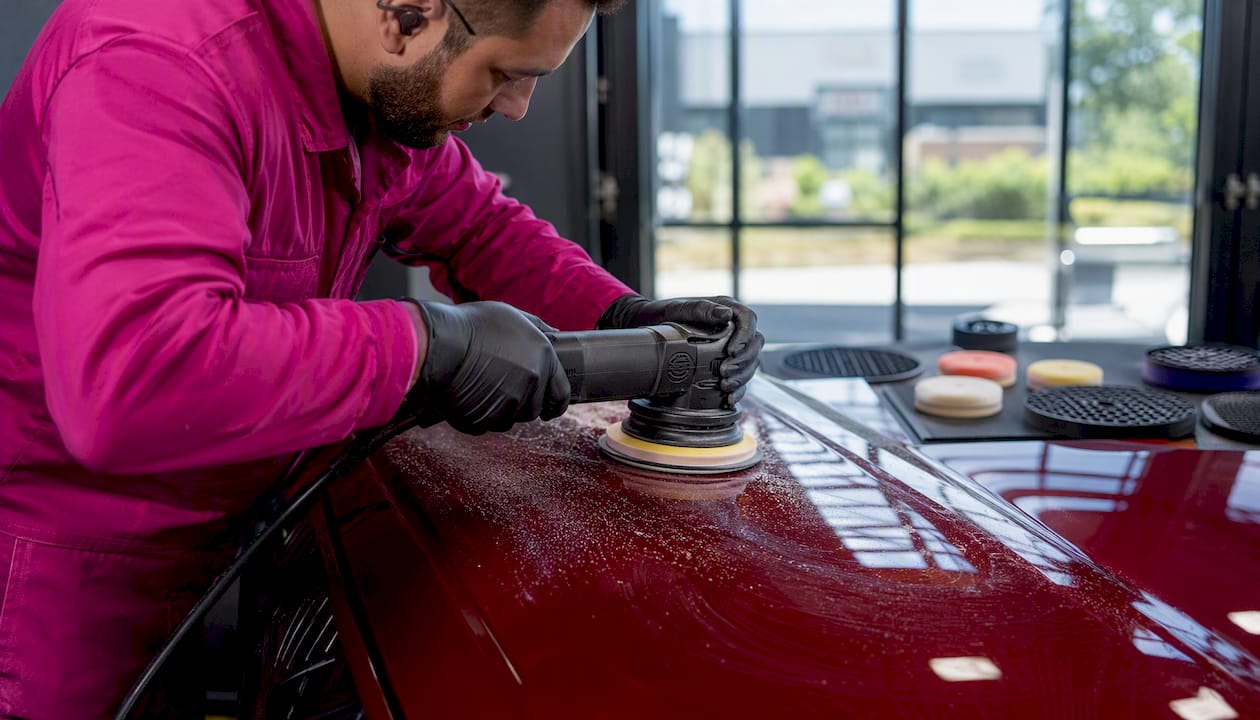
A ceramic coating seals whatever condition the paint is in at application. Apply a coating over swirled paint and those swirls are locked in for the coating’s full lifespan. This is why professional installers almost always include or quote correction as the essential prep step.
Standard correction process:
- Full wash and chemical decontamination
- Clay bar treatment to remove bonded surface contamination
- Paint thickness measurement across all panels
- Correction stage selection based on defect severity and clear coat depth
- Machine polishing (single-stage, two-stage, or multi-stage)
- Inspection under high-intensity lighting to confirm defect removal
- Final wipe-down and surface prep before protection application
A single-stage polish removes approximately 70–80% of light defects. A two-stage process reaches 90%+ and is the standard before any professional coating. Multi-stage correction is reserved for show-level work or heavily damaged paint, with costs ranging from $300–$500 for single-stage to $900–$1,500+ for multi-stage.
Pro Tip: Ask your installer to perform a test panel correction and take a paint thickness reading before and after. This confirms they are working within safe limits and gives you a baseline record for future services.
Which combination strategies work best for luxury vehicles?
Hybrid builds consistently outperform single-solution approaches for high-value vehicles. The most effective combinations:
| Build | Best for | What it delivers |
|---|---|---|
| Front PPF + ceramic/graphene full-vehicle coat | Daily highway drivers | Maximum chip resistance where it matters; gloss and UV protection everywhere else |
| Full urethane PPF + graphene topcoat | Stored/concours vehicles and track use | Complete physical armor plus optical depth and easy maintenance |
| Liquid PPF + ceramic topcoat | Complex body lines, lower visual footprint priority | Edge-to-edge coverage with added hardness and hydrophobicity |
| Paint correction + full ceramic/graphene (no film) | Garage-kept, low-mileage vehicles | Optimal gloss and UV protection; cost-effective where chip risk is low |
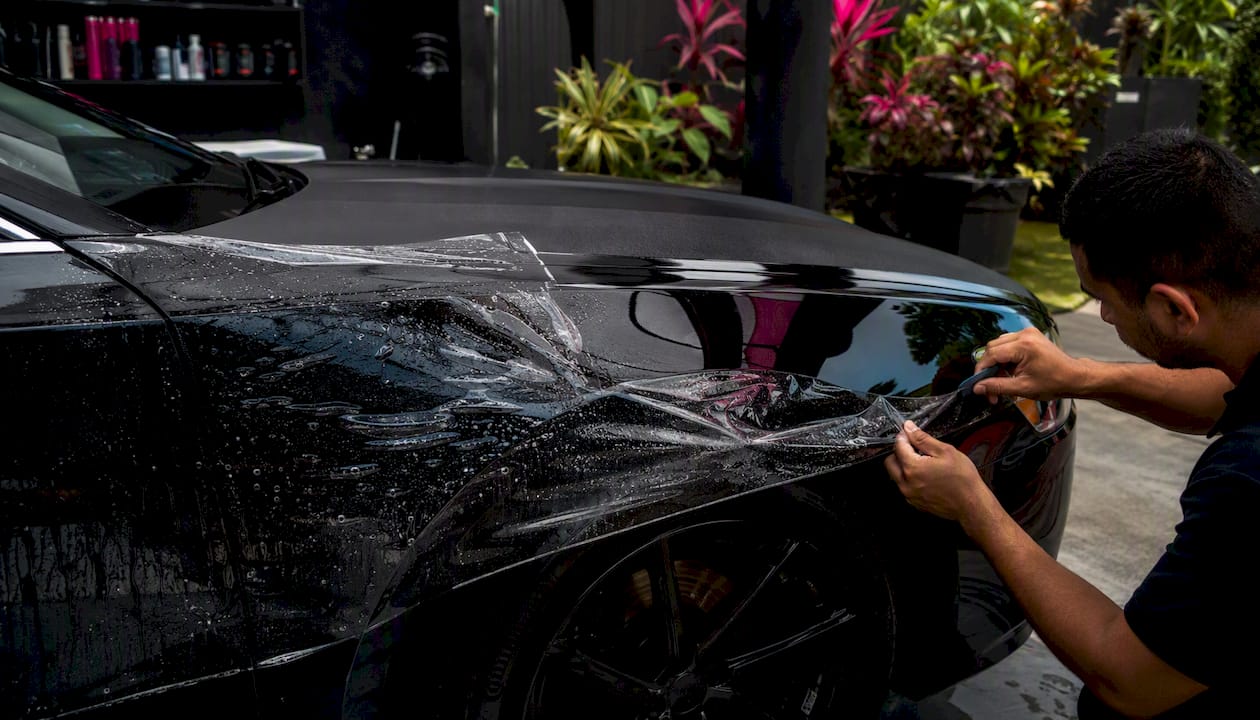
Sequencing matters. Paint correction always precedes film or coating application. Film goes on corrected paint before the topcoat. The topcoat seals both the film surface and any unfilmed panels simultaneously.
For owners phasing a budget, starting with paint correction plus a full ceramic coating, then adding targeted PPF on the front end at a later service, is a practical and value-preserving approach.
What do these services cost in the U.S., and how long do they last?
| Service | Typical U.S. cost range | Typical lifespan | Common warranty length |
|---|---|---|---|
| Single-stage paint correction | $300–$500 | Permanent until re-damaged | N/A |
| Multi-stage paint correction | $900–$1,500+ | Permanent until re-damaged | N/A |
| Liquid PPF (full vehicle) | $900–$1,500+ | 3–5 years depending on product and maintenance | 1–3 years, varies by product |
| Traditional urethane PPF (full vehicle) | — | 7–10 years on premium film | 5–10 years on premium products |
| Ceramic coating (professional grade) | — | 3–7 years depending on product tier | 2–5 years, maintenance-dependent |
| Graphene coating (professional grade) | — | 4–7 years | 2–5 years |
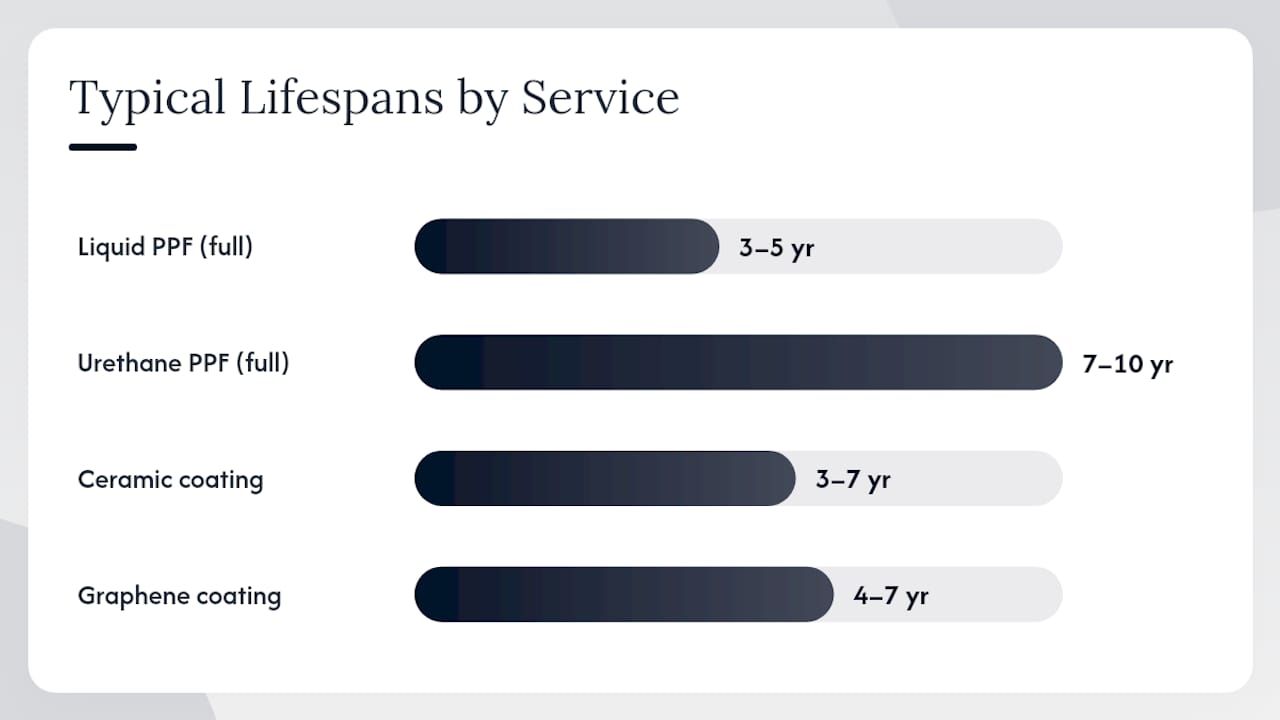
Lifespan depends on four factors: exposure intensity (UV, road salt, coastal air), maintenance consistency, installation quality, and product grade. A premium film installed by a certified technician and maintained correctly will outlast a budget product installed carelessly by several years. Warranties typically exclude damage from improper washing, automatic car washes, and chemical misuse.
How should you maintain protected paint to keep warranties valid?
Maintenance is where most owners lose the benefit of a professional installation. Neglect accelerates wear; the wrong wash method voids warranties.
Recommended schedule:
- Weekly: Hand wash with a pH-neutral automotive shampoo and a clean microfiber wash mitt. No automatic car washes.
- Monthly: Inspect film edges for lifting. Check for water-spot buildup on coated surfaces, especially in coastal or hard-water areas.
- Every 6 months: Apply a coating-safe maintenance spray or topper to refresh hydrophobicity on ceramic or graphene surfaces.
- Annually: Return to your installer for a professional inspection, decontamination wash, and coating assessment.
Pro Tip: Keep a service folder with dated photos, installer receipts, and product documentation. Many warranty claims require proof of professional installation and documented maintenance history.
Red flags that indicate a return to the shop:
- Film edges lifting or developing bubbles
- Coating no longer beads water effectively after a proper wash
- Persistent staining that does not respond to pH-neutral cleaners
- Visible yellowing or haze on film panels
- New chips or scratches that have penetrated to the base coat
Maintenance differs slightly by protection type. Film surfaces tolerate slightly more aggressive decontamination. Ceramic and graphene topcoats benefit from periodic topper applications. Liquid PPF surfaces should be treated like a coated panel: gentle washing and regular topper maintenance. For guidance on preventing environmental paint damage, Mannyceramicprotouch’s resource covers the most common threats by climate and season.
How do you choose the right strategy and find a qualified installer?
The right preservation strategy depends on how you use the vehicle, where you drive it, and what outcome matters most to you.
Priority checklist:
- Daily highway miles? Prioritize physical film on the front end.
- Coastal or high-UV climate? Ceramic or graphene coating is non-negotiable for UV and chemical resistance.
- Concours or stored vehicle? Full film plus topcoat, or a premium multi-layer coating if chip risk is low.
- Resale value preservation? Any professional-grade protection with documented service history adds measurable value.
Questions to ask every installer before booking:
- Which specific product brands do you use, and are you certified by those manufacturers?
- Does your quote include paint correction, or is that a separate line item?
- What does your warranty cover, and what voids it?
- Can you show before-and-after photos from similar vehicles?
- Do you take paint thickness readings before and after correction?
- What is your repair and replacement policy if film lifts or a coating fails prematurely?
Installer trust signals to verify:
- Manufacturer certifications (product-specific training and endorsement)
- Written warranty documentation provided at delivery
- Documented paint thickness readings on file
- Case-study photos from comparable vehicles
- Clear aftercare instructions and a maintenance plan
A qualified installer will welcome all of these questions. One who deflects or cannot produce written warranty terms is a red flag. For a structured decision framework, Mannyceramicprotouch’s guide on how to choose surface protection for luxury cars walks through the full evaluation process.
Pro Tip: Never book a coating or film installation without confirming that paint correction is included or explicitly quoted separately. Skipping correction is the single most common cause of coating complaints.
What should you expect during the installation process?
Timeline varies by package complexity. Here is a realistic breakdown:
- Single-stage correction + ceramic coating: 2–3 days. Day one: wash, decontamination, correction. Day two: coating application and initial cure. Day three: final inspection and delivery.
- Multi-stage correction + full urethane PPF + topcoat: 5–7 days. Correction takes 1–2 days. Film installation takes 2–3 days. Topcoat application and cure add another 1–2 days.
- Liquid PPF + ceramic topcoat: 2–4 days depending on vehicle size and panel complexity.
Delivery checklist for owners:
- Inspect every panel under natural and artificial light for correction quality and film alignment.
- Confirm water beading behavior on coated surfaces.
- Receive written warranty documentation with coverage terms, exclusions, and duration.
- Receive written aftercare instructions specific to the products applied.
- Confirm the curing window: most professional coatings require 5–7 days before exposure to rain or washing, and 30 days before any decontamination treatment.
Do not run the vehicle through an automatic car wash during the curing period. Even a touchless wash can introduce water-spot contamination before the coating has fully hardened.
Key Takeaways
The most effective long-term paint preservation strategy for luxury and high-value vehicles combines physical film protection on high-impact zones with a ceramic or graphene topcoat, always preceded by professional paint correction.
| Point | Details |
|---|---|
| Hybrid builds outperform single solutions | Front PPF plus a ceramic or graphene topcoat delivers chip resistance and long-term gloss in one system. |
| Paint correction is always first | A coating seals whatever condition the paint is in; skipping correction locks in defects permanently. |
| Correction costs $300–$1,500+ | Single-stage runs $300–$500, two-stage $500–$900, and multi-stage reaches $900–$1,500+, depending on defect severity. |
| Maintenance determines lifespan | pH-neutral washing, 6-month topper applications, and annual inspections keep warranties valid and performance high. |
| Mannyceramicprotouch for luxury vehicles | Mannyceramicprotouch specializes in Liquid PPF, traditional PPF, ceramic and graphene coatings, and paint correction for luxury and exotic vehicles. |
The part most owners get wrong about paint preservation
Most owners focus on which product to choose. The real decision is about sequencing and preparation. A $4,000 ceramic coating applied over uncorrected paint is a worse outcome than a $1,500 coating applied over properly corrected paint. The product is almost secondary to the prep.
The other underestimated factor is climate. Owners in South Florida, coastal California, or the Gulf Coast face UV intensity and salt air that accelerate coating degradation at a rate that owners in temperate inland climates simply do not experience. A coating rated for five years in moderate conditions may need reassessment at three years in a coastal environment. That is not a product failure. It is a maintenance reality that most installers do not communicate clearly enough at the time of sale.
Hybrid builds are not just a premium upsell. For a vehicle driven daily on highways, the front bumper, hood, and mirrors absorb debris that no coating can stop. Film on those panels is functional protection. Coating everywhere else is optical and chemical protection. They solve different problems, and treating them as interchangeable is where owners make expensive mistakes.
Mannyceramicprotouch protects what you’ve invested in
Owners of luxury and exotic vehicles who want professional-grade, long-term paint preservation have a clear option in Mannyceramicprotouch. The studio offers Liquid PPF, traditional urethane PPF, ceramic and graphene coatings, and multi-stage paint correction, all applied with a measurement-driven prep process built specifically for high-value assets.
Every vehicle receives a tailored protection plan, not a volume-based package. Paint thickness readings, documented correction stages, and written warranty terms are standard, not optional. The process is designed for owners who expect precision and want results that hold up over years of real-world use.
To book a consultation or request a quote for your vehicle, visit Mannyceramicprotouch’s Liquid PPF and ceramic coating services or review the full PPF service options to find the right starting point for your vehicle.
Useful sources and further reading
External references:
- Paint correction: what it is, when you need it
- Paint Correction Before Ceramic Coating: 2026 Pro Installer Guide | LA Wrap and Tint School
- Paint Correction: What It Is & When Your Car Needs It
Mannyceramicprotouch resources:
- Ceramic paint protection: what car owners must know
- How to prevent paint fading on your car
- Advanced detailing procedures: expert guide
- Car paint protection: complete guide
Consult manufacturer warranty documentation and a certified professional installer for advice specific to your vehicle, climate, and usage profile.