

TL;DR:
- Proper dashboard maintenance for luxury vehicles requires pH-neutral cleaners, correct technique, and the right tools to preserve surfaces. Incomplete or incorrect cleaning can cause damage and accelerate aging, making discipline and routine essential. Consistent care, including cleaning, conditioning, and UV protection, significantly extends the lifespan and appearance of the dashboard.
The dashboard cleaning process for luxury vehicles is a specialized regimen requiring pH-neutral products, precise technique, and material-specific tools to preserve both appearance and structural integrity. A standard household cleaner strips the protective topcoat from soft-touch and leather surfaces, causing damage that compounds over time. The difference between a dashboard that looks showroom-fresh at five years and one that cracks at two comes down to process discipline. This guide covers the right tools, the correct sequence, the most common mistakes, and the long-term care routine that protects your investment.
What tools and products are essential for luxury dashboard cleaning?
The right tools define the outcome before a single drop of cleaner touches the surface. Using the wrong cloth or brush on a soft-touch dashboard creates micro-abrasions that dull the finish permanently.
Essential tools for luxury dashboard detailing:
- Low-nap microfiber towels: Use one for applying cleaner and a separate, clean, dry towel for the final leveling wipe. Two distinct microfiber towels prevent residue buildup that dulls the finish and causes streaks.
- Ultra-soft boar’s hair brushes: Professional detailers use these to clean textured vinyl without leaving lint or haze. The soft bristles reach into grain patterns without scratching.
- Soft bristle detailing brushes: Ideal for air vents, seams, and recessed trim areas where microfiber cannot reach flat.
- Ergonomic spray bottles: Allow controlled, low-volume dispensing. You never spray product directly onto the dashboard.
- pH-neutral interior cleaner: The only safe choice for modern luxury interiors. High-pH household products strip oils from leather and degrade soft-touch coatings.
- Dedicated UV protectant: A non-negotiable product for any luxury vehicle dashboard exposed to sunlight.
Pro Tip: Always apply cleaner to the towel first, never to the dashboard surface. Direct application saturates seams and wicks into electronics or stitching, causing damage that is invisible until it is too late.
| Tool category | Recommended product type | Purpose |
|---|---|---|
| Applicator cloth | Low-nap microfiber towel | Applies cleaner with controlled pressure |
| Leveling cloth | Dry ultra-soft microfiber towel | Removes residue and prevents streaks |
| Detail brush | Ultra-soft boar’s hair brush | Cleans textured vinyl and grain patterns |
| Vent and seam brush | Soft bristle detailing brush | Reaches recessed areas and tight seams |
| Cleaner | pH-neutral interior spray | Safe for leather, vinyl, and soft-touch |
| Protectant | Dedicated UV protectant spray | Blocks UV radiation and prevents fading |
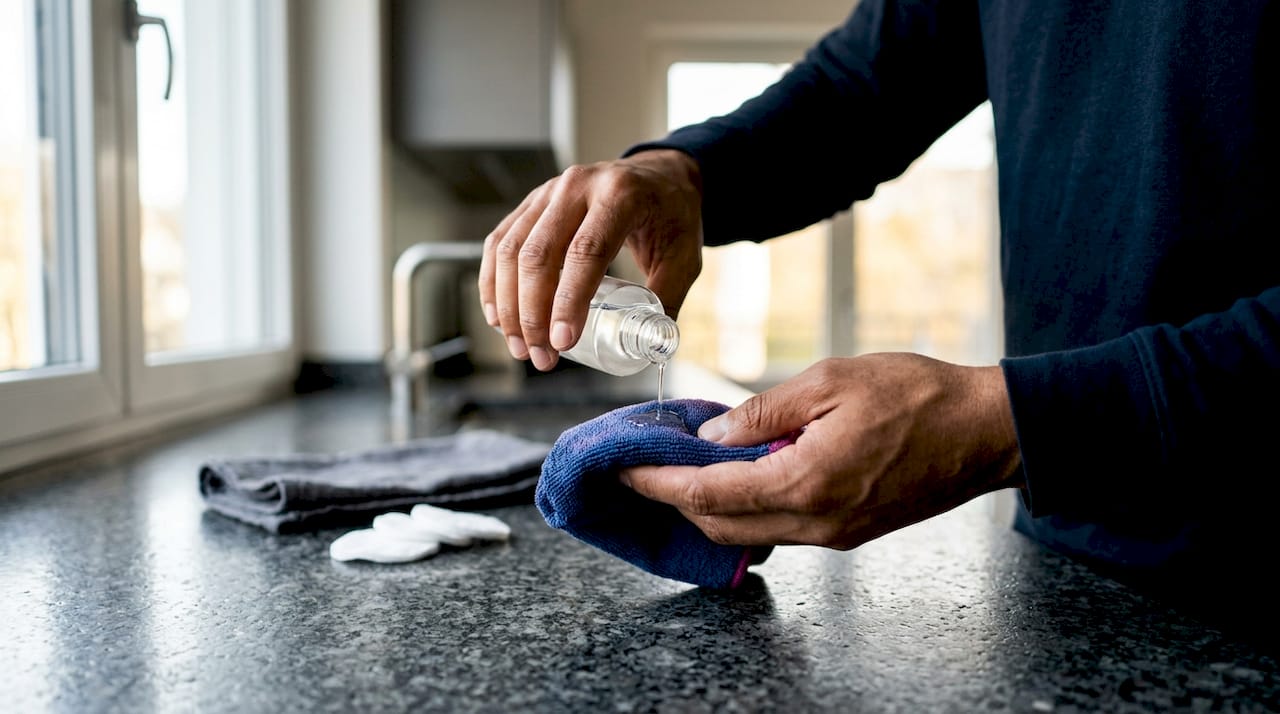
Selecting products from the pH-neutral category matters because luxury car leather degradation spikes significantly when improper products are used. That degradation is not always visible immediately, which makes the damage harder to catch before it becomes permanent.
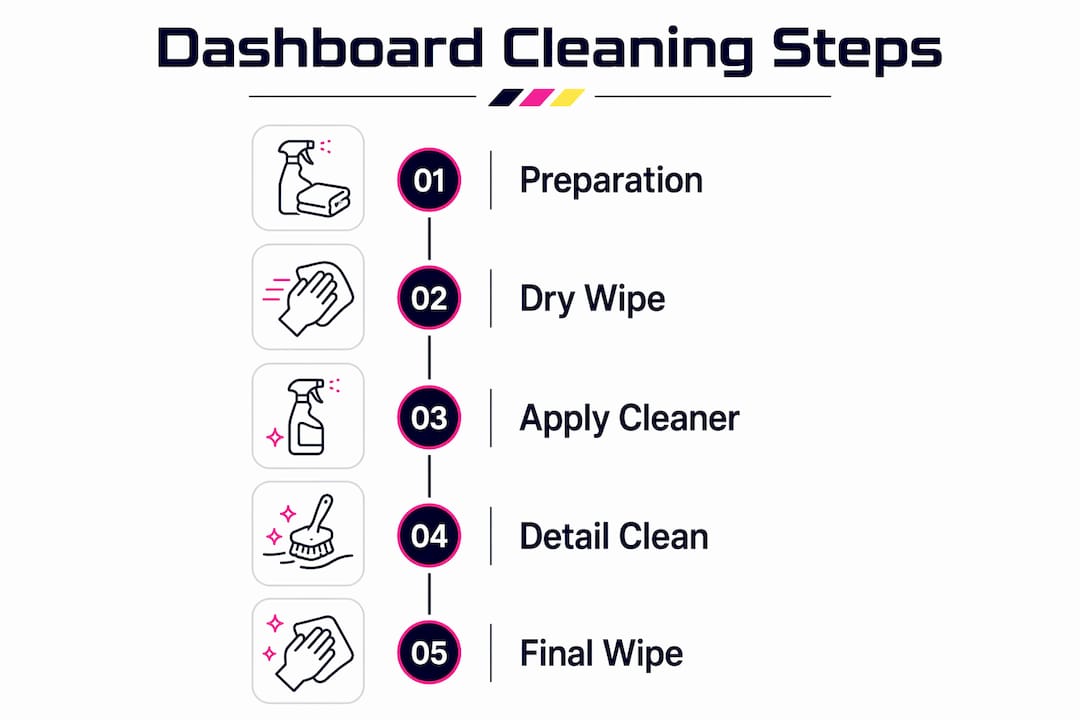
How to execute the step-by-step cleaning process for luxury dashboards
The correct sequence for luxury car interior maintenance is dry removal first, wet cleaning second, and protection last. Reversing this order traps contaminants under conditioner or protectant, accelerating wear rather than preventing it.
Step-by-step luxury dashboard cleaning process:
- Vacuum all surfaces. Vacuuming dust and debris before wet cleaning prevents grinding loose particles into delicate materials. Use a soft brush attachment on vents and seams.
- Remove loose debris from crevices. Use a dry boar’s hair brush to dislodge particles from grain patterns and trim edges before introducing any moisture.
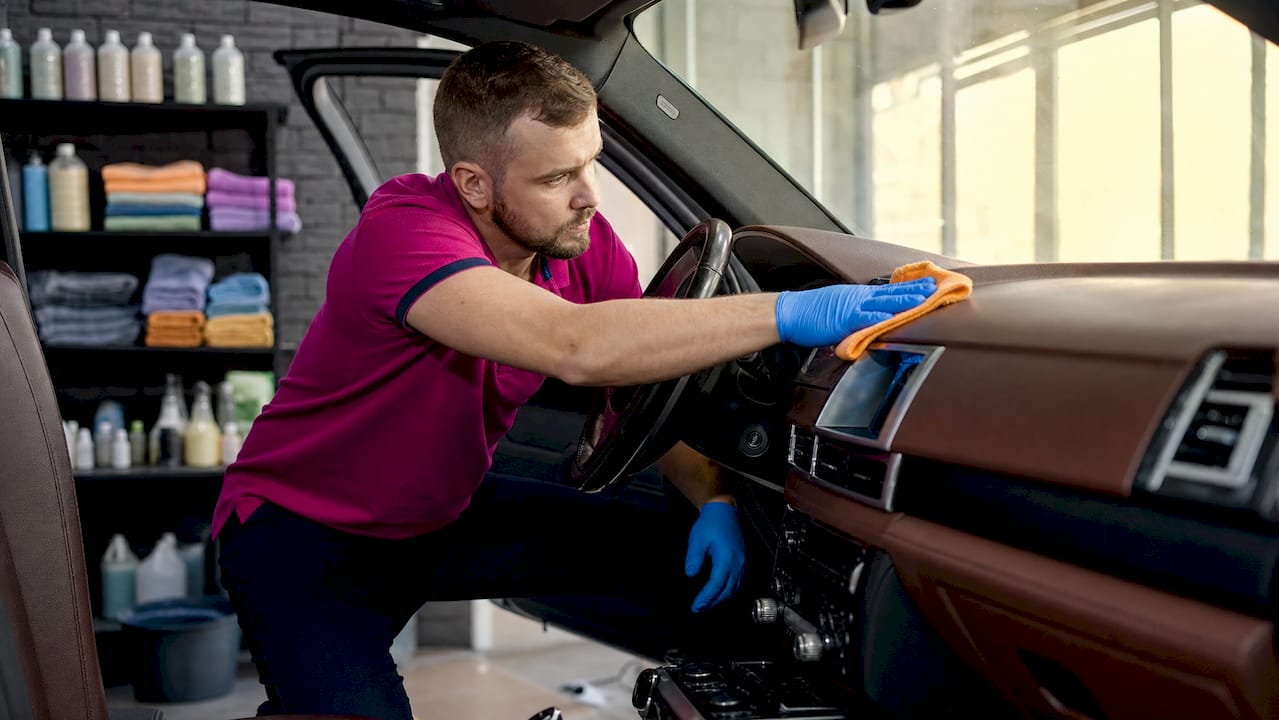
- Apply cleaner to the towel. Mist the pH-neutral cleaner onto a low-nap microfiber towel until it is lightly damp, not saturated.
- Wipe surfaces with light, even pressure. Work in small sections. Use the damp towel in straight, overlapping passes. Avoid circular scrubbing on soft-touch surfaces, which can create swirl marks in the coating.
- Agitate textured areas with a boar’s hair brush. For grain patterns, wood trim, or carbon fiber inserts, use the brush in short strokes to lift embedded grime without scratching.
- Follow immediately with the dry leveling wipe. A separate dry microfiber towel removes surfactant residue and delivers a professional, streak-free finish. Do not skip this step.
- Address leather sections separately. Apply a water-based, non-greasy conditioner in small circular motions after cleaning. Regular conditioning restores suppleness and prolongs dashboard life. Allow dwell time before buffing lightly.
- Apply UV protectant last. Mist onto a clean towel and spread evenly across all non-leather surfaces. Buff to a uniform, matte finish.
Pro Tip: For the final pass on textured vinyl, use an ultra-soft boar’s hair brush rather than a towel. The brush lifts any remaining product from grain valleys without depositing lint or creating haze.
Handling coated trim and piano black inserts requires extra care. These surfaces show fingerprints and micro-scratches from any towel with texture. Use only the softest microfiber available, and apply almost no pressure. The cleaner does the work; the towel only removes it.
What are common dashboard cleaning mistakes and how to avoid them?
Most dashboard damage in luxury vehicles comes from well-intentioned but incorrect technique. The materials used in high-end interiors, including Alcantara, soft-touch polymer, and full-grain leather, are engineered to look and feel exceptional. They are not engineered to tolerate abuse from the wrong products.
Common mistakes and how to prevent them:
- Using household or all-purpose cleaners. These products carry high pH levels that strip the protective topcoat from leather and soft-touch surfaces. Use only pH-neutral interior cleaners.
- Applying conditioner over a dirty surface. Conditioning an unclean surface traps dirt and accelerates degradation. Always clean thoroughly before conditioning.
- Spraying product directly onto the dashboard. Excess moisture migrates into seams, electronics, and stitching. Apply all products to the towel first.
- Skipping the dry leveling wipe. Over-application and skipping final wipes cause streaking and uneven sheen. The leveling wipe is not optional.
- Using plush or rough towels. High-pile towels deposit lint in grain patterns. Rough towels scratch soft-touch coatings. Low-nap microfiber is the only safe choice.
- Applying too much product. Excess cleaner leaves residue that attracts dust faster and creates a greasy film over time.
Pro Tip: Use less product than you think you need, and apply lighter agitation than feels necessary. The goal is to lift grime, not scrub it. Less product with light agitation produces a cleaner, more natural finish every time.
The most overlooked mistake is inconsistency. Owners who clean their dashboards once every few months allow contaminant layers to build up. Those layers require more aggressive cleaning to remove, which increases the risk of surface damage. A brief wipe-down every one to two weeks prevents that cycle entirely.
How to maintain and protect luxury vehicle dashboards for the long term
Long-term luxury car interior maintenance is a cycle of three distinct actions: cleaning, conditioning, and protecting. Skipping any one of them shortens the lifespan of dashboard materials significantly.
Regular vacuuming and quick wipe-downs prevent contaminant buildup between full cleaning sessions. Dust carries abrasive particles. Left on a soft-touch surface, those particles act like fine sandpaper every time a hand or sleeve brushes across the dashboard. A dry microfiber pass twice a week costs two minutes and prevents cumulative surface wear.
UV damage can occur within a few years of untreated exposure, causing embrittlement, fading, and cracking on luxury dashboards. This makes a dedicated UV protectant mandatory, not optional. The protectant creates a barrier between the dashboard material and solar radiation, and it needs to be reapplied on a regular schedule to remain effective. Owners who rely on tinted windows alone still see UV-related degradation because glass does not block all UV wavelengths. A full guide on UV protection for cars explains the specific wavelengths that cause the most damage.
Parking in shade and using sunshades reduces UV exposure and works in combination with topical protectants to extend dashboard lifespan. These are passive measures, but they compound the effect of active protection products.
| Care action | Recommended frequency | Primary benefit |
|---|---|---|
| Dry microfiber wipe-down | Every 1–2 weeks | Removes abrasive dust before it causes wear |
| Full pH-neutral cleaning | Monthly | Lifts embedded grime and resets surface condition |
| Leather conditioning | Every 6–8 weeks | Restores suppleness and prevents cracking |
| UV protectant application | Every 4–6 weeks | Blocks solar radiation and prevents fading |
| Sunshade use | Every park in direct sun | Reduces thermal and UV load on dashboard materials |
pH-balanced cleaning and conditioning cycles prevent material degradation at the molecular level. Leather loses natural oils over time through normal evaporation. Conditioning replaces those oils before the material becomes brittle. The daily wear impact on luxury vehicles accumulates faster than most owners realize, which is why a fixed schedule outperforms reactive cleaning every time.
Key Takeaways
The most effective dashboard cleaning process for luxury vehicles combines pH-neutral products, a strict dry-before-wet sequence, and a consistent conditioning and UV protection schedule.
| Point | Details |
|---|---|
| Use pH-neutral cleaners only | High-pH products strip protective topcoats from leather and soft-touch surfaces. |
| Vacuum before wet cleaning | Removing loose debris first prevents grinding abrasive particles into delicate materials. |
| Always use two microfiber towels | One for cleaning, one for the dry leveling wipe, to eliminate streaks and residue. |
| Apply UV protectant every 4–6 weeks | UV damage causes embrittlement and cracking within a few years of untreated exposure. |
| Clean before conditioning | Applying conditioner over a dirty surface traps contaminants and accelerates degradation. |
What I’ve learned from watching owners get this wrong
Most luxury vehicle owners treat their dashboards the way they treat their kitchen counters. They grab whatever cleaner is nearby, spray it on, and wipe it off. That approach works on granite. It destroys soft-touch polymer and full-grain leather.
The pattern I see most often is this: an owner conditions their leather dashboard regularly, feels good about the maintenance, and then wonders why the surface looks dull and feels sticky after six months. The answer is almost always that they conditioned over a dirty surface. The conditioner sealed in the contamination. Every subsequent application made it worse.
The second most common oversight is skipping the leveling wipe. Owners clean the surface, see it looks good, and move on. What they leave behind is a thin layer of surfactant residue that attracts dust within hours. The dashboard looks dirty again by the next morning, and the owner concludes the product does not work. The product works fine. The process was incomplete.
What actually separates a well-maintained luxury interior from one that ages poorly is discipline, not product budget. You do not need expensive specialty products. You need the right category of product, the right sequence, and the consistency to repeat it on schedule. A maintenance detailing guide built around these principles will outperform any single premium product used incorrectly.
The owners who get the best long-term results are the ones who treat interior care as a fixed routine, not a reaction to visible dirt.
— Emmanuel
Professional surface protection for your luxury vehicle
Interior care preserves what you see and touch every day. Exterior protection preserves the asset underneath.
Mannyceramicprotouch specializes in advanced surface preservation for luxury, exotic, and high-value vehicles. The studio’s paint protection film services and Liquid PPF applications defend against rock chips, scratches, and environmental damage that no interior cleaning routine can address. Every vehicle receives a tailored protection strategy built around its specific materials and the owner’s long-term goals. If your interior care routine is already dialed in, the next step is making sure the exterior receives the same level of attention. Contact Mannyceramicprotouch to discuss a preservation plan built for your vehicle.
FAQ
What products are safe for cleaning luxury dashboards?
pH-neutral interior cleaners are the only safe choice for luxury dashboards. High-pH or household products strip protective topcoats from leather and soft-touch surfaces, causing premature cracking and fading.
How often should a luxury vehicle dashboard be cleaned?
A dry microfiber wipe-down every one to two weeks prevents abrasive dust buildup. A full pH-neutral cleaning should be performed monthly, with UV protectant reapplied every four to six weeks.
Why does my dashboard look streaky after cleaning?
Streaking results from skipping the dry leveling wipe or applying too much product. A separate, clean, dry microfiber towel used immediately after cleaning removes surfactant residue and delivers a streak-free finish.
Can I apply conditioner directly to a leather dashboard?
Applying conditioner over an unclean surface traps dirt and accelerates degradation. Always complete a full pH-neutral cleaning cycle before applying any conditioner to leather or soft-touch surfaces.
Does parking in shade actually protect a luxury dashboard?
Parking in shade and using sunshades reduces UV exposure and works alongside topical UV protectants to extend dashboard lifespan. Neither measure alone is sufficient; both together produce the best results.
Recommended
- Luxury Car Drying Techniques for a Flawless Finish – Many Ceramic Pro Touch
- 12 Signs Your Car Needs Detailing: 2026 Guide – Manny’s Ceramic Pro Touch and Luxury Surface Preservation™
- How to Schedule Elite Car Detailing: 2026 Guide – Many Ceramic Pro Touch
- Maintenance detailing guide for luxury car owners – Many Ceramic Pro Touch