

You can clay a ceramic-coated car, but in most cases you should not. A clay bar works by abrading contamination off the surface, and a ceramic coating is a thin layer that cannot be abraded without being worn away. For a coated vehicle, the better first move is a pH-balanced wash followed by a chemical decontamination step. Clay is a last resort, used with fine-grade clay, heavy lubrication and light pressure, and ideally by a professional who can re-check the coating afterward. The same logic applies to paint protection film (PPF), with one extra factor: the film’s topcoat.
This guide explains what clay does to a coating, what to use instead, how to clay safely when you have no other option, and what to do after.
TL;DR
- A clay bar is mildly abrasive. On a ceramic coating, any abrasion removes or dulls a small amount of the coating, so it is not routine maintenance.
- If a coated car feels rough, wash it properly first, then use a chemical decontamination product before considering clay.
- When clay is unavoidable, use fine-grade clay, plenty of lubricant, no pressure, and clean the area afterward.
- On PPF, film makers warn that clay can damage the topcoat and discolor the film, so follow the manufacturer’s care sheet.
- On a luxury or exotic vehicle, have a detailer assess the surface before anything abrasive touches it.
Table of Contents
- Why clay and ceramic coatings do not mix well
- Does clay remove a ceramic coating?
- Why a coated car should not need clay often
- What to do before you reach for clay
- How to clay a ceramic-coated car when you have to
- Can you clay bar PPF?
- When clay still makes sense around a coating
- Warning signs that a coating needs attention, not clay
- Protecting the finish between visits
- Our perspective
- Have your coated vehicle assessed in Fort Lauderdale
- FAQ
- Sources
Why clay and ceramic coatings do not mix well
A clay bar is a pliable abrasive compound. Glided across lubricated paint, it shears off bonded contaminants such as industrial fallout, tree sap residue and overspray. That is why it is a standard step before polishing or applying protection. We cover that process in our clay bar process for luxury vehicles.
A ceramic coating changes the situation. The coating is a hard, thin, sacrificial layer on top of the clear coat. The Society of Collision Repair Specialists (SCRS) states that ceramic coatings cannot be abraded without stripping them. Clay is gentle compared with a polish, yet it still works by friction. Even with lubricant, repeated passes can leave fine marring in the coating and take the edge off its slickness and gloss.
Two things can go wrong:
- Coating wear. Every pass removes a tiny amount of the coating. One careful session on a fresh coating is unlikely to be visible, but sessions repeated twice a year add up.
- Marring. Clay that has picked up grit, or a panel that dries out, scratches the coating itself. Because the coating is the outermost layer, those marks sit where you see them and are not easy to polish out without removing the coating.
The forum advice you will find online, that fine-grade clay “won’t hurt it,” is usually from owners who clayed once with generous lubricant. Even in those threads, users note that clay mitts and towels are more aggressive and carry a higher chance of marring a coating. Treat that as the realistic ceiling of the risk: possible, manageable with technique, never zero.
Does clay remove a ceramic coating?
Yes, it can, gradually. A single light pass with fine clay will not strip a coating in the way a compound or a heavy polish does. But the coating thins and its water-shedding behavior can change when it is clayed, particularly on coatings that are already a year or more old and have taken a season of sun and washing.
The practical rule is simple. If you clay a coated panel, assume you have spent some of the coating’s life. That is the reason we do not recommend clay as a scheduled maintenance step on a coated vehicle.

Why a coated car should not need clay often
One of the main benefits of a coating is that dirt and contamination bond to it less readily than to bare clear coat. Road film, bugs and light dust rinse or wipe off during a regular wash. If your coated car feels rough every few weeks, something else is usually going on:
- The coating has aged and lost its slickness, so contamination is bonding more.
- Washing technique is leaving contamination behind, for example a dirty mitt or too little rinsing.
- The car is parked near a source of fallout, such as a rail line, a construction site or a marina.
- Hard-water spotting has formed on the surface. Here in South Florida, sprinkler overspray and humid mornings are common sources.
SCRS notes that coatings remain susceptible to mineral deposits, etching, scratching and swirl marks, and that mineral deposits left too long can eventually need abrasion to remove, which takes the coating off with them. The takeaway is to deal with deposits early, while they are still removable with chemistry instead of friction.
What to do before you reach for clay
Work up from the least aggressive method. Most coated cars never need to go past step three.
- Wash with a pH-neutral shampoo using the two-bucket method and a clean microfiber mitt. Rinse thoroughly and dry with a clean towel or filtered air.
- Spot-treat obvious contaminants. Bug remains and bird droppings should come off with a quality detail spray and a soft towel, before they sit and etch. Our guide on paint transfer removal covers what to do when something has rubbed onto the paint.
- Use a chemical decontaminant. Iron-fallout removers and tar removers dissolve embedded particles without abrading anything. Choose products rated safe for coatings, and rinse fully afterward.
- Re-test the surface. Place your fingertips inside a thin plastic bag and glide over the clean, wet panel. If it still feels gritty, a localized, careful clay pass may be justified.
- Escalate to a professional inspection if the roughness is widespread, if spotting has etched the surface, or if the car is high value.
This order protects the coating and still solves the problem in most cases. It is also the order we follow when a coated client brings in a vehicle that feels contaminated.
How to clay a ceramic-coated car when you have to
If chemical decontamination did not work and the surface is still rough, here is how to limit the damage. Use this only on a clean, fully washed car, and never in direct sun or on a hot panel.
Choose the least aggressive tool
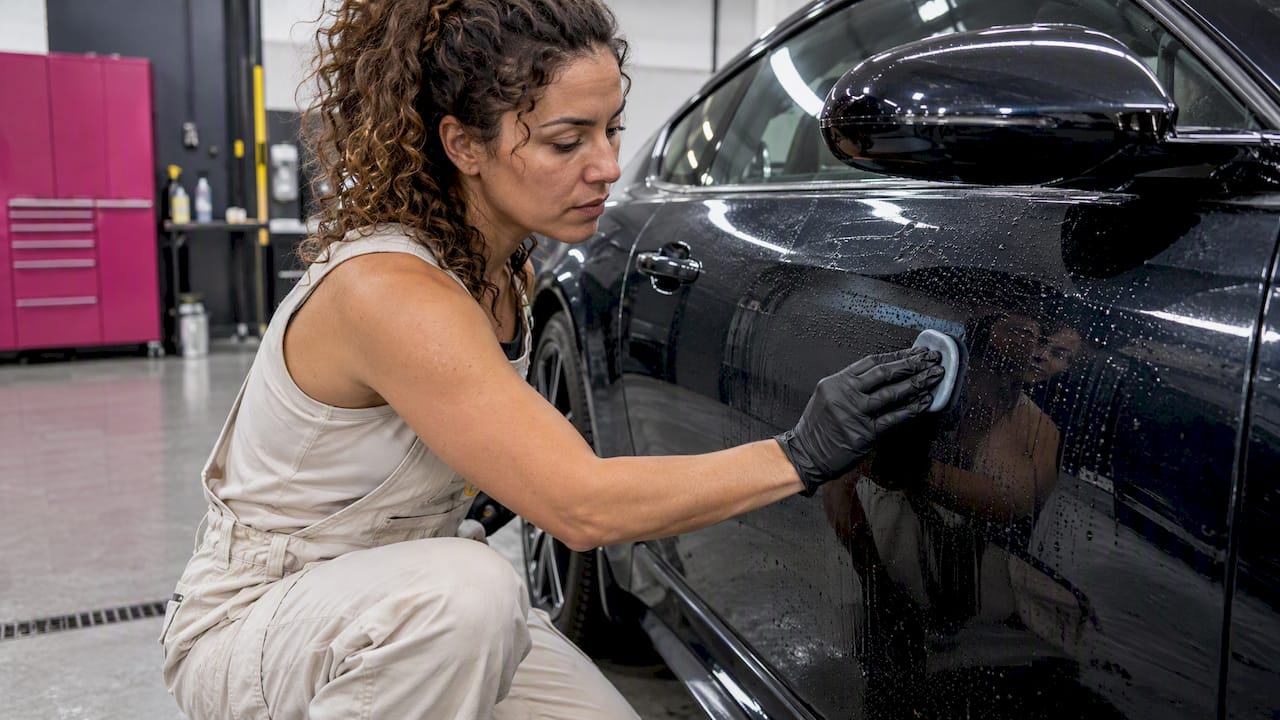
Fine-grade clay is the minimum aggression you should consider. Skip medium and heavy-grade clay, and avoid clay mitts, towels and sponges, which are harder to keep clean and easier to press too hard. Synthetic clay products exist, but the same caution applies to them.
Lubricate more than feels necessary
Lubricant is what keeps clay from digging in. CARPRO’s published directions for its clay lubricant say that the lubricant reduces friction and unwanted digging and marring and that the surface should be kept lubricated throughout, then wiped and washed afterward. Use a dedicated clay lubricant, spray both the panel and the clay, and reapply the moment the clay stops gliding freely. Water alone is not enough.
Use a light touch
- Work in small sections, about two feet square.
- Flatten the clay into a pancake and glide it in straight lines with almost no pressure.
- Stop when the clay moves freely and the section feels smooth. Do not keep going “to be sure.”
- Fold and knead the clay often to expose a clean surface. Discard any piece you drop.
Wipe, rinse and inspect
Wipe off residue with a clean microfiber, then rinse or wash the car again. Check the panel in diffused light for fine marring and test whether water still beads and sheets as before. If the coating’s behavior has changed, a coating-specific topper or a professional refresh is the next step. Some manufacturers publish products for repairing and boosting durable coatings, such as Essence Plus, which CARPRO describes as filling coating defects and improving gloss and performance. A coating refresh is a job we would rather handle in a controlled environment than leave to a driveway.
Can you clay bar PPF?
PPF is a different material from a ceramic coating, and the answer depends on the film. Most clear films have a protective topcoat that provides gloss and stain resistance, and in some cases self-healing behavior. ORAFOL Americas, in its care sheet for one of its films, cautions that clay bars may damage the topcoat and potentially discolor the film, so they should be used with caution. The same sheet points owners toward tested film-safe care products, including a ceramic-effect shampoo that cleans and seals in one step.
That guidance fits the broader pattern:
- Film installed on the car: do not assume clay is safe. Check the film maker’s care sheet for your exact product, and use chemical decontamination first.
- Paint before film installation: here clay is expected. 3M recommends mild clay to remove contaminants from painted surfaces before PPF installation, so the paint is truly clean for the adhesive.
- Polishing and waxing film: the same 3M document says regular polishing or waxing is unnecessary and that waxes with dyes, abrasive polishes and rubbing compounds should be avoided.
A ceramic coating applied over PPF follows the coating rules above. You now have two layers to respect, and the more fragile of them sets the limit.
What about liquid PPF?
Liquid PPF is a sprayed, cured protective layer rather than a sheet of film, so the manufacturer’s cure and care instructions matter even more. We do not recommend claying any liquid PPF or coating system without confirming the product’s care guidance with the installer who applied it. For a side-by-side look at the two approaches, see our comparison of liquid PPF vs traditional PPF.
When clay still makes sense around a coating
There are legitimate cases where clay and coatings meet:
| Situation | Clay appropriate? | Better approach |
|---|---|---|
| Bare paint before coating | Yes | Clay is part of surface prep |
| Fresh coating, still curing | No | Follow the installer’s cure instructions |
| Coated car, light roughness | Usually no | Wash, then iron and tar remover |
| Coated car, stubborn bonded contamination | Sometimes | Fine clay, heavy lube, small area, or professional assessment |
| Coating that has failed or is being replaced | Yes, after the old coating is removed | Full decontamination and paint correction |
| PPF installed | Only per film maker’s guidance | Film-safe wash and chemical decon |
The prep row matters most. Coatings bond best to clean paint, which is why decontamination, correction and a final wipe-down come before application. Our steps to prep your car for coating and the checklist before ceramic application walk through that sequence, and why surface preparation is critical explains the reasoning.
Warning signs that a coating needs attention, not clay
Roughness is not always contamination. Before you clay, check whether the real issue is the coating’s condition:
- Water no longer beads or sheets off as it used to.
- Dirt returns quickly after washing.
- Gloss looks flat even though the surface is clean.
- Spots remain after washing and iron removal, suggesting etching in the surface.
Claying a coating that has simply aged will not restore it, and it may speed up the wear. A professional inspection can tell whether the answer is a maintenance treatment, a topper, localized correction or recoating. For owners weighing options, ceramic paint protection: what car owners must know and our auto coating guide give the background.
Protecting the finish between visits
The best way to avoid clay on a coated car is to stay ahead of contamination:
- Wash every one to two weeks, more often in coastal conditions with salt air and heavy pollen.
- Rinse off bird droppings and bug remains promptly.
- Use touchless or hand washing instead of brush-style automatic washes. Our post on preventing auto wash scratches explains the risks, and how coatings prevent swirl marks shows why technique matters.
- Park under cover when you can, and avoid sprinkler overspray.
- Book a periodic professional maintenance wash and inspection.
Our perspective
We see clay questions from coated-car owners more than almost any other maintenance question, and our answer is consistent: treat clay as a surgical tool, not a routine habit.
A coating is an investment in the paint. Every time something abrasive touches it, you are spending some of that investment. We would rather solve contamination with chemistry and good washing technique, and keep friction for the rare spot that needs it.
When a client’s vehicle does need more than a wash, we assess the coating first. We look at the panel under inspection lighting, test what is bonded and what is just dirty, and choose the least aggressive method that works. That quality-first, low-volume process is how we approach luxury and exotic vehicles, where a single marred panel is not an acceptable outcome.
If you are unsure whether your coating, film or liquid PPF can take a clay pass, ask before you touch it. A short conversation costs far less than a repair.
Emmanuel
Have your coated vehicle assessed in Fort Lauderdale
If your coated or filmed vehicle feels rough, looks dull or has spots that will not wash off, we can inspect it and decontaminate it safely instead of leaving you to guess. We specialize in liquid PPF, ceramic coatings, paint correction and detailing for luxury and exotic vehicles.

See our paint protection services in Fort Lauderdale or our detailing services for luxury and exotic vehicles to book an assessment.
FAQ
Will a clay bar remove ceramic coating?
It can wear it down. Clay works by abrasion, and SCRS notes that a coating cannot be abraded without being stripped to some degree. One careful pass of fine clay with heavy lubricant is unlikely to remove a coating outright, but repeated claying will thin it and can dull its gloss and slickness.
Can you clay a ceramic coated car right after application?
No. A new coating is still curing, and abrasion during that window is the riskiest time for marring. Follow the cure and wash instructions the installer gave you, and ask them before doing anything beyond a gentle wash.
Should you clay bar before applying a ceramic coating?
Yes, in most cases. Clay removes bonded contamination that would otherwise be sealed under the coating, and it is a standard prep step before coating or PPF. It is followed by paint correction if needed and a final wipe-down so the coating bonds to clean paint.
Can you clay bar PPF?
Only with caution and according to the film maker’s care sheet. ORAFOL warns that clay may damage a film’s topcoat and potentially discolor it. Start with a film-safe wash and a chemical decontaminant, and ask your installer which products your specific film allows.
What should I use instead of clay on a coated car?
Use a pH-neutral wash, a coating-safe iron-fallout or tar remover, and a quality detail spray for light contamination. These dissolve or lift contamination without grinding against the coating. If roughness persists, have a professional inspect the surface.
Sources
- SCRS corrects common industry misconceptions on ceramic coatings, Repairer Driven News
- Claylube product page, CARPRO
- Essence Plus product page, CARPRO
- ORAGUARD 2815 product care sheet, ORAFOL Americas
- Paint Protection Film installation guidelines, 3M