

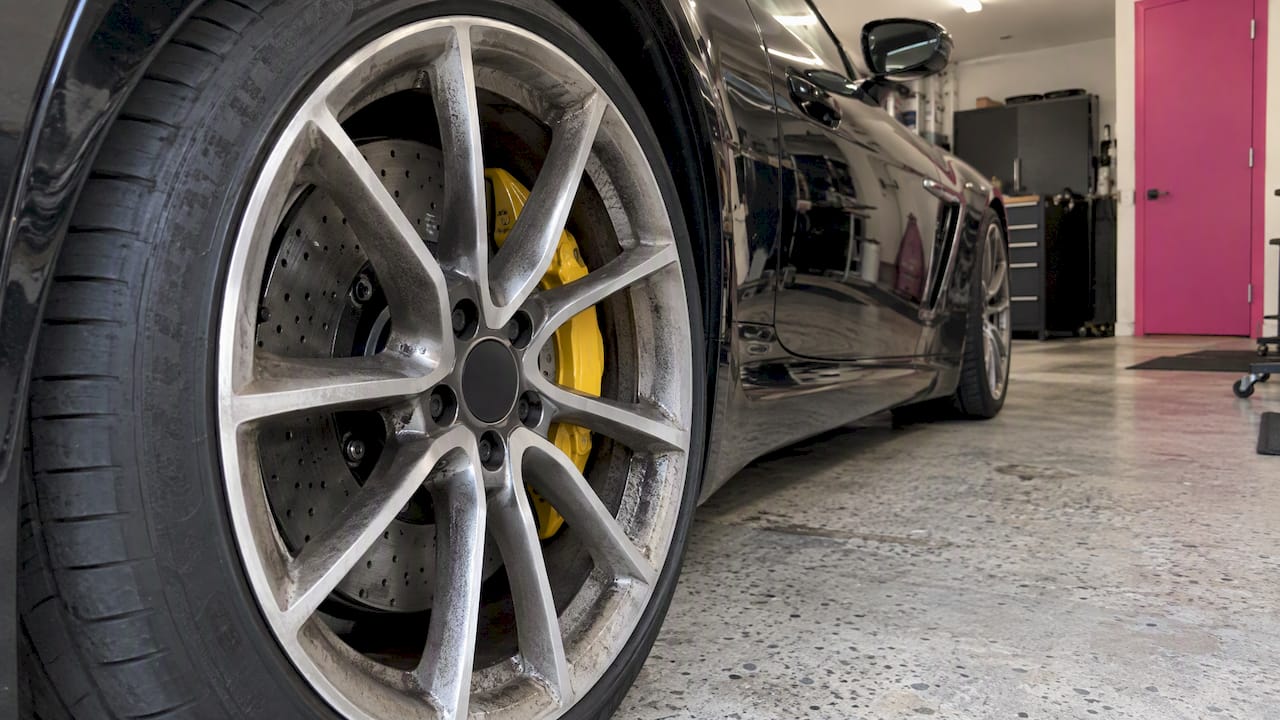
The most reliable wheel brake dust protection is a three-part routine: clean the wheel with a cleaner made for its exact finish, apply a barrier (a wheel sealant or a professionally applied ceramic coating), and keep washing on a regular schedule. The barrier does not stop brake dust from forming. It makes the dust harder to bond to the wheel and easier to rinse off. On luxury and exotic cars, where wheels can be polished, matte, forged or clear-coated, choosing the right method for the finish matters more than choosing the strongest product.
TL;DR
- Brake dust is made of pad material and iron worn from the rotors, and left on the wheel it can stain and etch the finish.
- A sealant or ceramic coating gives the wheel a protective layer so dust sticks less and rinses off more easily.
- Never use a cleaner or coating without confirming the wheel finish first: a cleaner safe for one finish can permanently damage another.
- Wash wheels regularly, with dedicated tools, before you wash the paint.
- On high-value wheels, professional prep and application is the safer route.
Table of Contents
- What brake dust is and why it stains wheels
- Step one: identify your wheel finish
- Step two: remove brake dust without damaging the finish
- Step three: add a barrier that keeps dust from bonding
- Perspective: why we coat wheels as part of a full protection plan
- How often to wash and reapply
- Do-it-yourself or professional application?
- Protect your wheels in Fort Lauderdale
- FAQ
- Sources
What brake dust is and why it stains wheels
Every time you brake, the pads press against the rotors. That friction wears away a small amount of both. Bendix explains that brake dust comes from the pad friction material and from iron shed by the rotors, and that the heat and friction create fine particles that settle on the wheel. Because the metallic dust is corrosive, leaving it in place can etch alloy finishes.
That is the difference between a dirty wheel and a damaged one. Fresh dust sits on the surface and rinses away. Dust that has been baked on by heat and left for weeks bonds to the finish, and the staining you see (brown or black film, rust-colored specks) can turn into pitting. A detailing guide from Sensible Driver makes the same point: untreated brake dust can corrode protective coatings and stain or pit wheels.
If you want a deeper look at how metallic particles behave once they land on hot, wet surfaces, the explanation of why brake rotors rust after rain covers the rotor side of the same problem.

Why some cars throw more dust than others
The amount of visible dust is not the same on every car. PowerStop notes that frequent braking, stop-and-go driving, driving style, road conditions and brake-pad composition all affect how much dust is produced, and that ceramic pads generally produce less visible dust than metallic or semi-metallic pads.
This is relevant in Fort Lauderdale, where traffic on Federal Highway, A1A and the I-95 corridor means a lot of low-speed braking. Performance cars with high-friction pads and large rotors tend to leave the heaviest film on their wheels, which is why Ferrari, Lamborghini and Bentley owners often see it first.
When heavy dust is a warning sign
A wheel that turns dark again within a day or two can mean more than a dirty finish. Bendix says excessive brake dust could indicate a brake-system issue, such as brake drag caused by sticking calipers or sliding pins. If one wheel is far dirtier than the others, have a brake technician inspect it. Coating a wheel will not fix a mechanical cause.
Step one: identify your wheel finish
Before you choose any cleaner, wax, sealant or coating, identify what is on the wheel. AAA’s detailing guide says wheel finishes vary (painted, polished, chromed, machined, anodized, powder-coated or clear-coated) and that a cleaner suitable for one finish can permanently damage another. Its advice is to read the product label, consult the vehicle manual, and test the product in a concealed area first.
This is the step most owners skip, and it is the one that causes the costly mistakes. Consider the common finishes on a luxury vehicle:
| Finish | What to watch for |
|---|---|
| Clear-coated or painted alloy | Most common on factory wheels. Harsh cleaners can dull or cloud the clear coat. |
| Polished or machined | Easily stained and scratched. Avoid abrasives. |
| Chrome | Needs a chrome-safe polish. Sensible Driver notes chrome wheels require a chrome polish. |
| Powder-coated | Durable, but still sensitive to strongly acidic or alkaline cleaners. |
| Matte or satin | Sheen can be ruined by polishing or glossy sealants. See our guide to matte wheel protection. |
| Forged or carbon | Often custom finishes. Confirm with the manufacturer before using any chemical. |
If you are not sure what the finish is, ask the wheel manufacturer or a professional before you apply anything.
Step two: remove brake dust without damaging the finish
Protection only works on a clean surface. A sealant or coating applied over bonded dust simply locks the contamination in. Cleaning comes first, and it has to be done gently.
Use the right cleaner and the right tools
Consumer Reports says built-up brake dust may need a special cleaner selected for the wheel type, or one labeled safe for all wheels, and recommends a separate sponge for wheels so abrasive dirt is not carried onto the paint. In a separate guide it warns that a strong cleaner intended for one wheel type can damage another finish.

AAA gives the same order of work: clean wheels first, with dedicated tools, so that grit and cleaning chemicals are not splashed onto freshly washed paint.
A safe cleaning sequence
- Work on a cool wheel, one at a time. Hot rotors and wheels flash-dry cleaners and can leave marks. Hagerty’s interview with an Autoglym expert advises doing one wheel at a time, and notes that some dedicated wheel cleaners can be corrosive.
- Rinse off loose contamination. AutoZone’s guide starts with a rinse to remove loose dirt before any chemical touches the wheel.
- Apply the cleaner for the dwell time on the label. Hagerty’s source suggests spraying from the bottom up. AutoZone warns that leaving cleaner on too long can damage wheels, because cleaners may be strongly acidic or alkaline.
- Agitate lightly with a soft brush. Sensible Driver advises avoiding stiff brushes, aggressive pads and steel wool, which can permanently scratch wheels.
- Rinse thoroughly and dry with dedicated microfiber. Do not reuse the wheel towel on paint.
- Treat what remains. If contamination is still present, AutoZone suggests a second treatment or gentle clay-bar use. Our explanation of paint decontamination describes the same principle for painted surfaces.
If you see rough, pitted texture that does not wipe away, the dust has already done damage. Our wheel pitting repair guide explains how to judge whether the wheel needs more than cleaning.
Step three: add a barrier that keeps dust from bonding
Once the wheel is clean and dry, a barrier is what turns brake dust protection from occasional rescue into routine upkeep. The principle is simple: a smooth, slick, heat-resistant layer gives dust less to grip. The three options owners most often consider are wax or polish, sealants and ceramic coatings.
Wax or polish
AAA recommends a finish-compatible polish or wax to maintain appearance and help keep brake dust from adhering. Sensible Driver suggests a wheel-specific spray wax or hand wax after cleaning and rinsing. The key phrase is wheel-specific. Wheels run far hotter than paint, so a product designed for body panels may not hold up.
Wheel sealants
A wheel sealant is a synthetic, heat-resistant layer. It is easy to apply and forgiving if you make a mistake, but it is a short-term layer that has to be reapplied on a regular schedule. It suits owners who like to maintain their own wheels and do not mind the routine.
Ceramic coatings
A ceramic wheel coating bonds to the surface and builds a harder, more chemical-resistant layer than a sealant. PowerStop lists a ceramic wheel coating or sealant among its recommendations for reducing the effect of brake dust. In our experience, the benefits owners notice are that dust rinses off with far less effort and the finish keeps its depth between washes. The trade-off is that a coating depends on preparation: the wheel must be decontaminated and, where appropriate, corrected before the coating goes on, because it will lock in whatever is underneath. That is why we treat wheel coating as a prep-first service, and why the steps to prepare a car for coating apply to wheels as much as to paint.
Comparing the options
| Wax or polish | Sealant | Ceramic coating | |
|---|---|---|---|
| Application | Simple, by hand | Simple, forgiving | Needs careful prep and skill |
| Protection period | Shortest | Short to moderate | Longest |
| Reapplication | Frequent | Regular | Less frequent |
| Best for | Quick refresh between washes | Owners who maintain wheels often | Owners who want lasting, low-effort protection |
The exact durability of any product depends on the formula, the wheel, the climate and how you drive and wash, so follow the maker’s instructions and ask the installer what their specific coating is rated for.
What about brake dust shields?
Dust shields are thin metal plates positioned behind the rotor. According to one automotive explainer, they are normally steel or aluminum and are meant to catch debris before it reaches the rim. They are a factory component, and whether to modify or remove them is a question for your brake technician, not a detailing decision. They do not replace a clean, protected wheel surface.
Perspective: why we coat wheels as part of a full protection plan
Most of the wheels we see damaged by brake dust were not neglected out of carelessness. They were cleaned with the wrong product, or protected with something that was never meant to handle brake heat.
Our approach is quality-first and tailored to the vehicle. On a luxury or exotic car, we begin by identifying the wheel finish, because a polished, matte, forged or clear-coated wheel each needs a different process. Then we decontaminate, inspect for pitting, and only then apply protection. The result is a surface that is designed to shed dust and clean easily, so the owner is not scrubbing a wheel that cost thousands of dollars.
We think of this as asset protection, not just detailing. The wheels, the paint and the glass work together to give the car its look, and protecting them as one system is how a vehicle holds its appearance over time.
Emmanuel
How often to wash and reapply
How often you clean matters as much as what you apply. A practical schedule for most owners:
- Ordinary driving: rinse or wash wheels every one to two weeks. MAPerformance suggests this interval, with more frequent washing for heavy traffic, winter road salt or unpaved roads.
- Salt exposure: Consumer Reports recommends a monthly wash during snow season, or more often when the vehicle is coated in salt. If you drive north in winter, or take your car through coastal spray, wash wheels sooner.
- Sealants and waxes: reapply on the maker’s schedule, typically every few months depending on driving and washing frequency.
- Ceramic coatings: need less frequent reapplication, but still need maintenance washes and periodic inspection.
With a coating, switch to a pH-neutral wash soap and clean mitts, and avoid harsh or abrasive wheel products. Consistent gentle washing is what lets any protection last. Our exterior detailing essentials guide covers the wider wash routine, and the 12 signs your car needs detailing will help you spot when wheels or paint are overdue for attention.
Reduce the dust at the source
Protection and washing manage the dust, but driving and maintenance reduce how much there is. PowerStop recommends smooth, anticipatory braking, keeping brake components maintained and regularly cleaning wheels with a brake-dust-specific cleaner. If you are replacing pads anyway, ask your brake shop about low-dust ceramic pad options that are approved for your vehicle. Do not change pad type on a performance or exotic car without the manufacturer’s guidance.
Do-it-yourself or professional application?
For a daily driver with a simple clear-coated wheel, a good cleaner and a wheel sealant are a reasonable routine. For luxury, exotic and high-value vehicles, we recommend professional work for three reasons:
- Finish identification. Custom, forged, matte and specialty-coated wheels are easy to damage with the wrong chemistry.
- Prep quality. A coating is only as good as the surface beneath it. Pitting, bonded iron and old residues need to be addressed first.
- Consistency. Applying a coating evenly in the barrel and around the spokes, where heat is highest, takes time and experience.
Our auto detailing services for luxury and exotic vehicles are built around that process, and we work on a quality-first basis rather than by volume, so each vehicle gets a plan tailored to its finish.
Protect your wheels in Fort Lauderdale
If you own a Bentley, Rolls-Royce, Lamborghini, Ferrari or another high-value vehicle in South Florida, we can assess your wheel finish, decontaminate it, and apply protection designed to keep brake dust from bonding. Wheels are often coated alongside paint so the whole car is protected on one plan. See our ceramic coating packages in Fort Lauderdale or contact us through Manny’s Ceramic Pro Touch to request a quote for your vehicle.

Pricing varies by vehicle and package, so we quote each job individually after seeing the wheels.
FAQ
What can I put on my rims to keep brake dust off?
A wheel-specific wax, a heat-resistant wheel sealant or a ceramic wheel coating. All three create a smooth barrier that makes dust harder to bond and easier to rinse away. Apply them only to a clean, decontaminated wheel and confirm the product is compatible with your wheel finish.
Why do my wheels stain even though I wash them?
Brake dust bonds when heat bakes it onto the surface, and washing with a general car shampoo may not lift it. A cleaner made for your wheel type, a soft brush and a protective layer help. If one wheel stains much faster than the others, have the brakes inspected for a sticking caliper or slide pin.
Is ceramic coating worth it for wheels?
For many luxury owners, yes, because it reduces the effort of keeping wheels clean and helps shield the finish from corrosive dust. It does depend on proper preparation and application, so it is best done by a professional who identifies the finish first.
Can I use a homemade brake dust cleaner?
We advise against it. Household acids and strong alkaline mixes can damage clear coats, polished aluminum and chrome. Use a cleaner labeled for your wheel finish and follow its dwell time and rinse instructions.
Sources
- What causes brake dust and how to reduce it, Bendix
- What Causes Brake Dust and How Do You Clean and Prevent It, PowerStop
- A Detailer’s Guide To Creating Hot-looking Wheels, Sensible Driver
- Car cleaning and detailing guide, AAA
- Expert Detailing Secrets for a Cleaner Car, Consumer Reports
- How to Wash Your Car Like a Pro, Consumer Reports
- How Often Should You Wash Road Salt Off Your Car, Consumer Reports
- 11 Detailing Tips from an Autoglym Expert, Hagerty Media
- How to Remove Brake Dust from Wheel Rims, AutoZone
- How do I protect my wheel finish from brake dust and road grime, MAPerformance
- Do We Really Need Brake Dust Shields, CarFromJapan