

TL;DR:
- A residue free finish means a vehicle surface has no leftover films, surfactants, oils, or wax after cleaning. It is essential for long-term protection, as residual films attract dirt, dull the paint, and hinder coatings’ performance. Proper inspection using staged light and IPA wipe-down confirms the surface is thoroughly cleaned before applying protective coatings.
A residue free finish is defined as a vehicle surface that contains zero leftover films, surfactants, oils, or wax after cleaning. The industry term for this standard is a “clean finish,” and it represents the baseline requirement for any professional automotive detailing process. Car owners who skip this standard end up with surfaces that look clean but actively attract new dirt, dull the clear coat, and require more aggressive correction later. Understanding what causes residue, how to test for it, and how to prevent it is the foundation of long-term vehicle surface protection.
What is residue free finish and why does it matter?
A residue free finish means the surface carries no chemical trace after cleaning. No soap film. No wax haze. No silicone sheen. Residue is a thin film of soap, surfactants, or mineral deposits left behind after cleaning that attracts grime and causes dullness. That definition matters because most car owners assume a surface looks clean if it looks shiny. The two are not the same.
Persistent dullness after washing is almost never a product failure. It is a leftover surfactant film that continues to attract airborne grime and fine dust. The visual result is a finish that looks flat within days of washing, regardless of how much effort went into the process. For vehicles with ceramic coatings or paint protection film, residue sitting on top of the protective layer blocks the coating from performing at full capacity.
The difference between a clean finish and a residue finish shows up clearly under direct light. A truly clean surface reflects light uniformly with no streaks, haze, or linear marks. A residue surface scatters light unevenly and often shows swirl-like patterns that were not there before washing. Recognizing this difference is the first skill any serious car owner needs to develop.
What causes residue during vehicle cleaning?
Residue forms when cleaning chemistry is not fully removed from the surface. The most common cause is over-application of cleaners by two to three times the recommended dilution, which leaves a concentrated film that water alone cannot rinse away. That film dries on the surface and bonds lightly to the clear coat, creating the haze that most owners mistake for water spots.
The main sources of residue on vehicle surfaces include:
- Soap and shampoo films: Car wash soaps contain surfactants that must be fully rinsed. Any remaining surfactant dries into a thin, sticky layer.
- Wax and silicone-based shine products: Wax and silicone additives create temporary gloss but coat the surface with a film that attracts dust and requires harsher chemicals to remove later.
- Polish and compound residue: Polishing compounds leave behind micro-particles and carrier oils that must be wiped away before any coating or inspection.
- Hard water mineral deposits: Tap water used for rinsing leaves calcium and magnesium deposits as it evaporates, especially in South Florida’s climate.
- Incorrect product selection: Using a pH-inappropriate cleaner for the surface type can leave reactive residue. A pH-appropriate cleaner formulated for automotive clear coats prevents this entirely.
Pro Tip: Always check the dilution ratio on your car shampoo label before mixing. Using a foam cannon or bucket wash at the correct ratio is the single fastest way to cut residue risk in half.
Residue accumulation compounds over time. Each wash that leaves a partial film adds another layer. After several cycles, the buildup requires a dedicated decontamination step, including clay bar treatment or chemical decontamination, to restore the surface to a true clean finish.
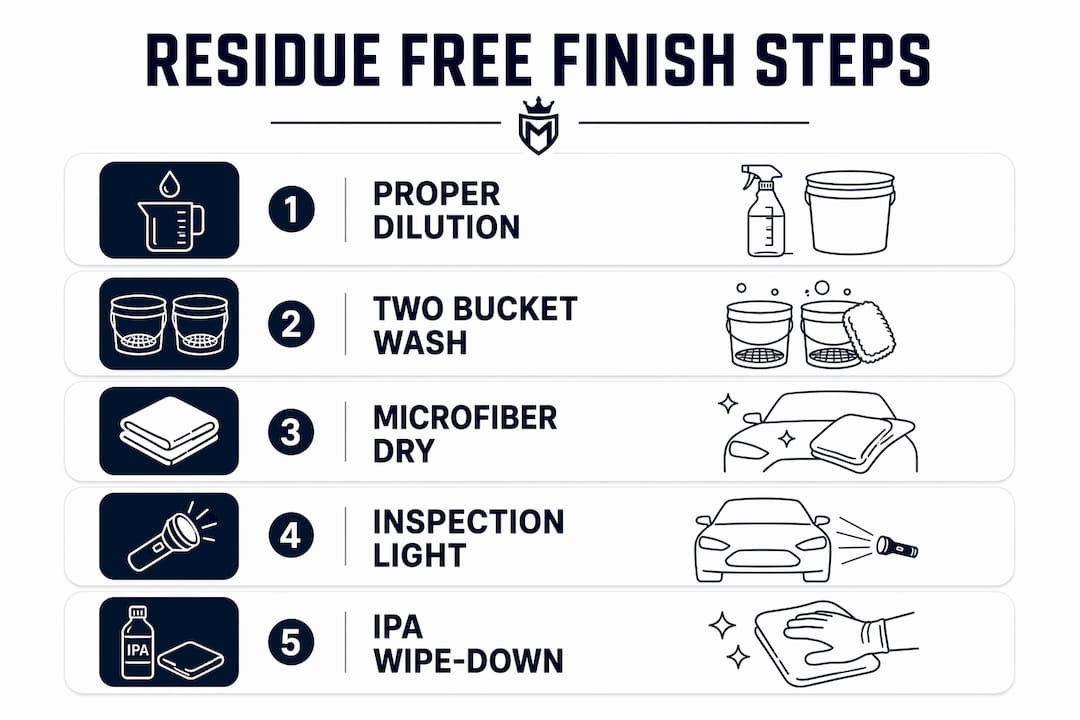
How to test and verify a truly residue free automotive finish
Verification is where most detailers cut corners, and where most residue goes undetected. A proper inspection requires more than a glance in sunlight. Residue detection requires staged wipe-downs, varied lighting angles, and timing to detect solvent outgassing effects that can temporarily mask leftover films.
Follow this staged verification process:
- Initial wipe-down pass: Use a clean microfiber cloth dampened with an IPA solution at 10–25% concentration in distilled water. Work in small sections, folding the cloth after each pass to expose a clean face.
- Wait for outgassing: Allow 10–15 minutes after the IPA wipe before final inspection. Solvents can temporarily hide residue by dissolving it briefly. Waiting lets any remaining film reappear as the solvent evaporates.
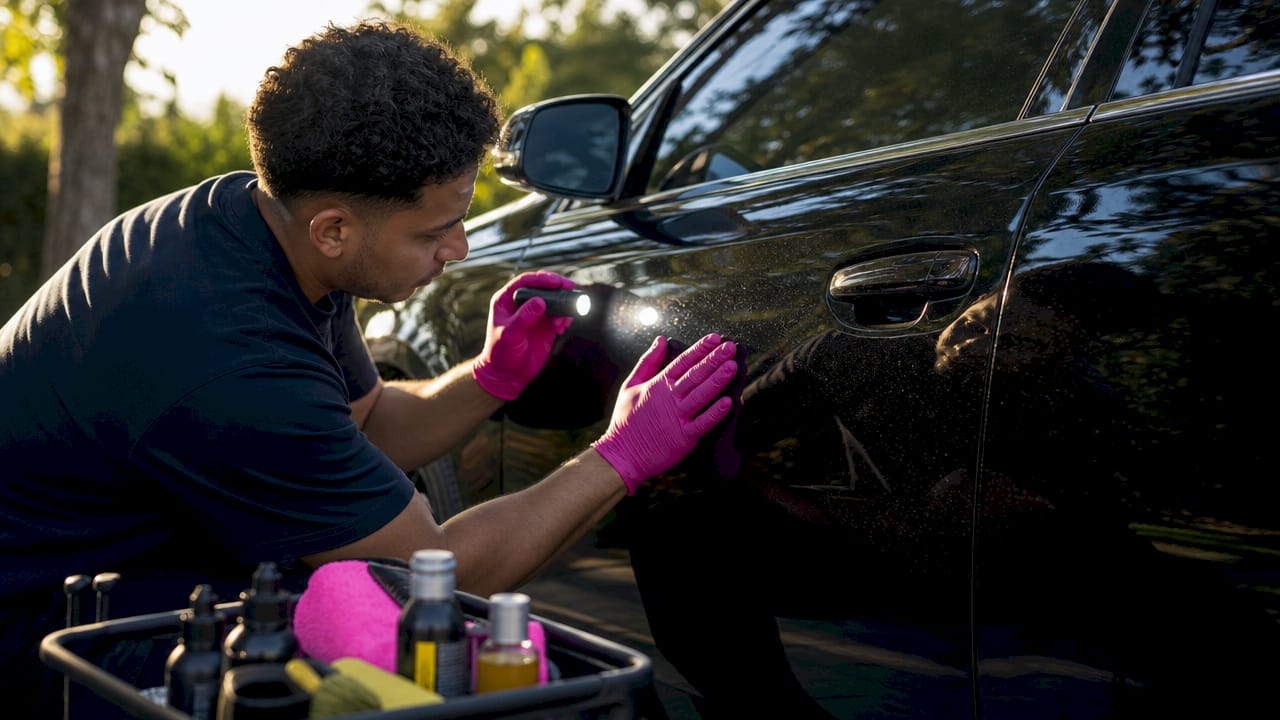
- Primary light inspection: Use a high-CRI penlight at 15–30 degrees to the surface. This raking angle catches linear streaks and haze that overhead light misses entirely.
- Secondary overhead inspection: Check under diffused overhead light to identify any remaining film or uneven reflectivity across panels.
- Verification wipe pass: Run a dry, clean microfiber cloth across the inspected area. If the cloth picks up any color, oil, or residue, the surface is not clean.
Pro Tip: Keep a dedicated inspection penlight in your detailing kit. A high-CRI light (95+ CRI rating) reveals residue that standard flashlights and shop lighting completely miss.
| Inspection Method | Tool Required | What It Detects |
|---|---|---|
| Raking penlight at 15–30 degrees | High-CRI penlight | Linear streaks, haze, polish residue |
| Diffused overhead light | Shop light or natural shade | Broad film, uneven reflectivity |
| IPA wipe-down | 10–25% IPA in distilled water | Oils, surfactants, compound carriers |
| Dry microfiber verification pass | Clean, dry microfiber cloth | Any remaining surface contamination |
IPA wipe-downs work best at 10–25% concentration in distilled water. Higher concentrations flash off too quickly, causing temporary surface swelling and uneven chilling that can distort the inspection result.
Best practices for achieving a residue free finish on vehicles
Achieving a finish without leftover residue is a process, not a single step. Proper chemical dilution and rinsing are the two most critical variables. Every other technique builds on getting those two right. Mannyceramicprotouch applies these standards to every vehicle before any coating or protection work begins, because a contaminated surface will compromise even the highest-grade ceramic coating or paint protection film.
The core practices that produce a clean finish every time:
- Correct dilution ratios: Follow the manufacturer’s dilution specification exactly. Doubling the soap concentration does not double the cleaning power. It doubles the residue risk.
- Two-bucket rinse system: Use one bucket for clean rinse water and one for the wash solution. The two-bucket method prevents cross-contamination and keeps the rinse water free of surfactant buildup that would redeposit onto the paint.
- Final microfiber buff: Dry, clean microfiber cloths remove suspended oils and surfactants that a water rinse leaves behind. This step is not optional for a true residue free surface.
- Avoid silicone-based dressings on painted surfaces: These products create a temporary shine but leave a film that bonds to the clear coat and is difficult to remove without a dedicated solvent.
- Use distilled or deionized water for final rinse: Tap water introduces mineral content that deposits on the surface as it evaporates. Distilled water eliminates this variable entirely.
| Approach | Residue Risk | Long-Term Result |
|---|---|---|
| Correct dilution + two-bucket + microfiber dry | Very low | Clean finish, coating-ready surface |
| Correct dilution + single bucket + air dry | Moderate | Mineral deposits, partial surfactant film |
| Over-diluted soap + single bucket + air dry | High | Visible haze, accelerated dirt attraction |
| Silicone shine product applied over wash | Very high | Layered film buildup, requires decontamination |
Pro Tip: Before applying any ceramic coating or paint protection film, always perform a surface preparation check using the IPA wipe method. Any color transfer to the cloth means the surface is not ready.
Proper car prep for coating follows this same sequence. The surface must be chemically clean before any protective layer bonds correctly. Skipping residue removal at this stage results in coating failure, adhesion loss, and premature delamination.
What are the real benefits of a residue free finish?
A residue free surface stays cleaner longer. Surfaces cleaned without residue have no leftover films to attract new dirt, which reduces cleaning frequency and lowers the risk of surface damage from repeated washing. For car owners who invest in ceramic coatings or paint protection film, this benefit compounds significantly over time.
“Persistent dullness after cleaning is usually caused by leftover surfactant films that attract grime, not by the cleaning product failing.”
The practical benefits of maintaining a residue free finish include:
- Deeper, more uniform gloss: Without a film layer scattering light, the clear coat reflects with full depth and clarity.
- Reduced dust and fingerprint attraction: Clean surfaces carry no static-attracting residue, so they stay visibly cleaner between washes.
- Extended coating performance: Ceramic coatings and liquid PPF bond directly to the clear coat. A clean surface allows the coating to perform at its rated hydrophobic and UV-resistant capacity.
- Less aggressive maintenance: Residue-free care reduces the need for clay bar decontamination, chemical stripping, and paint correction cycles. Each of those processes carries a small risk of surface marring.
- Paint preservation: Avoiding residue accumulation protects the clear coat from chemical stress, which extends the life of the paint and maintains resale value.
The connection between clean finishes and long-term surface value is direct. Every layer of residue left on a vehicle is a layer of chemical stress that the clear coat absorbs over time.
Key Takeaways
A residue free finish is the non-negotiable baseline for any vehicle protection process, requiring correct dilution, two-bucket rinsing, microfiber drying, and staged lighting inspection before any coating is applied.
| Point | Details |
|---|---|
| Definition of residue free finish | A surface with zero leftover films, surfactants, oils, or wax after cleaning. |
| Primary cause of residue | Over-application of cleaners and silicone-based products that bond to the clear coat. |
| Verification method | Use a high-CRI penlight at 15–30 degrees and IPA wipe-down at 10–25% concentration. |
| Best practice process | Two-bucket rinse system plus dry microfiber buff eliminates surfactant and oil residue. |
| Core benefit | Residue free surfaces stay cleaner longer and allow coatings to perform at full capacity. |
Why I think most detailers underestimate the residue problem
After years of working on luxury and exotic vehicles at Mannyceramicprotouch, the single most common issue I see is not bad products. It is residue from good products applied incorrectly. Car owners spend serious money on premium ceramic coatings and then apply them over a surface that still carries polish oils or surfactant films. The coating bonds to the residue, not the paint. That is why some coatings fail within months when they should last years.
The other misconception I encounter constantly is that a shiny surface is a clean surface. Silicone-based dressings and spray waxes are specifically engineered to look good immediately. They are not engineered for long-term cleanliness. The gloss fades within weeks, and the residue they leave behind requires a full decontamination cycle to remove properly.
My honest recommendation: treat residue removal as a separate, dedicated step in your detailing process. Not a byproduct of washing. Not something that happens automatically when you rinse. A deliberate, staged process with proper lighting and verification. The vehicles that hold their finish the longest are the ones where this step is never skipped.
— Emmanuel
Professional paint protection that starts with a clean surface
Mannyceramicprotouch builds every paint protection service on a verified residue free surface. No coating goes down until the IPA wipe-down confirms zero contamination. That standard is what separates a coating that lasts from one that fails early.
For car owners in South Florida who want lasting protection, Mannyceramicprotouch offers paint protection film services and liquid PPF solutions engineered for luxury and high-value vehicles. Every service includes full surface decontamination, residue verification, and a coating application process built for long-term results. Schedule a consultation to find out which protection option fits your vehicle and your goals.
FAQ
What is a residue free finish in automotive care?
A residue free finish is a vehicle surface that contains no leftover soap films, surfactants, oils, wax, or mineral deposits after cleaning. It is the required baseline before applying any ceramic coating or paint protection film.
How do I know if my car has residue on the surface?
Inspect the surface with a high-CRI penlight held at 15–30 degrees to the panel. Linear streaks, haze, or uneven reflectivity indicate residue. A dry microfiber cloth that picks up color or oil confirms contamination.
What products cause the most residue on car paint?
Silicone-based shine sprays and wax dressings are the most common sources of stubborn residue. Over-diluted car shampoos and tap water used for final rinsing also leave mineral deposits that accumulate over time.
Is a residue free finish safe for all vehicle surfaces?
A properly executed residue free finish using pH-appropriate cleaners and IPA at 10–25% concentration is safe for automotive clear coats, paint protection film, and ceramic coatings. Higher IPA concentrations can cause temporary surface swelling and should be avoided.
How often should I verify a residue free surface?
Verify after every wash before applying any product, and always before coating application. For maintained vehicles with ceramic coatings, a monthly IPA wipe-down inspection keeps the surface performing at full capacity.
Recommended
- The Role of Factory Finish Preservation for Car Owners – Many Ceramic Pro Touch
- Gloss Retention Explained for Vehicle Owners – Many Ceramic Pro Touch
- What Is Paint Decontamination? A Car Owner’s Guide – Many Ceramic Pro Touch
- What Is Chemical Resistance for Cars: A Full Guide – Many Ceramic Pro Touch