

TL;DR:
- Proper luxury car drying involves a top-to-bottom, shade-based workflow that combines blower, microfiber towels, and drying aids to prevent water spots and swirl marks. Using separate towels for bulk removal and finishing, along with careful tool maintenance, ensures high-quality results and protects delicate finishes. Rushing or improper techniques increase the risk of damage, making patience and discipline essential for professional-level drying.
Luxury car drying techniques are specialized procedures designed to remove water from high-end vehicle surfaces without causing scratches, water spots, or paint marring. The standard industry term for this practice is controlled contact drying, and it covers everything from tool selection to environmental timing. Done wrong, a single drying session can leave swirl marks on a Porsche 911’s clear coat or mineral deposits on a matte-finish Lamborghini. Done right, it preserves the depth and refinement your vehicle demands. This guide covers the tools, workflow, and precautions that separate professional results from costly mistakes.
What are the best luxury car drying techniques?
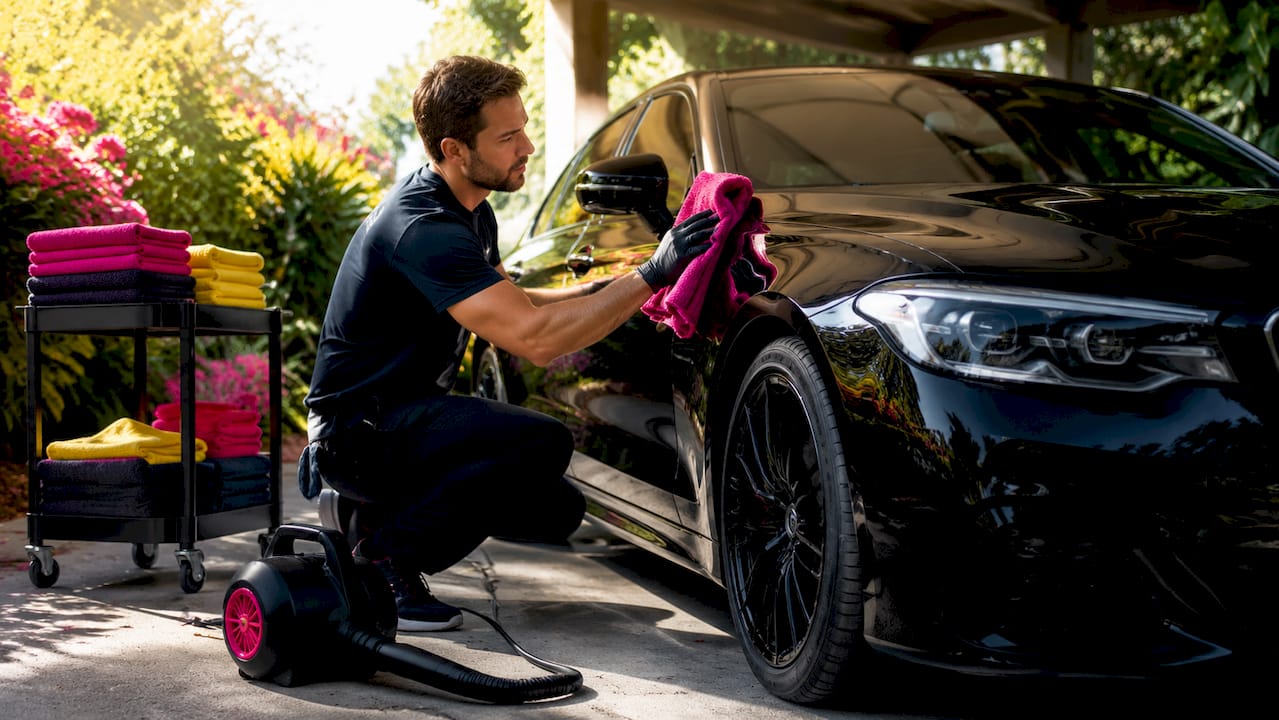
The most effective luxury car drying techniques combine the right tools, the right environment, and a disciplined sequence. No single method works alone. Professionals at high-end detailing studios use a layered approach: a vehicle blower to remove bulk water, quality microfiber towels for surface contact, and a drying aid to lubricate and protect the finish during the final pass.
Drying in direct sunlight accelerates evaporation and leaves mineral deposits before a towel can lift the water cleanly. This is especially damaging on dark paint, where water spots are visible within minutes. Always work in shade or during cooler parts of the day, such as early morning or late afternoon.
Three named entities define the professional toolkit: waffle-weave or twisted-loop microfiber towels in the 300–400 GSM range, a dedicated vehicle blower such as the Metro Master Blaster or Tornador Black, and a spray drying aid like CarPro Reload or Gyeon Cure. Each plays a distinct role in the workflow.
Choosing the right drying towels
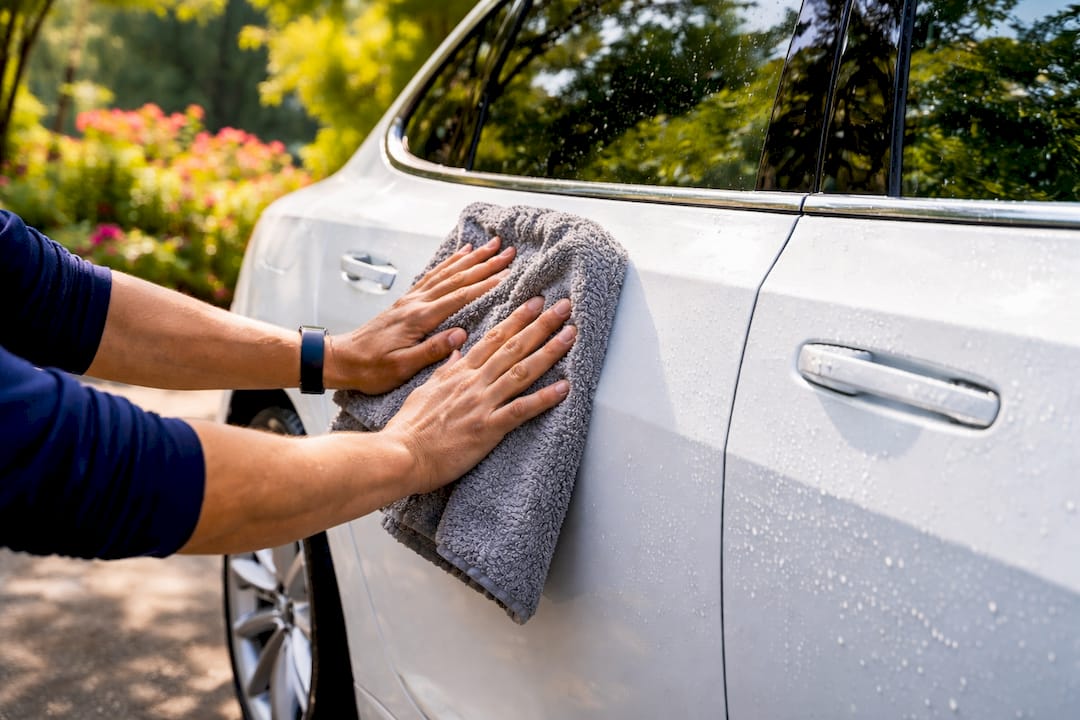
Microfiber towels in the 300–400 GSM range trap water inside their fibers rather than pushing it across the paint surface. That distinction matters because dragging water across clear coat is exactly how swirl marks form. Waffle-weave designs excel at bulk water absorption, while twisted-loop towels are better suited for finishing passes on delicate surfaces.
Towel maintenance is non-negotiable. Wash microfiber in cold water without fabric softener to preserve absorbency and fiber structure. Fabric softener coats the fibers and destroys their ability to absorb water, turning a premium towel into an abrasive rag.
Essential tools at a glance
| Tool | Type | Primary Purpose |
|---|---|---|
| Waffle-weave microfiber | 300–400 GSM towel | Bulk water absorption |
| Twisted-loop microfiber | Finishing towel | Final surface pass |
| Vehicle blower | Air dryer | Hard-to-reach areas, trim gaps |
| Drying aid spray | Lubricant and gloss enhancer | Reduces friction during towel contact |
| Automotive squeegee | Glass tool | Water sheeting on windows |
Pro Tip: Keep two separate towel sets per session: one for bulk removal and one for finishing passes. Mixing them transfers mineral-laden water back onto already-dried panels.
How to execute the drying workflow step by step
A methodical workflow starting with glass first lowers the risk of water marking luxury finishes during drying. The logic is simple: glass dries fast and drips onto paint. Handle it first, and you eliminate one source of contamination before it becomes a problem.
The recommended sequence for any high-end car drying workflow follows this order:
- Pre-rinse sheet: After the final wash rinse, remove the spray nozzle and flood water across panels at low pressure. This sheeting method uses physics to pull water off large flat surfaces, leaving only a thin film for towel contact. Less water on the panel means less towel work and less risk of micro-marring.
- Blower pass: Run a vehicle blower across the entire car before touching it with a towel. Using a blower first removes standing water from door jambs, trim gaps, mirror housings, and grille openings. These spots drip onto paint after towel drying if not addressed.
- Glass drying: Use vertical then horizontal strokes on all glass surfaces. A neutral-pH glass spray and an automotive rubber squeegee help sheet remaining water before the final towel pass.
- Bulk towel drying: Starting at the roof and working down, use a waffle-weave microfiber with a pat-and-lift motion. Do not drag or apply pressure. Work in sections no larger than two feet square.
- Drying aid application: Mist a drying aid onto each panel before the finishing towel pass. A drying aid combined with a blower improves gloss and reduces the friction that causes micro-scratches.
- Finishing pass: Use a clean twisted-loop microfiber for the final wipe. This removes any remaining haze and leaves the surface with maximum depth and clarity.
Pro Tip: Fold your drying towel into quarters. Each fold gives you a fresh surface. A single large towel provides eight clean contact faces before it needs to be replaced or flipped.
Why top-to-bottom order matters
Working from the roof down follows gravity. Water from the roof runs onto the hood and doors. If you dry the hood first, the roof will re-contaminate it. Top-to-bottom sequencing eliminates that problem entirely. It also mirrors the professional detailing SOP used by high-end detail shops, where consistency in sequence directly affects the final result.
What mistakes cause water spots and swirl marks?
The most common drying errors on luxury vehicles are drying in direct sun, applying pressure with towels, and using a single towel for the entire car. Each one introduces a different type of damage. Sun causes mineral deposits. Pressure causes micro-marring. A single contaminated towel transfers grit from one panel to another.
Water spots are primarily a timing and environmental issue, not just a materials problem. Rapid evaporation in sunlight leaves mineral deposits before a towel can lift the water cleanly. Slow evaporation in moderate temperatures gives towels time to absorb water fully. That single insight changes how you schedule your wash sessions.
Dark and black painted cars require extra caution. Water spots show immediately on these finishes, and any towel drag is visible as swirl marks under direct light. Ceramic-coated vehicles are more forgiving because water beads and sheets more aggressively, but they still require clean, soft towels and proper sequencing.
Do’s and Don’ts for High-End Car Drying:
- Do dry in shade or during cooler parts of the day
- Do use separate towels for bulk removal and finishing passes
- Do run a blower before any towel contact
- Do apply a drying aid before the finishing towel pass
- Don’t apply downward pressure with a towel
- Don’t use a towel that has touched the ground or a dirty surface
- Don’t skip the blower on trim gaps and door jambs
- Don’t dry a hot panel directly after driving
Pro Tip: If you notice early-stage water spots after drying, address them immediately with a diluted detail spray and a clean microfiber. Waiting allows mineral deposits to bond to the clear coat, making removal significantly harder.
For ceramic-coated vehicles, review the prep steps for coated surfaces to understand how coating chemistry affects water behavior during drying.
Towel drying vs. blower drying vs. drying aids: which is best?
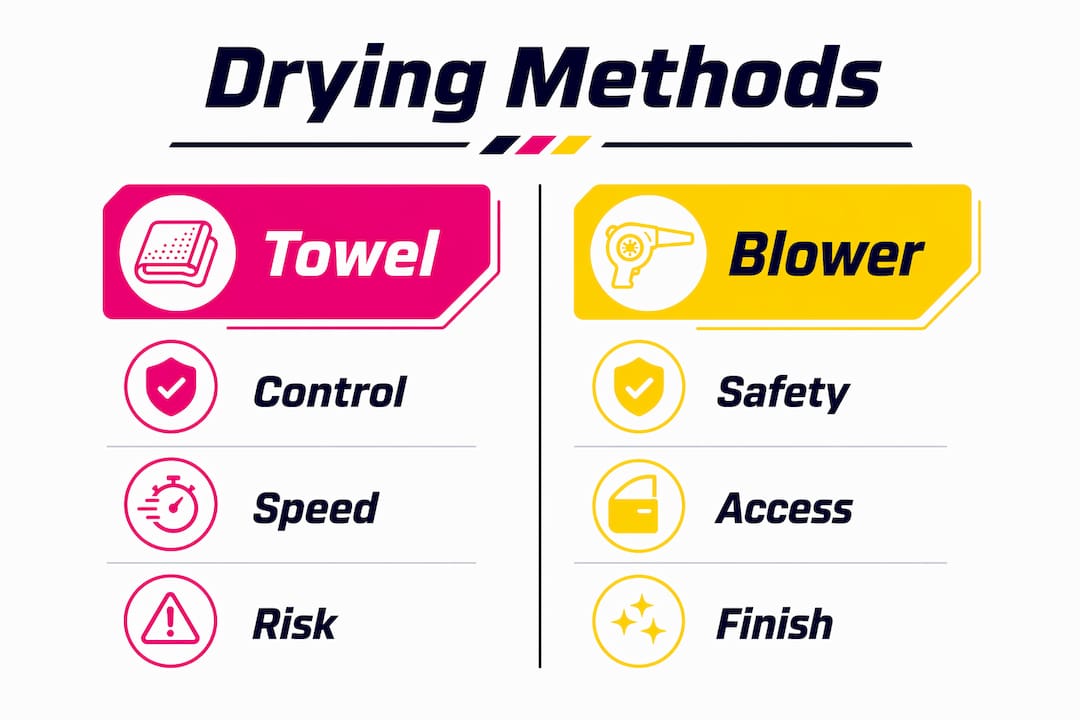
No single method covers every situation on a luxury vehicle. The most effective approach combines all three, with each method assigned to the task it handles best.
| Method | Speed | Finish Quality | Primary Risk | Best Use Case |
|---|---|---|---|---|
| Towel drying | Moderate | High | Micro-marring if mishandled | Large flat panels |
| Blower drying | Fast | High | None (no contact) | Trim gaps, mirrors, jambs |
| Drying aid spray | Slow | Very high | Streaking if over-applied | Final finishing pass |
Towel drying delivers the most control on large panels like hoods, roofs, and doors. The risk is micro-marring, which occurs when a towel drags grit across clear coat. Using a pat-and-lift technique with a clean, high-GSM microfiber eliminates most of that risk.
Blower drying is the safest method because it involves zero surface contact. It excels in areas where towels cannot reach without folding or forcing fabric into tight spaces. The Metro Master Blaster and similar units generate enough airflow to clear water from door jambs and grille openings in seconds.
Drying aids serve a dual purpose. They lubricate the surface during the final towel pass, reducing friction, and they leave behind a thin layer of gloss-enhancing protection. Products like CarPro Reload and Gyeon Cure are formulated specifically for coated and uncoated luxury finishes. Understanding how UV exposure affects your finish helps explain why that final protective layer matters beyond just the drying session itself.
The most reliable approach for effective drying methods on high-end vehicles is to use the blower first, towels second, and drying aid third. That sequence minimizes contact, maximizes coverage, and leaves the finish in the best possible condition.
Key takeaways
Controlled contact drying on luxury vehicles requires the right tools, a shade environment, and a disciplined top-to-bottom sequence to prevent water spots, swirl marks, and paint marring.
| Point | Details |
|---|---|
| Environment controls outcome | Dry in shade or cool conditions to prevent mineral deposits from rapid evaporation. |
| Blower before towel | Run a vehicle blower first to clear trim gaps and door jambs before any towel contact. |
| Separate your towels | Use one towel for bulk removal and a second clean towel for the finishing pass. |
| Drying aid is not optional | Apply a drying aid before the final pass to reduce friction and improve gloss. |
| Sequence matters | Start with glass, work top to bottom, and finish with a drying aid pass for consistent results. |
What i’ve learned drying luxury cars that most guides skip
The advice most guides give is technically correct but practically incomplete. They tell you to use a good microfiber and stay out of the sun. What they don’t tell you is that the biggest variable is patience, not product.
I’ve worked with matte-finish vehicles where a single impatient drag with a drying towel created a visible sheen line across the entire door panel. Matte paint has no clear coat to absorb minor abrasion. Every contact point is permanent. On those cars, I use only a blower and a drying aid mist. No towel contact at all on the painted surfaces.
High-gloss black paint is the opposite challenge. It shows everything: water spots, towel marks, fingerprints. The only way to get a clean result is to work in small sections, replace or flip towels constantly, and never let a panel sit wet for more than 30 seconds after the blower pass.
The detail that separates professionals from enthusiasts is tool maintenance. A premium microfiber towel that has been washed with fabric softener or dried on high heat is worse than a budget towel in good condition. Your tools only perform as well as you maintain them.
Rushing the drying process is the single most common cause of damage I see on luxury vehicles brought in for paint correction. A proper drying session on a full-size sedan takes 20–25 minutes when done correctly. Anyone promising faster results without compromise is cutting corners somewhere.
— Emmanuel
Protect your finish before and after every wash
Proper drying technique preserves your finish in the short term. Long-term protection requires a surface treatment that makes every wash and dry session safer and more forgiving. At Mannyceramicprotouch, ceramic coatings and Liquid PPF create a hydrophobic layer that causes water to bead and sheet aggressively, reducing the amount of towel contact your paint needs after every wash.
For Fort Lauderdale area luxury vehicle owners, Mannyceramicprotouch offers tailored protection strategies built around your specific paint type and usage. Explore the top liquid PPF options available in 2026, or review the full range of ceramic coating packages designed to keep your vehicle at showroom level between details.
FAQ
What is the safest way to dry a luxury car?
The safest method combines a vehicle blower to remove bulk water with a pat-and-lift microfiber technique and a drying aid for the final pass. This approach minimizes surface contact and reduces the risk of swirl marks and water spots.
Why do water spots form even after careful drying?
Water spots form when water evaporates faster than a towel can absorb it, leaving mineral deposits on the paint surface. Drying in direct sunlight or on a hot panel accelerates this process, making shade and cooler temperatures the most effective prevention.
How many microfiber towels do i need per drying session?
Professionals recommend a minimum of three to four towels per session: one or two for bulk water removal, one for the finishing pass, and one dedicated to glass. Separating bulk and finishing towels prevents mineral transfer to already-dried panels.
Does ceramic coating change how you dry a car?
Ceramic-coated vehicles shed water more aggressively due to their hydrophobic properties, which reduces the total towel contact needed. However, the same sequencing rules apply: blower first, clean microfiber second, drying aid third.
Can i use a regular bath towel to dry my luxury car?
A regular bath towel is not safe for luxury paint. Cotton terry cloth lacks the fiber structure to trap water without dragging it across the surface, and it can introduce micro-scratches on clear coat. Waffle-weave or twisted-loop microfiber in the 300–400 GSM range is the correct tool for this task.