

TL;DR:
- Luxury vehicle paint faces constant threats from environmental elements, road debris, and improper maintenance, requiring proactive protection. High-end finishes are more vulnerable to visible damage and difficult to repair, emphasizing the importance of layered protection strategies like PPF and ceramic coatings. Regular inspections and careful habits preserve the vehicle’s appearance, ensuring long-term value and aesthetic integrity.
Luxury vehicle ownership comes with a responsibility that goes far beyond regular maintenance schedules. Most owners assume their paint is only at risk during accidents or parking lot collisions, but the reality is far more complex. Your vehicle’s finish faces constant threats during every drive, every wash, and every hour spent parked in the sun. This guide breaks down exactly how paint damage occurs on high-value vehicles, identifies the everyday scenarios that accelerate deterioration, and outlines the evidence-based protection strategies that genuinely preserve your investment over the long term.
Table of Contents
- What is automotive paint damage?
- The main causes of paint damage
- Hidden threats: Everyday scenarios that damage your paint
- How to protect your luxury car from paint damage
- The truth most luxury car owners miss about paint damage
- Protect your investment with proven paint solutions
- Frequently asked questions
Key Takeaways
| Point | Details |
|---|---|
| Hidden dangers | Everyday driving exposes luxury car paint to frequent, hard-to-spot threats beyond major accidents. |
| Layered vulnerability | Modern automotive paint systems are vulnerable if any single layer is breached, especially by rock chips. |
| Prevention works best | Consistent maintenance and advanced protective solutions are the most effective ways to preserve high-value paint finishes. |
| Professional help matters | Expert consultation and services ensure optimal long-term results, especially for high-end vehicles. |
What is automotive paint damage?
Paint damage on a luxury vehicle isn’t a single event. It’s a process. Understanding that process starts with knowing what automotive paint actually consists of and why each layer matters.
Modern luxury vehicle paint systems are built in multiple layers, each serving a specific purpose:
- Clear coat: The outermost transparent layer that provides gloss and shields the color beneath from UV exposure, chemical contact, and minor abrasion.
- Base coat: The pigmented layer that carries the vehicle’s color. On luxury vehicles, this layer often contains metallic flakes or pearl pigments that give finishes their depth and complexity.
- Primer: Applied directly to the metal substrate, primer promotes adhesion and provides a first line of defense against corrosion.
- Substrate (metal or composite): The structural surface underneath everything. If moisture reaches this layer, rust or corrosion begins.
Damage can occur at any of these layers, and the depth of damage determines the severity of the repair needed. Superficial clear coat scratches can sometimes be polished out. Base coat damage requires professional color matching and respray. Primer and substrate exposure means corrosion risk is already active.
Luxury vehicles are actually more vulnerable to visible paint damage in some respects. Premium finishes with pearl pigments, tri-coat colors, and matte textures are notoriously difficult to touch up without leaving a trace. A minor chip on a standard vehicle might blend after a simple repair. The same chip on a high-end exotic with a custom color can require full panel repaints to achieve a seamless match, at significant cost.
The most common types of paint damage include chips (typically from road debris), scratches (from contact with abrasive surfaces or objects), fading and oxidation (from UV exposure breaking down the clear coat), and peeling (from adhesion failure often caused by moisture intrusion or poor preparation).
The main causes of paint damage
With that foundation, let’s examine the real-world culprits behind paint damage, many of which target luxury vehicles in surprising ways.
1. Road debris impacts
Road debris causes paint chips through high kinetic energy impacts, creating craters in the clear coat and base coat that allow moisture ingress and subsequent rust. This is especially relevant at highway speeds, where even a small pebble carries enough energy to penetrate multiple layers of paint. The kinetic energy formula is straightforward: faster travel multiplies the destructive force of even the smallest stone dramatically.
2. Environmental threats
UV radiation is a slow but relentless adversary. Prolonged sun exposure breaks down the chemical bonds in your clear coat, causing oxidation, fading, and eventually, a chalky, dull appearance. Acid rain deposits sulfuric and nitric acids onto your paint surface. If left to dry, these acids etch into the clear coat and leave permanent marks. Bird droppings are particularly aggressive because they contain uric acid, and their texture can trap additional debris against the finish. Tree sap, pollen, and road grime compound these effects by creating a layer of contamination that holds moisture and chemicals against the paint for extended periods.
For more detailed guidance on preventing environmental paint damage, proactive steps taken early can prevent costly corrections later.
3. Mechanical causes
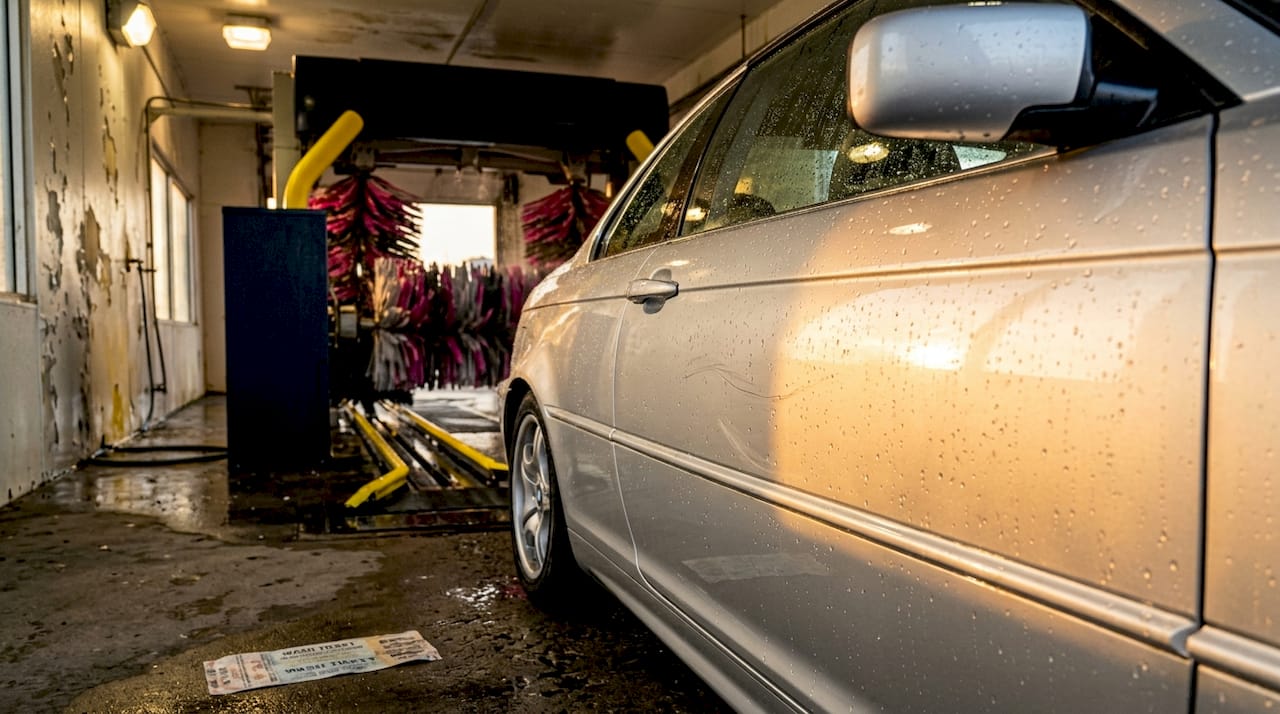
Automatic car washes are one of the most underestimated sources of paint damage. The brushes and cloth strips in these machines accumulate dirt and grit from previous vehicles, essentially dragging abrasive particles across your finish repeatedly. Even touchless systems use high-pressure chemicals that can be too aggressive for premium finishes. Improper hand-washing techniques, including dirty mitts, incorrect products, and the two-bucket method being ignored, cause swirl marks and micro-scratches that accumulate over time.
4. Human causes
Vandalism and careless behavior in parking areas account for a meaningful portion of paint damage claims. Door dings from neighboring vehicles, shopping carts, and deliberately keyed finishes are all real risks. Luxury vehicles, by their nature, attract attention, which unfortunately also includes unwanted contact.
5. Moisture ingress and rust acceleration
A chip that looks minor on the surface is rarely minor underneath. Once the clear coat and base coat are breached, moisture reaches the primer and metal substrate. Rust can establish itself within days in humid environments, spreading laterally beneath the paint and causing bubbling that is far more expensive to correct than the original chip.
“Even a small chip in your paint is a gateway for moisture, and in high-humidity climates, rust can spread faster than most owners expect.” This is why immediate attention to any breach in the paint system is essential for luxury vehicle owners.
Understanding UV coatings for luxury finishes is equally important when building a comprehensive protection strategy.
| Damage cause | Severity risk | Speed of damage | Reversibility |
|---|---|---|---|
| Road debris chips | High | Immediate | Moderate to difficult |
| UV oxidation | Medium to high | Gradual | Limited once advanced |
| Bird droppings/acid rain | High | Hours to days | Possible if caught early |
| Automatic car wash | Low to medium | Cumulative | Polish required |
| Moisture and rust | Critical | Days to weeks | Costly panel work |
Hidden threats: Everyday scenarios that damage your paint
After looking at the main categories, let’s get granular and see how day-to-day life puts your paint at risk even when you’re cautious.
Highway driving
Highway speeds dramatically increase the kinetic energy of airborne debris. Stones strike with force to create small craters, and at 70 mph or higher, even fine sand particles can cause surface abrasion. Drivers following large trucks are at heightened risk, as truck tires eject stones from their treads at high velocity. This is not an occasional risk. For anyone who regularly drives highways in a luxury vehicle, paint impact events are essentially continuous.
Parking near construction or under trees
Construction sites generate airborne concrete dust, metal shavings, and chemical overspray. These particles settle on your vehicle’s surface and bond to the clear coat over time, creating a contamination layer that dulls the finish and, in some cases, causes etching. Parking under trees compounds the issue. Beyond sap and pollen, trees attract birds, and the combination of bird droppings and sap sitting on your finish through a warm afternoon creates significant damage potential.
Hand-washing mistakes on premium finishes
Even conscientious owners make errors during washing. Using household dish soap strips protective waxes and coatings. A single pass with a dirty wash mitt can leave visible scratches on a fresh clear coat. Drying with a standard terry cloth towel instead of a microfiber drying cloth introduces swirl marks. The cumulative effect of these small mistakes over months of regular washing can leave a luxury finish looking aged and dull, well before its time.
Pro Tip: Always use the two-bucket wash method. One bucket contains your soap solution and the other contains clean rinse water. After each panel, rinse your mitt in the clean water bucket before reloading with soap. This simple step prevents transferring grit back onto the paint.
Warm climates and accelerated damage
Owners in Florida and similar warm, humid climates face an amplified version of every threat listed above. UV intensity is higher, humidity accelerates rust progression after chips occur, and frequent rain followed by direct sun creates the ideal conditions for acid rain etching and water spot formation. Understanding UV protection for luxury finishes is particularly critical for owners in these regions, where paint degradation timelines are compressed compared to cooler climates.
Statistic to consider: UV radiation accounts for a significant portion of exterior vehicle degradation in sunbelt states. Vehicles kept in Florida without UV-protective coatings can show measurable clear coat oxidation within two to three years of ownership.
- Avoid parking in direct sunlight for extended periods whenever possible.
- Rinse bird droppings off immediately rather than waiting for a scheduled wash.
- Inspect your paint surface monthly under direct light to catch new chips early.
- Avoid following large trucks closely on highways.
- Use a dedicated car cover if the vehicle is stored outdoors regularly.
How to protect your luxury car from paint damage
Recognizing the risks is only part of the solution. Here are the most reliable strategies to preserve your paint investment.
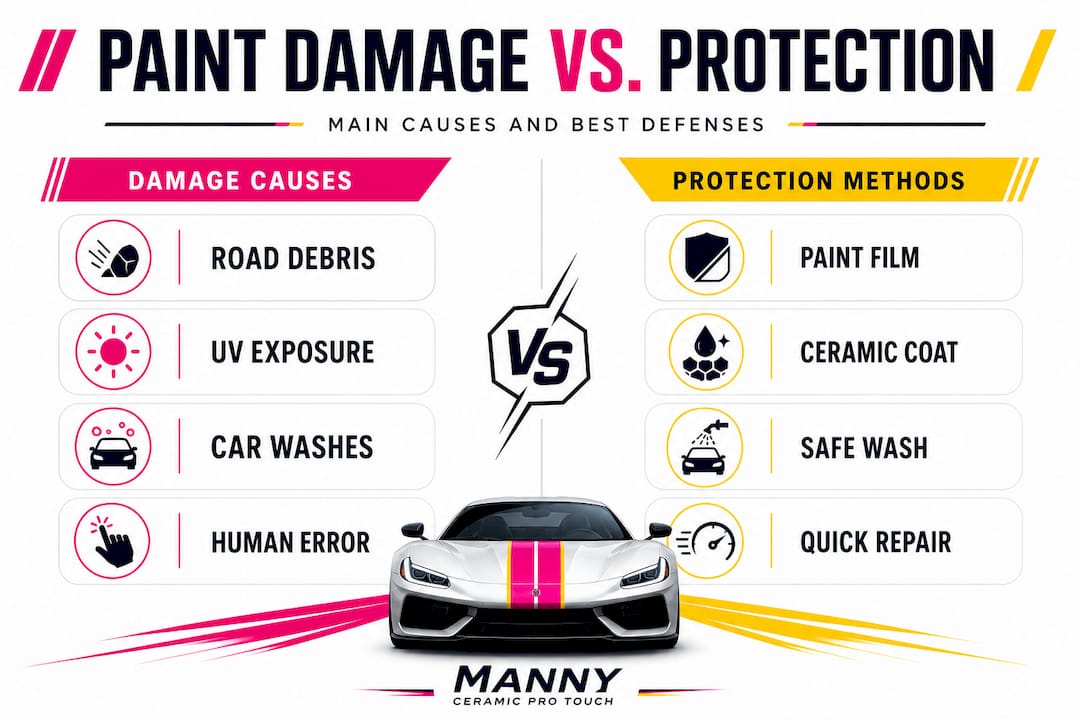
Professional protection solutions
Paint Protection Film (PPF) is widely regarded as the most physically robust paint protection option available. PPF is a thermoplastic urethane film applied to the vehicle’s exterior. It absorbs impacts from road debris, resists scratches, and has self-healing properties that allow minor surface abrasions to disappear with heat exposure. For full coverage, PPF wraps the entire vehicle. Partial coverage options focus on high-impact areas like the hood, front bumper, and side mirrors.
Ceramic coatings bond chemically to the paint surface, creating a hard, hydrophobic layer that repels water, blocks UV radiation, and makes cleaning significantly easier. A quality ceramic coating can last three to seven years with proper maintenance and significantly reduces the adhesion of bird droppings, tree sap, and road grime.
Liquid PPF combines properties of both technologies, offering chemical resistance and some impact absorption in a sprayable application format. This option is particularly suitable for vehicles with complex body lines where traditional film installation is challenging.
Explore paint protection film options for your specific vehicle to understand what level of coverage best matches your driving patterns and risk profile.
Maintenance best practices
- Wash your vehicle every one to two weeks using pH-balanced car wash soap and a quality microfiber mitt.
- Inspect the full exterior surface monthly under bright, direct light to identify new chips or scratches.
- Address paint chips promptly with professional touch-up paint or a professional consultation, rather than waiting.
- Apply a spray detailer or quick detailer after every wash to maintain the slickness of any coating or wax layer.
- Schedule a professional paint decontamination treatment twice per year to remove bonded contamination that regular washing cannot address.
For vehicles with existing surface marks, fixing micro scratches through professional correction before applying a long-term coating delivers significantly better results.
Pro Tip: Never attempt to remove bird droppings with a dry wipe. Always mist the area with a quick detailer or water first to soften the material before gentle removal. Dry wiping presses abrasive particles directly into the clear coat.
As noted in research on paint damage mechanics, moisture ingress and rust from unaddressed chips make swift action after any impact event essential for high-value vehicles.
| Protection method | Durability | Impact resistance | UV protection | Relative cost |
|---|---|---|---|---|
| Traditional wax | 3 to 6 months | Minimal | Low | Low |
| Ceramic coating | 3 to 7 years | Moderate | High | Medium to high |
| Paint Protection Film | 5 to 10 years | High | High | High |
| Liquid PPF | 2 to 4 years | Moderate to high | High | Medium to high |
The truth most luxury car owners miss about paint damage
With these strategies in place, it’s crucial to rethink how you view paint care for your prized vehicle.
Here is what experience in this industry consistently reveals: luxury vehicle owners often believe that the quality of their car’s original paint finish gives them a margin for error that standard vehicles don’t have. This belief causes more harm than any road debris encounter.
Premium paint systems are engineered for appearance, not necessarily resilience. A tri-coat pearl finish or a factory satin wrap paint costs exponentially more to repair than standard single-stage paint. The same chip that is a minor annoyance on a standard vehicle becomes a complex color-matching challenge on a high-end exotic. In that sense, advanced finishes amplify the consequences of damage, not reduce them.
The most effective luxury vehicle owners we work with share one trait: they treat paint care as a continuous practice, not a one-time event. They understand that no single product, regardless of marketing claims, eliminates all risk. What works is layering protection correctly, staying attentive to their vehicle’s condition, and addressing issues before they escalate.
Proactive prevention outperforms reactive repair every time, both in cost and in preserving the visual integrity that makes a luxury vehicle worth owning. The mindset shift from “my car looks fine” to “I actively maintain my car’s finish” is what separates vehicles that retain showroom quality for a decade from those that look tired within three years.
Protect your investment with proven paint solutions
At Manny’s Ceramic Pro Touch LLC, we work exclusively with luxury, exotic, and high-value vehicles to deliver protection strategies that match the quality of the vehicle itself. Every vehicle receives a tailored approach because no two finishes, driving environments, or risk profiles are identical.

Whether your vehicle needs full-coverage paint protection film, our specialized liquid PPF in Fort Lauderdale, or one of our premium ceramic coating packages, we bring a quality-first process to every application. We don’t work at volume. We work at precision. If you’re ready to protect your vehicle with solutions that are built to last and backed by real expertise, contact us to discuss the right protection plan for your specific vehicle.
Frequently asked questions
What causes paint chips on luxury cars?
Paint chips mostly occur from high-speed debris impacts that punch through the clear coat and base coat, and they are especially common on highway driving where kinetic energy is highest.
How can I tell if my car’s paint has been damaged?
Look for chips, scratches, dull patches, color fading, or irregular textures across the surface; even subtle changes in gloss level can indicate clear coat compromise before deeper damage sets in.
Does ceramic coating completely prevent paint damage?
Ceramic coating provides strong protection against UV radiation, chemical etching, and minor abrasion, but it cannot prevent physical impact damage from road debris, where PPF remains the more appropriate solution.
Why is untreated paint damage especially risky for luxury cars?
Unrepaired chips allow moisture to reach the primer and metal substrate, and as moisture ingress leads to rust, the cost of correction on premium finishes escalates rapidly compared to standard vehicles.
Are automatic car washes safe for luxury paint finishes?
Automatic car washes, especially brush-style systems, accumulate grit from previous vehicles and drag it across your finish, causing micro-scratches and swirl marks that dull premium clear coats over time; hand washing with proper technique is always the safer choice.