

TL;DR:
- Liquid PPF combined with a ceramic topcoat offers comprehensive protection against surface marring, UV damage, and contamination for luxury vehicles. Proper application by an experienced installer using documented build measurements and strict curing protocols is essential for optimal longevity. Warranties depend on regular maintenance and installer expertise, not just product choice.
For showroom-grade preservation of a luxury or exotic asset, the best practical setup is a professionally applied liquid PPF base combined with a high-performance ceramic topcoat. Mannyceramicprotouch delivers exactly this combination, using SiO2 ceramic chemistry over a cured elastomeric liquid PPF layer to address the full range of threats your vehicle faces. Here is why that matters:
- Seamless coverage: Liquid PPF flows onto complex curves, mirrors, and tight body lines where film edges would lift or show seams.
- Layered defense: The liquid PPF layer absorbs light marring and surface scuffs; the ceramic topcoat adds hydrophobicity, UV resistance, and deep gloss.
- Maintenance advantage: A ceramic topcoat over liquid PPF dramatically reduces contamination bonding, making routine washes faster and safer for the finish.
- Installer accountability: ASTM gravelometer-style testing provides a framework for chip-resistance claims, though standardized public data for liquid-applied products remains limited. Ask your installer for documented build measurements and warranty terms.
Table of Contents
- What are the core differences between PPF types?
- How does liquid PPF actually protect your vehicle?
- How does high-performance ceramic coating protect your vehicle?
- What does real-world performance evidence show?
- How do you choose the right protection for your asset?
- What should you expect during a professional application?
- How do you maintain and repair a treated surface?
- Which protection setup fits your owner profile?
- Key Takeaways
- Why the installer matters more than the product label
- Mannyceramicprotouch protects what you’ve invested in
- Useful sources and further reading
What are the core differences between PPF types?
| Dimension | Liquid PPF | High-Performance Ceramic Coating |
|---|---|---|
| Best for | Seamless scratch/mar protection on complex panels | Hydrophobicity, gloss, UV, and chemical resistance |
| Primary protection | Light-to-medium impact absorption, mar resistance | Chemical/UV defense, surface slickness |
| Longevity | 2–5 years depending on build thickness and maintenance | 2–7 years depending on prep quality and maintenance |
| Appearance | Adds depth; preserves factory gloss or matte finish | Enhances gloss significantly; adds visual depth |
| Maintenance | Periodic inspection; approved wash chemicals required | Easier washing; periodic decontamination |
| Repairability | Localized topcoat refresh or full reapplication | Spot recoat possible; full reapplication for worn areas |
| Application time | Multi-day (prep + layered build + cure) | 1–3 days (paint correction + coating passes + cure) |
| Typical cost range | Higher (multi-layer build, prep, cure time) | Moderate to high depending on prep and coat count |
For showroom preservation, the recommended setup is liquid PPF on impact-prone zones (hood leading edge, front bumper, mirrors, A-pillars) with a ceramic topcoat across the entire vehicle. Full-vehicle liquid PPF builds are also available for owners who prioritize maximum mar protection everywhere.
Two important limits apply to any comparison: outcomes are installer-dependent, and warranty coverage varies significantly by product brand and installer protocol.
How does liquid PPF actually protect your vehicle?
Liquid PPF is a distinct product category that sits between a ceramic coating and a manufactured film. It is a liquid-applied sacrificial polymer that cures to a seamless elastomeric layer, with some formulations incorporating self-healing topcoat resins that allow light surface scuffs to close under heat.
Composition and build: Liquid PPF uses elastomeric resins applied in multiple passes to build thickness on the panel surface. The cured layer is far thinner than a manufactured adhesive film. Independent measurements on test vehicles showed thick liquid builds reaching approximately 30 microns (about 1.2 mil). That is meaningful protection against wash-induced swirl marks and light marring, but it is a different category from the 150–250 micron (6–10 mil) thickness of manufactured film.
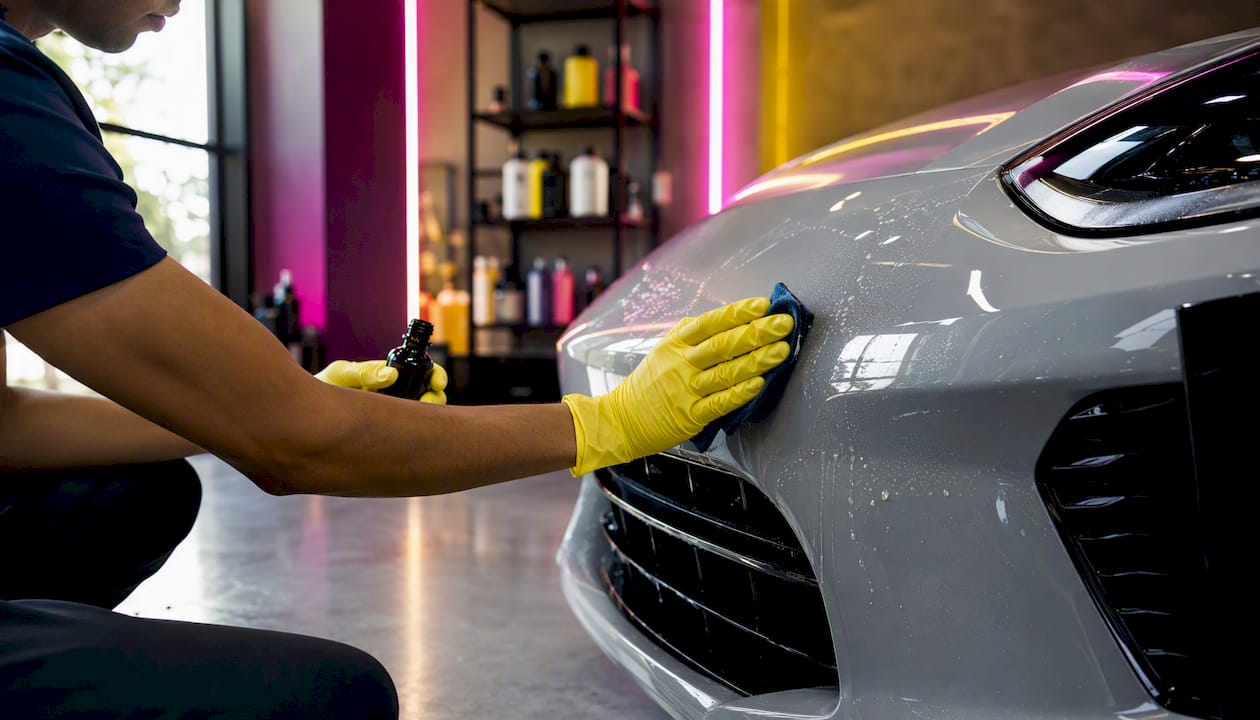
Where it excels: Liquid-applied systems cover complex shapes that are difficult to wrap cleanly, including curved bumpers, mirror housings, and intricate body lines. There are no film edges to lift, no seams to telegraph through the finish.
What it does not do: Liquid PPF is not a guaranteed replacement for heavy-impact protection. High-speed stone chips that would dent or crack a manufactured film will likely still reach the clear coat through a liquid build. Owners should treat it as a meaningful upgrade in scratch and mar resistance, not a chip-proof barrier.
What to ask your installer:
- Measured build per panel in microns or mils
- Cure protocol (temperature, humidity, time between layers)
- Warranty language that explicitly covers removal and reapplication
Pro Tip: Request a written build report with per-panel micron readings before you accept the vehicle. Any installer confident in their work will provide this without hesitation.
How does high-performance ceramic coating protect your vehicle?
Professional ceramic coatings are liquid polymers loaded with SiO2 (silicon dioxide) or TiO2 (titanium dioxide) nanoparticles that chemically bond to the clear coat. The cured layer is typically 1–3 microns thick, which is thinner than a human hair. That thinness is the key trade-off: ceramic coatings deliver exceptional surface performance but absorb no meaningful impact energy.
What ceramic chemistry delivers:
- Deep, wet-look gloss and enhanced paint depth
- Long-term UV oxidation resistance that preserves clear coat color
- Chemical resistance against bird droppings, road salt, and industrial fallout when contamination is removed promptly
- Dramatically easier washing due to hydrophobic water-beading behavior
- Surface slickness that reduces contamination bonding between washes
The hard limit: A ceramic coating does not stop stone chips or absorb impact. A gravel strike at highway speed will still reach the clear coat through a 1–3 micron ceramic layer. For a luxury vehicle driven regularly on U.S. highways, ceramic alone is not sufficient front-end protection.
Application timeline: Paint correction comes first, removing swirl marks and surface defects that would otherwise be locked under the coating. Coating passes follow, then a controlled cure window of 24–72 hours during which the vehicle must stay dry and away from contaminants. Prep quality defines longevity more than any other single variable.
What does real-world performance evidence show?
Installer skill, controlled cure environment, and measured-build documentation are the largest drivers of real-world longevity for both liquid PPF and ceramic coatings. Shops that control temperature and humidity, document micron builds per panel, and perform thorough paint correction report longer-lived results and fewer warranty claims.
On chip resistance: Independent testing on liquid PPF products is still in early stages. Public, standardized gravelometer or ASTM-style chip-resistance data across liquid-applied products is limited. Installers currently rely on internal data and manufacturer claims rather than a shared testing standard. Until that changes, owners should request installer-specific test data and ask which products have been independently evaluated.
How warranties are structured:
- Time-based coverage (typically 2–5 years for liquid PPF, 2–7 years for ceramic) tied to documented maintenance
- Bundled warranties that require the brand’s specified ceramic topcoat applied over the liquid layer to qualify for the longest coverage periods
- Installer-conditional clauses that void coverage if the vehicle is washed with unapproved chemicals or skips scheduled inspections
Profile contrast: A luxury sedan driven 20,000+ miles per year on Florida or Texas highways faces constant gravel and UV exposure. That owner needs liquid PPF on every leading surface, not just the hood. A low-mileage show car stored in a climate-controlled garage faces almost no impact risk; a high-quality ceramic coating alone may be the right call, with liquid PPF reserved for trailering or transport.
How do you choose the right protection for your asset?
Start with these owner priorities before you contact an installer:
- Annual mileage and driving environment: Highway miles above 10,000 per year in the U.S. justify liquid PPF on all leading surfaces. Local or show-car use may not.
- Resale horizon: Planning to sell within 3 years? Documented protection with a transferable warranty adds measurable value at resale.
- Aesthetic priority: Gloss enhancement or matte preservation? Ceramic coatings amplify gloss. Liquid PPF can preserve matte finishes when formulated correctly.
- Budget: Full-vehicle liquid PPF builds cost more than a ceramic-only application. Prioritize liquid PPF on high-impact zones if budget is a constraint.
- Asset type: Aircraft leading edges, yacht hull surfaces, and architectural glass each require substrate-specific formulations. Confirm your installer has documented experience with your asset type.
Questions to ask any installer:
- What is the measured build per panel in microns, and will you provide a written report?
- What are your cure temperature and humidity controls?
- Does your warranty explicitly state removal and reapplication terms?
- Can you show before/after documentation on a similar luxury or exotic asset?
- What maintenance schedule is required to keep the warranty valid?
Red flags to walk away from:
- Vague warranty language with no defined coverage scope
- No measured-build documentation offered
- No humidity or temperature-controlled cure space
- No case studies or before/after images on comparable assets
What should you expect during a professional application?
A quality installation follows a defined sequence. Skipping any stage compromises the result.
- Paint correction and contamination removal: Clay bar treatment, decontamination wash, and machine polishing to remove swirl marks and surface defects. This stage can add a full day or more depending on the vehicle’s condition.
- Panel prep and masking: Edges, trim, and glass are masked. Panels are wiped with IPA solution immediately before application.
- Layered build (liquid PPF) or coating passes (ceramic): Liquid PPF requires multiple passes with cure time between layers. Ceramic coatings require precise application in controlled conditions to avoid high spots.
- Controlled cure: Ceramic coatings require 24–72 hours of controlled cure. Liquid PPF builds may require additional time between layers and a final full cure before the vehicle is exposed to water or contaminants.
- Post-cure inspection: Panel-by-panel review for coverage uniformity, adhesion, and finish quality.
Primary cost drivers:
- Asset size and panel complexity (tight curves, carbon fiber, textured trim)
- Number of liquid PPF build layers
- Depth of paint correction required before application
- Warranty length and bundled topcoat requirements
- Specialized substrate work on wheels, glass, or architectural surfaces
Refer to Mannyceramicprotouch’s vehicle prep guide for a detailed checklist of what to do before drop-off.
How do you maintain and repair a treated surface?
Routine maintenance is not optional. It is a warranty condition.
- Wash frequency: Hand wash or touchless wash every 2–4 weeks using pH-neutral, coating-safe shampoos. Automatic brush washes void most warranties.
- Approved chemicals only: Solvent-based cleaners, tar removers, and abrasive compounds will degrade both liquid PPF and ceramic layers. Confirm approved product lists with your installer.
- Periodic inspections: Schedule a professional inspection every 6–12 months to catch delamination, contamination buildup, or topcoat wear before it reaches the base layer.
- Ceramic topcoat refresh: A ceramic topcoat applied over liquid PPF reduces contamination bonding and extends the practical lifespan of the liquid layer. When the topcoat shows hydrophobic degradation (water no longer beads cleanly), a topcoat refresh is usually sufficient before a full reapplication is needed.
- Repair workflow: Localized scuffs or topcoat damage in a defined area can often be addressed with a spot recoat. Full reapplication is necessary when the base layer is compromised or when coverage has degraded across multiple panels.
- Warranty and physical impact: Most warranties cover manufacturing defects and premature degradation, not physical impact damage from road debris. Read the fine print before assuming a chip is covered.
Which protection setup fits your owner profile?
- Show car or garage queen: High-performance ceramic coating across the full vehicle. Liquid PPF on any panels exposed during transport or trailering.
- Daily highway luxury vehicle (10,000+ miles/year): Liquid PPF on all leading surfaces (hood, front bumper, mirrors, A-pillars, rocker panels) with a ceramic topcoat across the entire vehicle.
- Seasonal driver or weekend exotic: Full-vehicle liquid PPF build with ceramic topcoat for maximum protection and the easiest maintenance schedule.
- Aircraft or yacht owner: Liquid PPF on high-exposure leading edges and surfaces prone to abrasion; ceramic coating for UV and chemical resistance across broader surface areas. Confirm the installer has substrate-specific experience.
- Budget-constrained owner: Prioritize liquid PPF on the front bumper, hood, and mirrors first. Add ceramic across the full vehicle. Expand liquid PPF coverage at the next service interval.
Key Takeaways
Liquid PPF and ceramic coating serve different protection roles; combining them delivers the most complete showroom-grade defense for luxury and high-value assets.
| Point | Details |
|---|---|
| Liquid PPF builds reach a thickness that resists marring and swirl marks but is not equivalent to manufactured film for heavy chip protection. | That thickness resists marring and swirl marks but is not equivalent to manufactured film for heavy chip protection. |
| Ceramic coatings form a very thin layer that delivers hydrophobicity, UV resistance, and gloss but absorb no meaningful impact energy. | They deliver hydrophobicity, UV resistance, and gloss but absorb no meaningful impact energy. |
| Installer quality defines longevity | Controlled cure environment and documented micron builds separate long-lived results from premature failures. |
| Warranties require maintenance compliance | Most multi-year warranties are voided by unapproved wash chemicals or missed inspection intervals. |
| Mannyceramicprotouch | Specializes in liquid PPF builds and ceramic topcoats for luxury and exotic assets, with documented measured-build reports and service-level guarantees. |
Why the installer matters more than the product label
The PPF type comparison most owners focus on, liquid versus ceramic, is actually the second most important decision. The first is who applies it. A premium liquid PPF product installed in an uncontrolled environment, without proper paint correction, without documented build measurements, and without a clear warranty, will underperform a mid-tier ceramic coating applied by a disciplined installer who controls every variable.
What gets overlooked is that the chemistry in both categories is mature enough to deliver excellent results. The failure points are almost always process failures: inadequate prep, insufficient cure time, or warranty language so vague it covers nothing. Owners of high-value assets should spend as much time evaluating the installer’s documentation practices as they spend comparing product specifications.
The other underappreciated point is the combined system. Applying a ceramic topcoat over a cured liquid PPF layer is not redundant. The ceramic layer changes the maintenance equation entirely, reducing contamination bonding and making the liquid PPF surface far easier to keep clean without abrasive washing. That matters over a 3–5 year ownership cycle.
Mannyceramicprotouch protects what you’ve invested in
Owners of luxury and exotic vehicles deserve a studio that treats surface protection as a precision discipline, not a volume service. Mannyceramicprotouch installs liquid PPF builds and high-performance ceramic topcoats with a quality-first process built around documented measured-build reports, controlled cure environments, and warranty terms that are clear before the work begins. Every vehicle receives a tailored protection strategy, whether that means prioritized liquid PPF on high-impact zones, a full-vehicle build, or a ceramic-only application for a low-mileage show car.
Paint correction, glass protection, and specialized substrate work for wheels, trim, and architectural surfaces are all part of the service offering. Request your quote and ask for measured-build data and a sample warranty document before you book. View Mannyceramicprotouch’s liquid PPF and ceramic coating packages or explore liquid PPF services near you to get started.
Useful sources and further reading
- Understanding Liquid PPF: How It Complements Ceramic Coatings and Paint Protection Film — Optimum Polymer Technologies
- PPF vs Ceramic Coating 2026: Definitive Guide for Car Owners and Installers — LA Wrap and Tint School
- Paint Protection Film vs Liquid Ceramic Coating — Softrop
- Car Paint Protection: Your Complete 2026 Guide — Mannyceramicprotouch
- Choose the Right Protection for Your Car: PPF vs Ceramic Coating — Mannyceramicprotouch
This article provides general information about surface protection products and services. Specific warranty terms, product performance, and pricing vary by installer and product brand. Confirm all technical specifications and warranty language directly with your chosen installer before booking.