

Auto coating, the industry term for ceramic coating, is a liquid-applied, semi-permanent surface barrier that improves gloss, repels water and contaminants, and adds chemical and UV resistance. It does not stop rock chips or replace Paint Protection Film (PPF). For high-value vehicles, the research-backed recommendation is clear: apply PPF on high-impact zones (hood, front bumper, fenders, and mirrors) and layer a ceramic coating over the full vehicle for contamination resistance and easier maintenance. Before committing to either, have a professional evaluate your paint condition and discuss paint correction, warranty terms, and the maintenance schedule required to keep any longevity claim valid.
- What it does well: hydrophobic surface, chemical and UV resistance, improved gloss, easier washing
- What it does not do: absorb rock chips, prevent deep scratches, or replace physical film protection
- Best strategy for high-value vehicles: PPF on impact zones + ceramic coating over the full car
- First step: get a professional paint condition assessment before any coating is applied
Pro Tip: Ask your installer for written documentation of every prep step, including before-and-after photos of paint correction. If they hesitate, that is a red flag worth taking seriously.
Table of Contents
- What is an auto coating, exactly?
- What ceramic coatings actually do — and where they fall short
- How do coating types and product tiers compare?
- How professionals prepare and apply a ceramic coating
- PPF versus ceramic coating: which one does your car actually need?
- What does auto coating actually cost, and how long does it last?
- How to wash and maintain a ceramic coating
- Common ceramic coating myths, corrected
- How to choose a professional installer
- Key Takeaways
- Why the coating conversation usually starts in the wrong place
- Mannyceramicprotouch protects what you have invested in
- Authoritative resources for further verification
What is an auto coating, exactly?
Ceramic coating, also marketed as auto coating or car ceramic coating, is a liquid polymer that bonds chemically to a vehicle’s factory clearcoat. The chemistry is typically silicon dioxide (SiO2) based, though newer formulations incorporate graphene or borophene compounds. Once cured, it forms a hard, hydrophobic layer that sits on top of the clearcoat rather than replacing it.
The functional difference from wax or an auto paint sealant is significant:
- Ceramic coating: — bonds semi-permanently to the clearcoat, resists chemical degradation, and does not wash off under normal conditions
Surface compatibility matters. Ceramic coatings work well on factory clearcoat and standard gloss paint. On matte finishes or vinyl wraps, compatibility varies by product. Some SiO2 formulations will alter the sheen of a matte finish or cause adhesion issues on certain wrap films. Always verify with the coating manufacturer or your installer before proceeding on a non-standard surface.
What ceramic coatings actually do — and where they fall short
The benefits of a properly applied ceramic coating are real and well-documented. The limitations are just as real, and any installer who glosses over them is not someone you want working on your vehicle.
Proven benefits:
- Hydrophobicity: water beads and sheets off the surface, carrying loose dirt with it and making washing faster
- Chemical resistance: protection against bird droppings, acid rain, tree sap, and industrial fallout that would etch unprotected clearcoat
- UV inhibition: slows oxidation and color fade caused by prolonged sun exposure
- Gloss enhancement: the hard, smooth surface layer improves depth and clarity in ways wax cannot match long-term
- Easier maintenance: contaminants release more readily from a coated surface, reducing the effort and abrasion risk of each wash
Realistic limits:
Ceramic coatings add no meaningful impact absorption. PPF is a thermoplastic urethane film designed to absorb road debris and physical impacts; ceramic coatings are chemical barriers, not physical armor. A stone chip will go straight through a coating to the paint underneath. Deep scratches, key marks, and abrasive contact are equally unaffected.
Vendor longevity claims also require scrutiny. A coating advertised as “5-year protection” reaches that lifespan only when paint correction is done properly, the application environment is controlled, and the owner follows a consistent maintenance regimen using approved products. Skip any one of those conditions and the effective lifespan drops.
Durability reality check: Coating longevity claims are conditional on correct paint correction, a controlled application environment, and consistent maintenance with pH-neutral products and manufacturer-recommended top-up treatments.
How do coating types and product tiers compare?
Not all ceramic coatings are the same product, and the difference between a $30 spray and a professional multi-layer system is not just marketing. Chemistry, concentration, application complexity, and installer skill all drive the outcome.
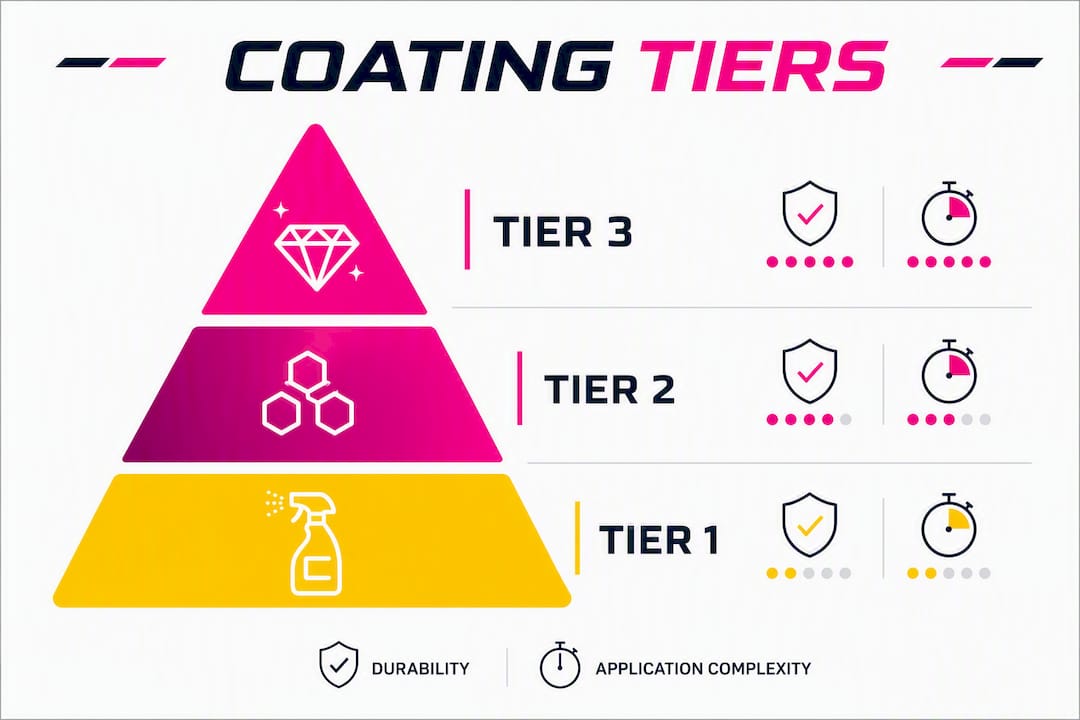
Tier 1: consumer DIY sprays and sealants
These are spray-on or wipe-on products available at auto parts stores. They require minimal surface prep, offer a short lifespan (typically 6–12 months), and provide a modest improvement in hydrophobicity. They are a reasonable option for a daily driver where the owner wants some protection without a significant investment, but they are not a substitute for professional-grade coatings on a high-value vehicle.
Tier 2: professional single-coat systems
Applied by trained installers after thorough paint correction, these systems carry multi-year durability claims (typically 2–5 years) when properly maintained. The SiO2 concentration is higher than consumer products, and the application requires controlled temperature and humidity. This is the entry point for serious automotive paint protection.
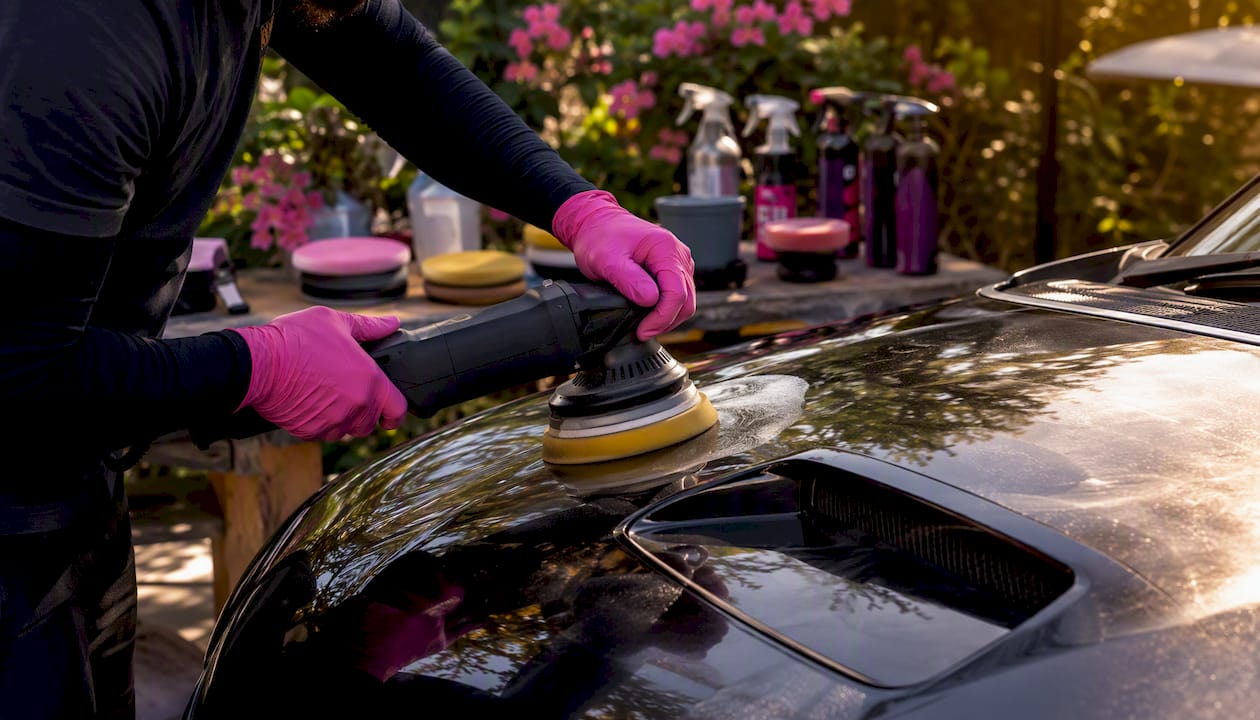
Tier 3: multi-layer professional systems
These include premium SiO2 systems and specialty chemistries marketed under graphene or borophene branding. Graphene-enhanced coatings generally offer improved water contact angles and reduced water spotting compared to standard SiO2 formulations. Borophene-branded products are newer and claim enhanced hardness and chemical resistance. Multi-layer professional systems can carry longevity claims of 5–9+ years, but they demand the highest level of surface preparation and installer expertise to deliver on those claims.
Compatibility note: wrapped cars and matte-finish vehicles require specific product selection. A test spot on an inconspicuous panel is standard practice before full application on any non-standard surface. Always request the manufacturer’s compatibility guidance in writing.
Pro Tip: Match your coating tier to your ownership timeline. If you plan to sell the vehicle in 18 months, a premium 7-year system is not the right investment. If you are keeping a collector car for a decade, a multi-layer professional system with documented warranty terms is worth every dollar.
How professionals prepare and apply a ceramic coating
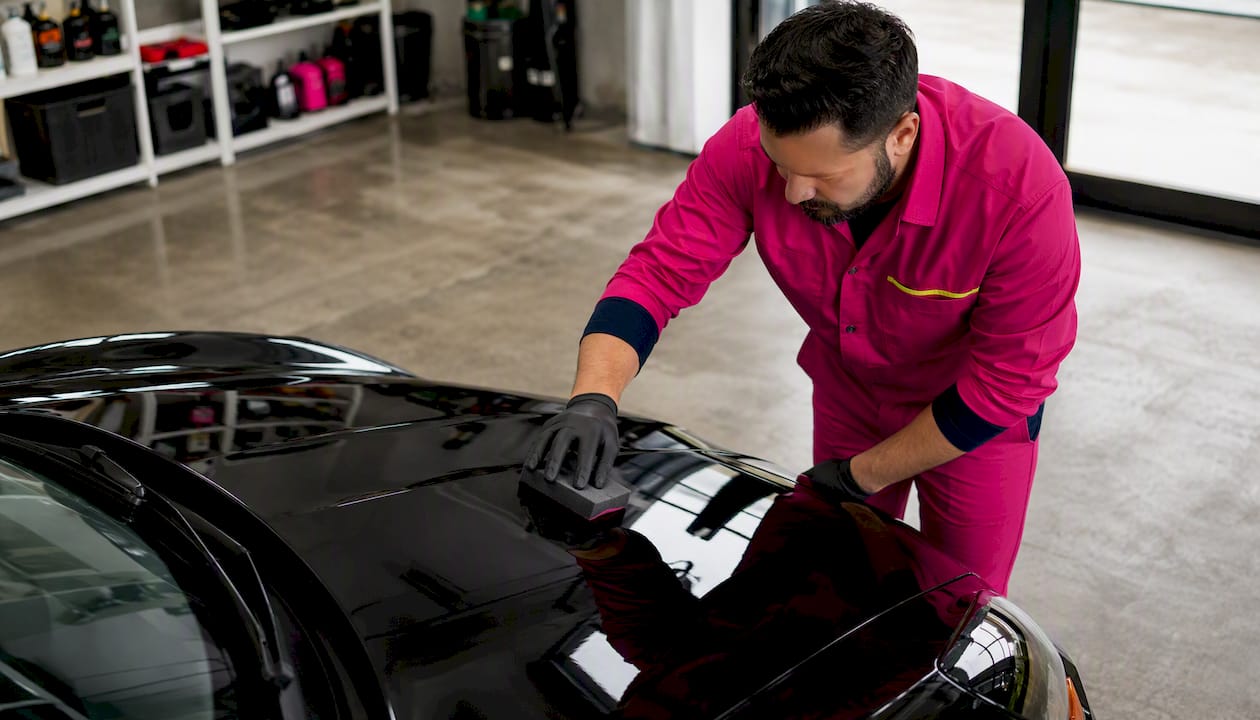
The application process is where most of the value is created or destroyed. A coating applied over contaminated or uncorrected paint locks defects in permanently and underperforms on every metric. Professional surface preparation is not optional; it is the foundation of the entire result.
The professional preparation sequence:
- Thorough wash: remove all loose contamination, road film, and prior product residue
- Decontamination: clay bar treatment and iron fallout remover to pull embedded metallic and chemical contamination from the clearcoat
- Paint correction: compounding and polishing to remove swirl marks, light scratches, and oxidation; this step determines the final visual result and the quality of the coating bond
- Solvent wipe: an IPA (isopropyl alcohol) or panel wipe solution removes polishing oils and residue so the coating bonds directly to clean clearcoat
Application environment and controls:
| Step | Typical time | Why it matters |
|---|---|---|
| Full wash and decontamination | 2–4 hours | Removes contamination that would be locked under the coating |
| Paint correction | 4–12 hours (varies by condition) | Eliminates defects; improves bond and visual clarity |
| Solvent wipe | 30–60 minutes | Clears polishing oils for direct clearcoat bond |
| Coating application (panel by panel) | 2–4 hours | Even coverage prevents high spots and streaks |
| Flash and cure | 7 days minimum | Allows chemical cross-linking before exposure |
Temperature, humidity, and dust control are non-negotiable during application. Most professional installers work within a 60–80°F temperature range and below 60% relative humidity. Applying in direct sunlight or in a dusty environment causes uneven flash times and surface contamination before the coating bonds.
Curing continues for several days after application. Most professional coatings require a 7-day window before the first wash and a longer period before full chemical resistance is achieved.
Pro Tip: Request before-and-after photos of the paint correction stage specifically, not just the finished car. Correction documentation is the clearest proof that the installer did the work that makes the coating perform.
PPF versus ceramic coating: which one does your car actually need?
PPF and ceramic coatings solve different problems, and treating them as interchangeable is one of the most expensive mistakes a vehicle owner can make. Understanding the functional boundary between them is the starting point for any serious automotive paint protection decision.
PPF is a thermoplastic urethane film that physically absorbs impact energy from road debris, stone chips, and abrasion. It sits on top of the paint as a sacrificial layer. High-quality PPF products include self-healing top coats that allow minor scratches to disappear with heat. Ceramic coatings, by contrast, are liquid chemical barriers. They alter surface energy to repel water and contaminants but add no structural thickness and offer effectively zero impact absorption.
| Protection category | PPF | Ceramic coating |
|---|---|---|
| Rock chip and impact protection | Yes | No |
| Chemical resistance | Moderate | High |
| Gloss enhancement | Moderate | High |
| Hydrophobicity | Moderate (varies by product) | High |
| Maintenance demands | Low to moderate | Low with proper wash protocol |
| Typical lifespan | 5 years (professional film) | 1–9 years (depends on tier and maintenance) |
When to choose each:
- PPF only: daily driver in a high-chip environment where gloss enhancement is secondary to physical protection
- Ceramic coating only: a garage-kept vehicle with low highway exposure where the owner wants easier maintenance and gloss without the cost of full-vehicle film
- Both (hybrid approach): the recommended strategy for high-value, luxury, or exotic vehicles; PPF on the hood, front bumper, fenders, A-pillars, and mirrors handles physical impacts, while a ceramic coating over the remaining exposed paint and even over the PPF itself (when product-compatible) delivers contamination resistance and a uniform finish across the whole car
Pro Tip: Sequence matters on a hybrid install. Apply PPF first on all impact zones, then apply the ceramic coating over both the exposed paint and the film. Confirm with your installer that the specific coating product is rated for application over PPF before proceeding.
What does auto coating actually cost, and how long does it last?
Realistic expectations on lifespan and cost protect you from both overpaying and underinvesting. The ranges below reflect general market conditions in the United States; actual pricing varies by vehicle size, paint condition, and installer.
Typical lifespan by tier:
- Consumer DIY sprays: 6–12 months
- Entry-level professional coatings: 1–3 years
- Premium professional multi-layer systems: 3–9 years, depending on chemistry, prep quality, and maintenance
Cost ranges:
- DIY ceramic coating kits: generally $50–$150 for the product alone, with significant time investment and no warranty
- Professional single-coat installation: varies widely by market and vehicle size; expect a meaningful premium over DIY for the prep labor alone
- Bundled PPF + ceramic coating packages: the most comprehensive protection option, priced accordingly; ceramic coating packages for luxury vehicles reflect the prep, correction, and documentation involved
| Tier | Typical lifespan | Common warranty terms |
|---|---|---|
| Consumer DIY spray | 6–12 months | None or limited manufacturer guarantee |
| Entry professional coating | 1–3 years | Often conditional on installer-approved maintenance |
| Premium professional system | 3–9 years | Written warranty; maintenance obligations required; no stone-chip coverage |
| PPF + coating bundle | PPF: 5 years; coating: per tier above | Separate warranties for film and coating; transferability varies |
Warranty language to watch for:
- Maintenance obligations: most professional warranties require pH-neutral wash products and periodic manufacturer top-up treatments. Skipping these voids coverage.
- Stone-chip exclusion: no ceramic coating warranty covers physical impact damage. That is PPF’s role.
- Transferability: some warranties transfer to a new owner, which supports resale value. Confirm this in writing before purchase.
Documented coating application, including installer credentials, prep photos, product specifications, and warranty terms, adds verifiable value at resale. A buyer for a high-value vehicle will notice the difference between a car with a documented protection history and one without.
How to wash and maintain a ceramic coating
A ceramic coating reduces maintenance effort; it does not eliminate it. The washing protocol you follow directly determines how long the coating performs and whether your warranty stays valid.
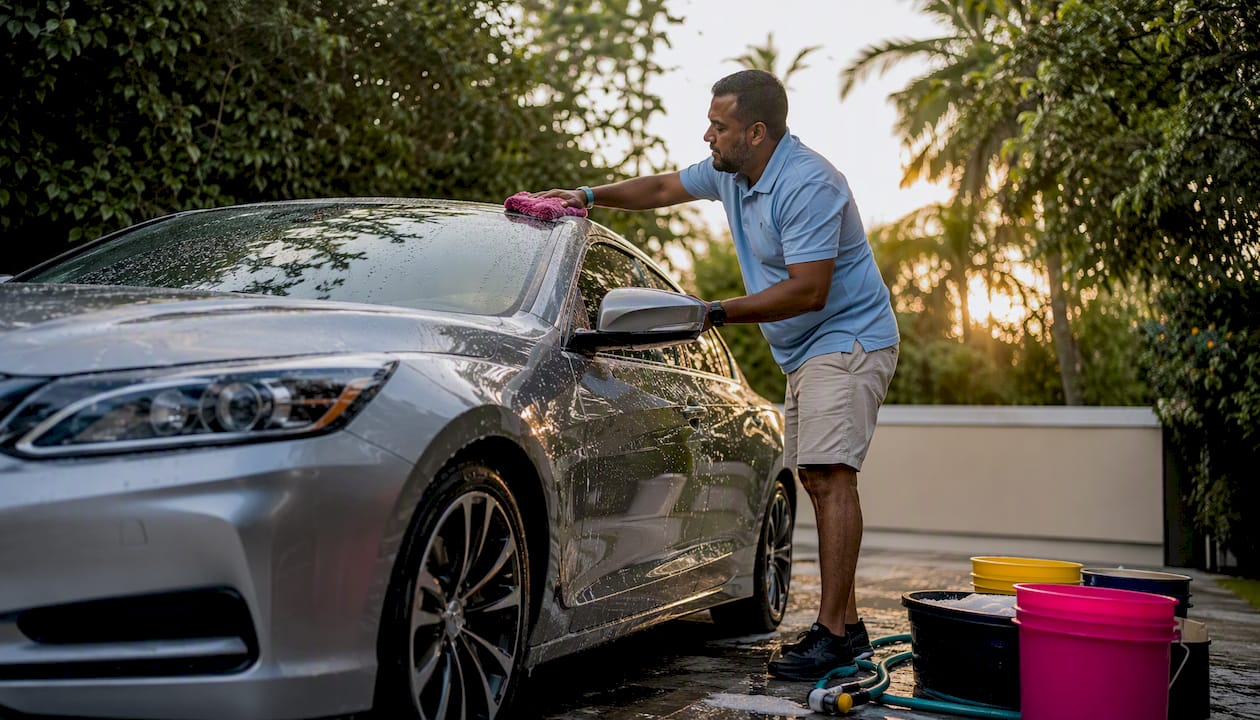
Washing protocol:
- Use a pH-neutral car shampoo specifically formulated for coated vehicles
- Follow the two-bucket method: one bucket for clean soapy water, one for rinsing your wash mitt, to avoid dragging abrasive particles across the surface
- A foam lance pre-soak loosens contamination before contact washing, reducing scratch risk
- Avoid automatic car washes with abrasive brushes; they degrade the coating surface and can void warranties
- Avoid high-alkaline or heavy-abrasive cleaners, which strip the hydrophobic layer
Periodic maintenance:
Coating manufacturers typically recommend a maintenance spray or “top-up” product applied every 3–6 months to refresh hydrophobicity and extend lifespan. These are not the same as a full recoat; they are light SiO2 boosters applied after a thorough wash. Water spot removal should be addressed promptly with a dedicated water spot remover rated for coated surfaces, as mineral deposits left to bake in sunlight can etch through the coating over time.
Maintenance reality: Coating longevity claims require consistent use of pH-neutral products and manufacturer-recommended top-up treatments. Owners who skip these steps should expect significantly shorter effective lifespans than advertised.
Owner do’s and don’ts:
- Do: wash every 2 weeks or when visibly dirty; use approved pH-neutral products; apply maintenance spray per manufacturer schedule; keep receipts and product records
- Do not: use dish soap, automatic brush washes, or abrasive compounds on a coated surface
- First post-application wash: wait the full period your installer specifies (typically 7 days minimum) before the first wash
When to refresh or recoat:
Water no longer beads aggressively, the surface feels less slick after washing, or you notice increased contamination adhesion. These are signs the coating has degraded. A professional can assess whether a decontamination and maintenance spray will restore performance or whether a full recoat is needed.
Pro Tip: Keep a simple vehicle file with your installer’s warranty document, the product data sheet, your maintenance spray purchase receipts, and dated wash log entries. This documentation protects your warranty and strengthens your resale position.
Common ceramic coating myths, corrected
Misinformation about ceramic coatings is widespread, and it costs owners money when they buy the wrong product or skip protection they actually need.
Myth 1: “Ceramic coatings are permanent.”
No coating is permanent. The term “semi-permanent” means the coating bonds chemically and does not wash off like wax, but it does degrade over time through UV exposure, abrasion, and chemical contact. Longevity claims of 5–9 years are conditional on proper prep and consistent maintenance, not a guarantee regardless of care.
Myth 2: “You never have to wash the car again.”
Hydrophobic means water and loose dirt release more easily. It does not mean the surface is self-cleaning. Dust, pollen, bird droppings, and industrial fallout still accumulate and still need to be removed. Regular washing is still required; it just takes less effort and carries less abrasion risk on a coated surface.
Myth 3: “Coatings prevent rock chips.”
They do not. A ceramic coating adds no structural thickness and absorbs no impact energy. Rock chip protection requires a physical film layer. This is the single most important boundary to understand when choosing between PPF and a coating.
Myth 4: “All coatings are the same product.”
The difference between a consumer spray and a professional multi-layer graphene system is substantial, in chemistry, SiO2 concentration, application complexity, and installer skill required. Two vehicles coated with different products and different levels of prep will perform very differently over time, even if both are marketed as “ceramic coatings.”
How to choose a professional installer
The coating is only as good as the installer who applies it. Prep quality, application environment, and documentation discipline separate a professional result from a disappointing one.
Questions to ask before booking:
- What paint correction process do you follow, and will you provide before-and-after photos?
- Which specific coating product will you use, and what are its stated longevity and warranty terms?
- What are the maintenance requirements to keep the warranty valid?
- What is your curing protocol, and what restrictions apply after application?
- Are you an authorized installer for the product you are applying?
Red flags:
- Vague longevity claims with no written warranty
- No before-and-after correction photos or unwillingness to document prep work
- Unable or unwilling to explain the full prep sequence
- No written maintenance requirements provided to the customer
Verification steps:
- Request written documentation of the prep process and the product applied
- Check for manufacturer-authorized installer status, which indicates training and product access standards
- Ask for local references or examples of work on similar vehicles
- Inspect a sample vehicle in person if possible, particularly in direct sunlight where surface defects and high spots are visible
The owner’s pre-application checklist covers the documentation and confirmation steps worth reviewing before you accept any job.
Pro Tip: Ask the installer to leave you a written prep and maintenance checklist at job completion. A professional who documents their process has nothing to hide and gives you the paper trail you need for warranty claims and resale.
Key Takeaways
A properly applied ceramic coating delivers a durable hydrophobic barrier, improved gloss, and easier maintenance, but it requires professional prep, consistent care, and PPF on impact zones for complete vehicle protection.
| Point | Details |
|---|---|
| Coating vs. PPF roles | Ceramic coatings resist chemicals and UV; PPF absorbs physical impacts. Neither replaces the other. |
| Hybrid strategy for high-value cars | Apply PPF on hood, front bumper, fenders, and mirrors; add a ceramic coating over the full vehicle for contamination resistance. |
| Lifespan is conditional | Consumer sprays last 6–12 months; premium professional systems reach 3–9 years only with correct prep and consistent pH-neutral maintenance. |
| Warranty requires documentation | Keep installer receipts, product data sheets, and maintenance records to protect warranty validity and support resale value. |
| Mannyceramicprotouch approach | Mannyceramicprotouch follows a Correct, Perfect, Protect workflow with documented paint correction and tailored hybrid PPF and ceramic coating packages for luxury vehicles. |
Why the coating conversation usually starts in the wrong place
Most vehicle owners arrive at the ceramic coating decision focused on the product: which brand, which tier, how many years. The product matters, but it is the last variable in the equation, not the first. What actually determines the outcome is the condition of the paint underneath, the quality of the correction work done before application, and the discipline of the maintenance regimen that follows.
A premium coating applied over uncorrected paint locks swirl marks and oxidation in permanently. A mid-tier coating applied over properly corrected, clean clearcoat will outperform a premium product applied carelessly. The chemistry is almost secondary to the process.
The other thing most articles understate is the hybrid strategy. PPF and ceramic coatings are not competing products; they are complementary tools that address different threat categories. Treating them as an either/or choice is how owners end up with a beautifully glossy car that chips on the first highway drive. For any vehicle worth protecting seriously, the question is not “PPF or coating?” It is “where does the PPF go, and what coating goes over everything else?”
Documentation is the third underrated variable. A vehicle with a complete protection history, including installer credentials, correction photos, product specifications, and maintenance records, is a demonstrably better-preserved asset. That paper trail has real value at resale, particularly for luxury and exotic vehicles where buyers scrutinize condition carefully.
Mannyceramicprotouch protects what you have invested in
Owners of luxury, exotic, and high-value vehicles need more than a product. They need a process they can verify and a result they can document. Mannyceramicprotouch delivers exactly that through a structured Correct, Perfect, Protect workflow: paint correction to remove defects before they get locked in, precision coating application in a controlled environment, and full documentation of every step for warranty and resale purposes.
Every project at Mannyceramicprotouch is approached as an asset preservation decision, not a detailing appointment. The studio specializes in Liquid PPF and ceramic coating packages tailored to the specific vehicle, its use case, and the owner’s protection priorities. Whether the goal is a full hybrid PPF and coating install on a new acquisition or a professional recoat on a vehicle that has been through years of daily exposure, the process starts with an honest assessment of paint condition and a clear explanation of what each protection layer will and will not do.
For owners ready to protect their investment with a documented, professional-grade result, explore Mannyceramicprotouch’s ceramic coating packages or request a quote to discuss the right protection strategy for your vehicle.
Authoritative resources for further verification
These sources support the technical claims in this article and give you the primary references needed to verify PPF and coating roles, manufacturer care guidance, and installer standards.
- Paint Protection Film — Wikipedia: technical overview of PPF as a thermoplastic urethane film, its role in impact protection, and how it differs from chemical coatings
- XPEL Automotive Paint Protection Film: manufacturer documentation on self-healing film technology, installer networks, and product compatibility
- Steps to Prep Your Car for Coating — Mannyceramicprotouch: professional prep sequence documentation including correction, decontamination, and wipe steps
- Ceramic Paint Protection: What Car Owners Must Know — Mannyceramicprotouch: buyer guidance on matching coating tiers to ownership needs and maintenance expectations
- Choose the Right Protection: PPF vs Ceramic Coating — Mannyceramicprotouch: hybrid strategy guidance and sequencing recommendations for high-value vehicles
- Checklist Before Ceramic Application — Mannyceramicprotouch: owner-facing checklist for confirming prep, documentation, and curing requirements before accepting a job
Use these resources to verify warranty terms, confirm product compatibility with your specific vehicle finish, and validate installer credentials before committing to any protection package.
This article provides general information about automotive surface protection. Specific product performance, warranty terms, and compatibility vary by manufacturer and installer. Confirm current specifications and terms directly with your chosen installer or product manufacturer before purchase.
Recommended
- Steps to Prep Your Car for Coating: Expert Guide – Many Ceramic Pro Touch
- Benefits of Professional Coating for Your Vehicle – Many Ceramic Pro Touch
- Car Paint Protection: Your Complete 2026 Guide – Manny’s Ceramic Pro Touch and Luxury Surface Preservation™
- How Does Ceramic Coating Enhance Your Vehicle’s Appearance