

TL;DR:
- Proper surface preparation is essential for ceramic coating durability and performance, with thorough washing, decontamination, and paint correction being critical. Skipping preparation steps leads to bonding issues, early failure, and permanent defects locked into the coating. Controlling the environment and following a detailed checklist ensures optimal bonding and long-lasting, high-gloss protection.
A comprehensive checklist before ceramic application is the single most important factor in determining how long your ceramic coating lasts and how well it performs. Ceramic coatings bond directly to the paint surface, which means any contamination, defect, or residual oil left behind gets locked in permanently. Proper preparation — washing, iron removal, claying, paint correction, and panel wipe — has a greater impact on durability and hydrophobic performance than the coating product itself. Skipping any step leads to early failure. This guide walks you through every stage of ceramic application preparation, from the first wash to the final panel wipe.
1. What does a complete checklist before ceramic application include?
A ceramic coating preparation checklist covers five core stages: decontamination washing, chemical and mechanical decontamination, paint correction, panel prep, and environment control. Each stage builds on the previous one. Miss a step and the coating bonds to a compromised surface. The result is reduced gloss, weak hydrophobic behavior, and premature failure.
The industry term for this process is surface preparation, and professionals treat it as the foundation of any coating job. The coating itself is almost secondary. A vehicle with flawless surface preparation and a mid-grade coating will outperform a vehicle with poor prep and a premium product every time.
2. Washing and decontamination: the first step in surface prep
Thorough washing removes loose dirt, road grime, and organic debris before any chemical or mechanical decontamination begins. Use a pH-neutral shampoo and the two-bucket wash method to avoid reintroducing contamination to the paint. Rinse from top to bottom and pay close attention to panel gaps, door jambs, and lower rocker panels where grime accumulates.
Chemical decontamination follows the wash. An iron remover spray dissolves embedded ferrous particles that washing cannot remove. These particles come from brake dust and rail dust and bond to the clear coat at a microscopic level. After the iron remover, apply a tar and adhesive remover to eliminate road tar, tree sap, and bug residue.
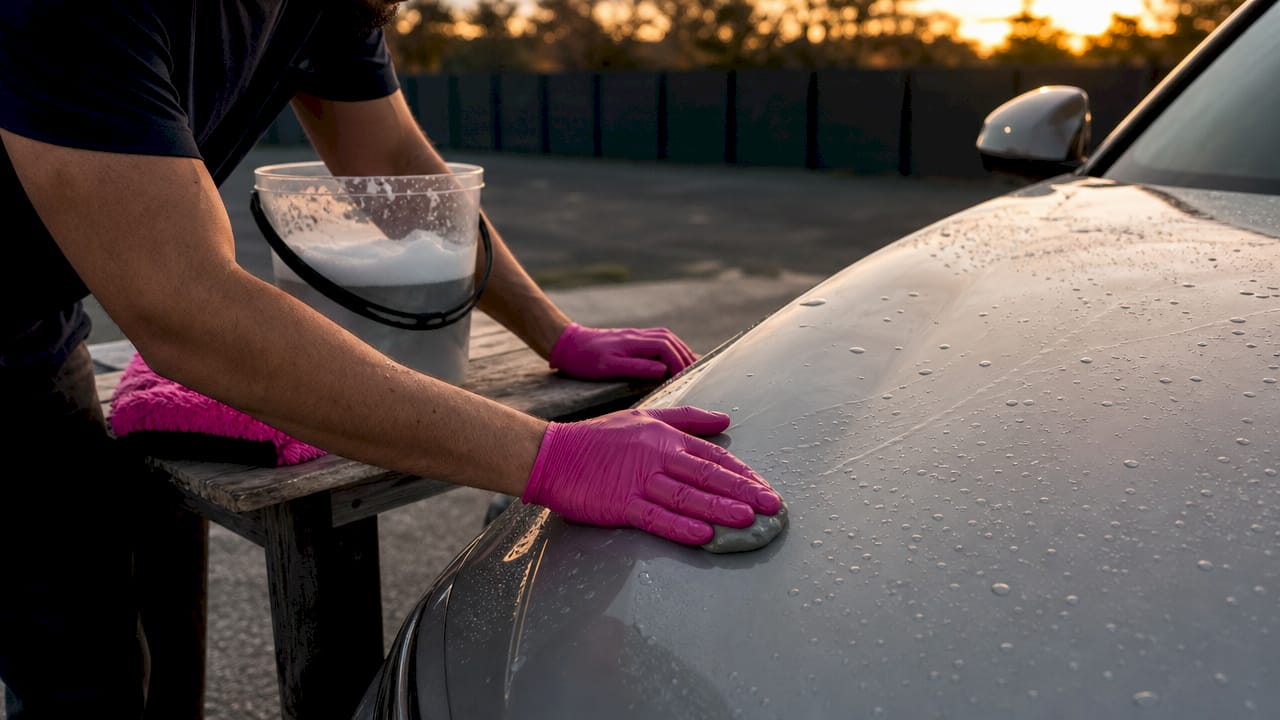
Mechanical decontamination comes last. Clay bars and clay mitts physically pull bonded contaminants from the surface that chemicals leave behind. Work panel by panel with a clay lubricant and use light, overlapping strokes.
Recommended materials for this stage:
- pH-neutral car shampoo (such as Chemical Guys Honeydew Snow Foam or Meguiar’s Gold Class)
- Iron remover spray (such as CarPro Iron X or Gyeon Iron)
- Tar and adhesive remover
- Clay bar or clay mitt with lubricant
- Microfiber wash mitts and drying towels
Pro Tip: After washing and claying, run your hand inside a clean plastic bag across the paint surface. This is the baggie test, a professional method to detect microscopic contaminants invisible to the naked eye. If the surface feels rough or gritty through the bag, clay again.
3. Why paint correction is non-negotiable before coating
Paint correction is permanent under ceramic coating. Any swirl mark, scratch, or oxidation spot left on the paint surface gets locked in permanently once the coating cures. This is the most common mistake vehicle owners make when skipping the pre-application ceramic guide.
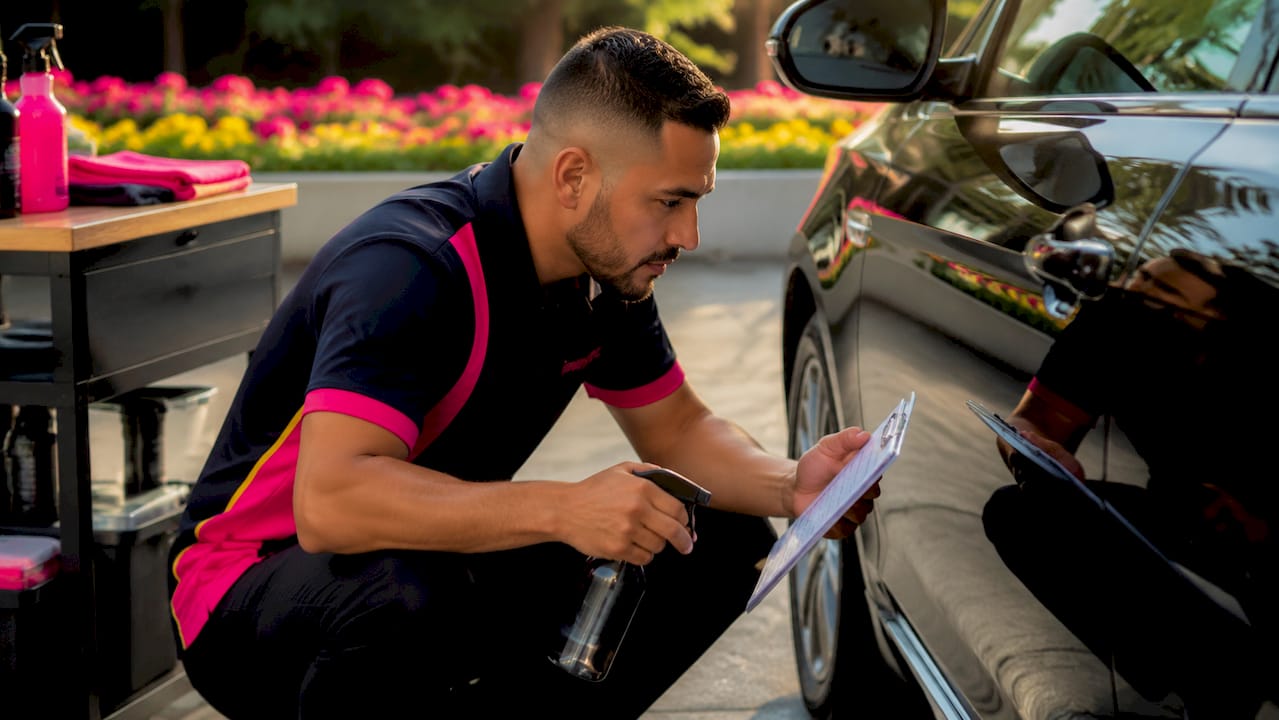
Start with a visual inspection under a bright, direct light source. A detailing light or a simple work light held at a low angle will reveal swirls, holograms, and scratches that are invisible in normal lighting. Mark problem areas with painter’s tape so you address every defect before moving to polishing.
Polishing falls into two categories. A one-step polish combines cutting and finishing in a single product and works well for lightly defected paint. Multi-step polishing uses a cutting compound first to remove deeper defects, followed by a finishing polish to restore clarity and gloss. For a vehicle going under ceramic coating, always finish with a dedicated finishing polish to achieve the highest cosmetic standard.
Paint correction checklist:
- Inspect under bright direct light before and after polishing
- Use a dual-action polisher (such as Rupes LHR15 or Flex XCE 10-8) for controlled correction
- Start with the least aggressive compound needed
- Finish with a fine finishing polish to maximize clarity
- Wipe down with isopropyl alcohol (IPA) after polishing to check true paint condition
Pro Tip: Document paint condition before and after correction with photos and gloss meter readings. Certified applicators use this documentation to support warranty claims and establish a baseline for future maintenance.
For guidance on addressing specific surface defects, Mannyceramicprotouch covers minor paint flaw correction in detail.
4. Final panel prep: drying, wiping, and masking
Complete drying is mandatory before any coating touches the paint. Water spots left on the surface will bond under the coating and become permanent. Use a clean microfiber drying towel or a forced-air blower to remove all moisture, including water trapped in panel gaps and around emblems.
Panel wiping removes polishing oils and residue that remain after correction. Use isopropyl alcohol (IPA) diluted to 70% or a dedicated panel prep spray. Work one panel at a time and use a clean microfiber towel for each wipe. If water beads tightly on the surface after wiping, polishing oils remain. A properly prepped surface sheets water slowly or shows no beading at all.
Masking protects trim, rubber seals, plastic moldings, and glass from ceramic overspray. Overspray from cured ceramic coating is difficult to remove and can permanently stain non-painted surfaces. Use automotive masking tape and paper to cover all sensitive areas before you open the coating bottle.
Final prep checklist:
- Dry all panels completely, including gaps and emblems
- Wipe each panel with IPA or panel prep spray using a fresh microfiber towel
- Confirm no water beading after IPA wipe
- Mask all trim, rubber, plastic, and glass edges
- Inspect one final time under bright light before coating
5. Environment control: temperature, humidity, and dust
Professional ceramic coating application requires temperature between 50°F and 80°F and relative humidity between 40% and 70%. Outside these ranges, the coating flows unevenly, cures too fast, or fails to bond correctly. A garage or enclosed space with controlled conditions is the minimum standard for a quality result.
Never apply coating to a vehicle that has been sitting in direct sunlight or was recently driven. Panel temperatures must normalize for at least 30 minutes in the application environment. Warm panels cause the coating to flash cure before you can level it, leaving high spots and uneven coverage.
Dust is a silent enemy during application. Even a small amount of airborne dust settling on a wet coating panel creates texture defects. Close garage doors, turn off fans, and allow the air to settle for at least 15 minutes before you begin coating.
6. Common mistakes to avoid on your ceramic installation checklist
Most coating failures trace back to skipped prep steps, not product quality. The most frequent errors are applying coating to contaminated paint, ignoring environmental conditions, and mismanaging flash time.
Coating flash time ranges between 30 seconds and 2 minutes depending on temperature and humidity. Waiting too long to buff the coating leaves high spots that are nearly impossible to remove without machine polishing. Moving too fast smears the coating before it has bonded. Work one panel at a time and never attempt to coat multiple panels simultaneously.
Mistakes that compromise coating results:
- Skipping iron removal or clay decontamination
- Applying coating to sun-warmed or recently driven vehicles
- Missing the flash time window due to working too large an area
- Leaving polishing oils on the surface before coating
- Ignoring humidity above 70%, which slows curing and causes hazing
- Failing to mask trim and rubber before application
Pro Tip: Perform a water break test after your final IPA wipe. Pour a small amount of water on the panel. If it sheets off in a thin, even film, the surface is ready. If it beads, wipe again with fresh IPA.
For a deeper look at paint decontamination methods, Mannyceramicprotouch has a dedicated guide covering both chemical and mechanical approaches.
7. Comparison of ceramic preparation products and tools
The right products make each preparation stage faster and more reliable. The table below compares key categories by use case, skill level, and what to look for.
| Product/Tool | Best For | Key Feature | Skill Level |
|---|---|---|---|
| pH-neutral shampoo (e.g., Meguiar’s Gold Class) | Pre-wash stage | Safe on wax and coatings; no stripping agents | Beginner |
| Iron remover (e.g., CarPro Iron X) | Chemical decontamination | Color-change indicator shows active removal | Beginner to enthusiast |
| Clay bar (e.g., Mothers Speed Clay) | Mechanical decontamination | Removes bonded contaminants after chemical step | Beginner to enthusiast |
| Dual-action polisher (e.g., Rupes LHR15) | Paint correction | Low risk of burning paint; consistent results | Enthusiast to professional |
| IPA panel prep spray | Final wipe before coating | Removes polishing oils without leaving residue | All levels |
| Automotive masking tape | Protecting trim and rubber | Clean removal without adhesive transfer | All levels |
Beginners should prioritize a quality clay bar and iron remover over an aggressive cutting compound. Enthusiasts and professionals benefit most from a dual-action polisher paired with a dedicated finishing polish for the highest gloss standard before coating.
Key takeaways
Proper surface preparation determines ceramic coating durability, gloss, and hydrophobic performance more than any other single factor.
| Point | Details |
|---|---|
| Prep outweighs product | Thorough washing, decontamination, and correction matter more than the coating brand. |
| Paint correction is permanent | Defects left before coating are locked in forever; inspect under bright light every time. |
| Environment controls results | Apply only between 50°F and 80°F with humidity at 40–70% to avoid curing defects. |
| Flash time is critical | Work one panel at a time and buff within the 30-second to 2-minute window. |
| Document everything | Photos and gloss readings before and after prep support warranties and future maintenance. |
What I’ve learned after years of ceramic coating prep
Working on high-value vehicles has taught me one thing above everything else: patience during prep is the only variable you fully control. The coating chemistry is fixed. The product is fixed. What you control is the surface you hand it.
The biggest mistake I see from enthusiastic vehicle owners is rushing the decontamination stage. They wash the car, skip the iron remover, and go straight to polishing. The clay bar then drags over embedded ferrous particles and creates new micro-scratches. Now they have a worse surface than when they started.
My honest advice is to treat the checklist as a quality gate, not a to-do list. Each step either passes or fails. If the baggie test shows contamination after claying, you clay again. If the IPA wipe shows beading, you wipe again. There is no “good enough” when the coating is about to lock everything in for years.
Adapting the checklist to your skill level is also worth considering. A beginner working on a daily driver can achieve excellent results with a clay bar, a quality finishing polish applied by hand, and careful IPA prep. A professional working on a Ferrari needs a multi-step machine correction and a gloss meter. The steps are the same. The tools and depth of correction scale with the vehicle and the stakes.
— Emmanuel
Professional ceramic coating prep at Mannyceramicprotouch
Vehicle owners who want professional-grade results without the risk of a DIY mistake have a direct option. Mannyceramicprotouch handles every stage of the preparation process, from the initial decontamination wash through paint correction and final panel wipe, before any coating is applied.
Every vehicle receives a documented prep process with photos and condition notes, which supports coating warranty eligibility and gives you a clear record of your vehicle’s paint condition. For vehicle owners in Fort Lauderdale looking for a quality-first approach to long-lasting ceramic protection, Mannyceramicprotouch offers packages built around precision prep and verified application. You can also review how surface protection extends vehicle value to understand the full return on a properly applied coating.
FAQ
What is the most important step in ceramic application preparation?
Decontamination and paint correction are the most critical steps. Ceramic coatings bond directly to the paint surface and permanently lock in any defects or contamination left behind.
How long should a vehicle sit before ceramic coating application?
Panels must normalize in the application environment for at least 30 minutes. Applying coating to warm or sun-exposed panels causes premature flash curing and uneven bonding.
What temperature and humidity are required for ceramic coating?
Professional application requires a temperature between 50°F and 80°F and relative humidity between 40% and 70% for correct coating flow and cure quality.
How do I know if my panel is ready for coating after the IPA wipe?
Pour a small amount of water on the wiped panel. If it sheets off in a thin, even film, the surface is ready. If it beads tightly, polishing oils remain and the panel needs another IPA wipe.
Can I apply ceramic coating to multiple panels at once?
Applying coating panel by panel is the correct method. Coating multiple panels simultaneously causes you to miss the flash time window, which results in high spots and uneven coverage.