

TL;DR:
- Self-healing PPF uses elastomeric polymers that repair surface scratches when heated, offering superior long-term clarity and resistance. It lasts between 5 to 10 years, especially when combined with ceramic coatings for comprehensive protection. Proper professional installation ensures optimal healing performance and durability, making it ideal for high-value, dark-colored vehicles.
If you own a luxury vehicle, you already know that paint damage is not just a cosmetic inconvenience. It affects resale value, curb appeal, and the long-term integrity of your investment. Self-healing PPF addresses this problem at a level that standard protective films simply cannot match. Most car owners assume all paint protection film works the same way, but that assumption overlooks a significant technological gap. This guide breaks down what self-healing PPF actually is, how it works on a material science level, and why it represents a fundamentally different approach to protecting your vehicle’s finish.
Table of Contents
- Key Takeaways
- What is self-healing PPF and how does it differ from standard film
- How self-healing PPF actually works
- Self-healing PPF vs. standard PPF and ceramic coatings
- Practical considerations: maintenance, lifespan, and cost
- My take on why heat-activated PPF is the right choice
- Protect your vehicle with Mannyceramicprotouch
- FAQ
Key Takeaways
| Point | Details |
|---|---|
| Self-healing PPF uses elastomeric polymers | The topcoat’s polymer chains return to their original form when exposed to heat, repairing surface scratches. |
| Heat-activated films outperform instant healing | Heat-activated PPF offers firmer topcoats with superior long-term clarity and resistance to chemical staining. |
| Lifespan ranges from 5 to 10 years | UV exposure, climate, and maintenance quality are the primary factors that affect how long the film lasts. |
| Combining PPF with ceramic coatings maximizes protection | PPF handles physical impact while ceramic coatings defend against UV radiation and chemical contaminants. |
| Professional installation is non-negotiable | Improper installation creates lifting edges, trapped debris, and premature film failure that undermines every benefit. |
What is self-healing PPF and how does it differ from standard film
Paint protection film, or PPF, is a sacrificial barrier applied directly to a vehicle’s painted surfaces. It absorbs rock chips, light scratches, and environmental contaminants before they reach the paint underneath. Standard PPF does this job reasonably well. Self-healing PPF does it and then goes a step further: it repairs itself.
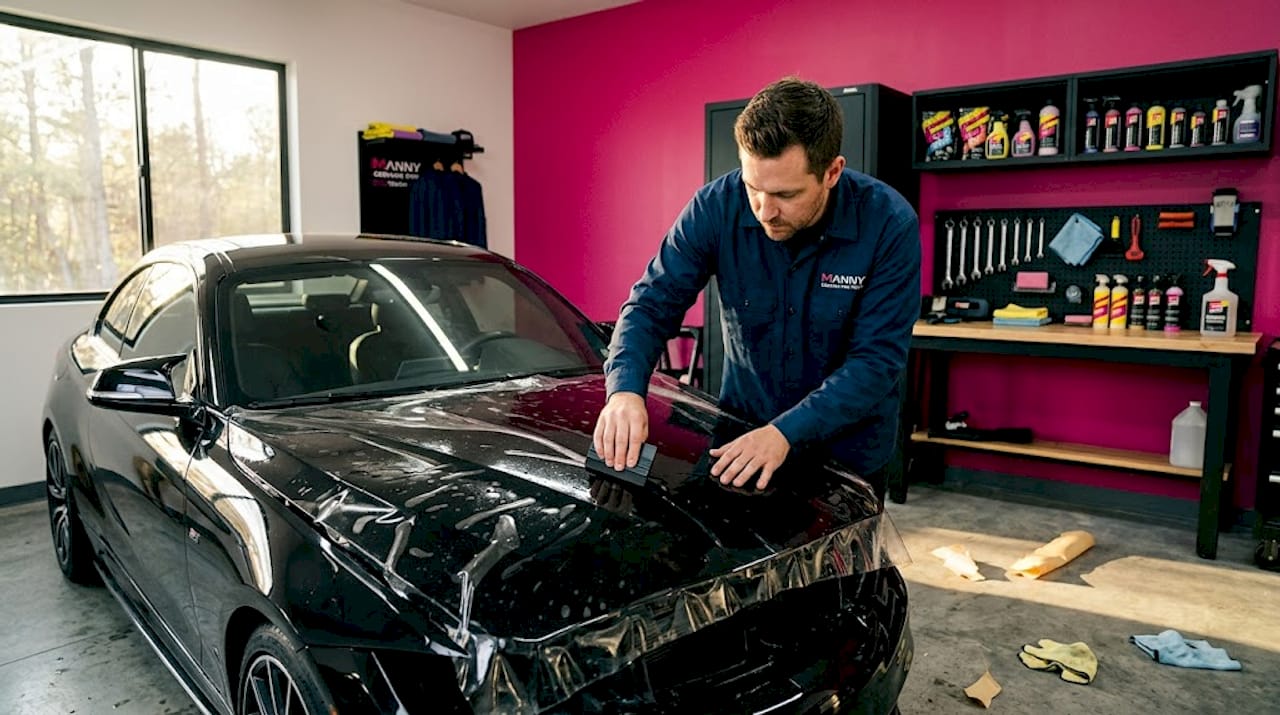
The difference lies in the topcoat. Standard PPF uses a rigid clear coat layer that, once scratched, stays scratched. Self-healing PPF is engineered with an elastomeric polymer topcoat that has shape memory built into its molecular structure. When the surface is scratched, the polymer chains are displaced. When heat is applied, those chains return to their original equilibrium position, effectively erasing the scratch.
There are two categories of self-healing film worth understanding:
- Heat-activated PPF: Requires a heat source such as direct sunlight, warm water, or a heat gun to trigger the healing process. These films use firmer topcoats that resist chemical staining and maintain optical clarity over years of use.
- Instant self-healing PPF: Repairs minor scratches at room temperature without any external heat. The tradeoff is a softer topcoat that is more prone to premature wear and chemical staining over time.
It is also worth being clear about what self-healing PPF cannot do. It repairs surface-level scratches in the topcoat layer. It will not fill deep gouges that penetrate through the film to the paint, and it will not repair physical damage like dents or chips in the body panel itself. Understanding these limits helps set accurate expectations before you invest.
Pro Tip: Properly engineered PPF is typically 6 to 8 mils thick. That thickness balances optical clarity with genuine impact resistance. When comparing film products, thickness is one of the first specs to check.
How self-healing PPF actually works
The science behind self-healing paint protection is more straightforward than it sounds. The topcoat is made from thermoplastic polyurethane, or TPU, a material with a unique property: its polymer chains flex under stress but return to their resting state when energy is introduced. In practical terms, that energy is heat.
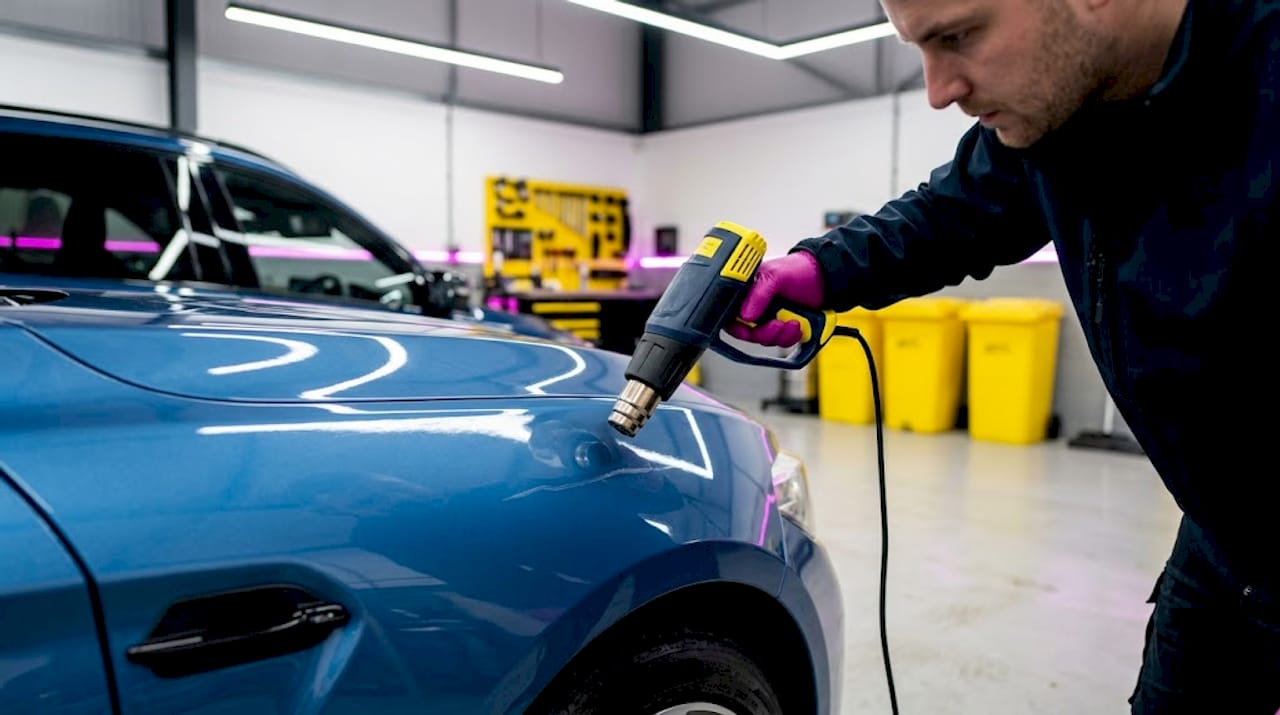
Heat-activated self-healing PPF begins repairing light scratches at approximately 140 to 160°F (60 to 70°C). That temperature range is comfortably within what direct sunlight or a warm water rinse can achieve. On a sunny day, parking your vehicle outdoors for 20 to 30 minutes can be enough to trigger the process on fresh surface scratches. For faster results, a heat gun held at a safe distance works efficiently.
Here is what happens at the molecular level. The scratch displaces polymer chains from their equilibrium position. Heat gives those chains enough kinetic energy to move freely again. As they move, they return to their original, undisplaced arrangement. The surface smooths out and the scratch disappears. This is not a temporary filling effect. It is a permanent repair at the molecular level, which is what separates self-healing PPF from waxes or sealants that simply mask scratches visually.
| Activation method | Temperature range | Repair time | Notes |
|---|---|---|---|
| Direct sunlight | 140 to 160°F (60 to 70°C) | 20 to 30 minutes | Effective for light surface scratches |
| Warm water rinse | 120 to 150°F (49 to 65°C) | 10 to 20 minutes | Gentle and controlled method |
| Heat gun | 140 to 160°F (60 to 70°C) | 3 to 10 minutes | Fastest option; keep distance to avoid damage |
One point that often surprises car owners: the self-healing property is built into the TPU molecular structure itself. It is not a surface treatment or an additional coating applied on top. This means the healing capability does not wear off with repeated activations. The film’s performance degrades only when UV radiation breaks down the polymer structure over time, which is the same mechanism that limits all PPF products regardless of self-healing capability.
Installation quality directly affects how well the healing function performs. Air pockets, lifted edges, or contamination beneath the film create stress points in the polymer structure that compromise its ability to return to equilibrium after a scratch.
Self-healing PPF vs. standard PPF and ceramic coatings
Choosing the right protection for a luxury vehicle means understanding what each product actually defends against. Self-healing PPF, standard PPF, and ceramic coatings solve different problems.
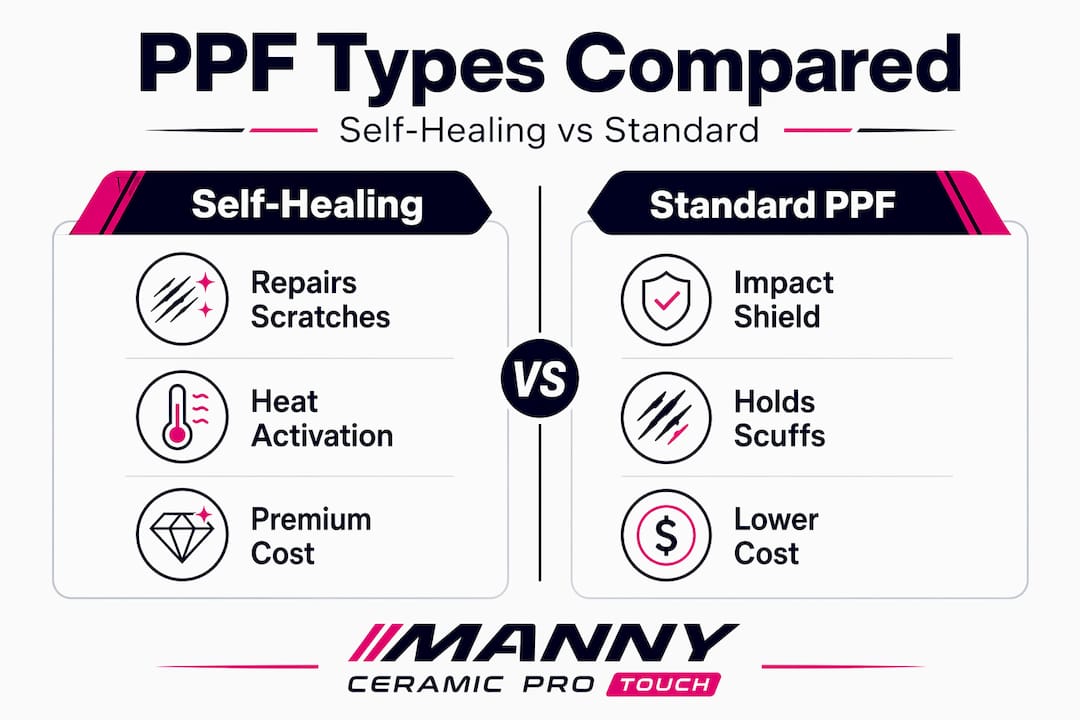
| Protection type | Physical impact resistance | Scratch self-repair | Chemical/UV defense | Typical lifespan |
|---|---|---|---|---|
| Standard PPF | High | No | Moderate | 5 to 7 years |
| Self-healing PPF | High | Yes | Moderate to good | 5 to 10 years |
| Ceramic coating | Low | No | Excellent | 2 to 5 years |
| PPF plus ceramic | Very high | Yes (with PPF layer) | Excellent | 7 to 10 years |
Standard PPF provides a strong physical barrier against rock chips and abrasion, but it holds every scratch it receives. On a dark-colored luxury vehicle, those accumulated surface scratches become visible over time, dulling the finish without any path to recovery short of film replacement. Self-healing PPF eliminates that problem entirely.
Ceramic coatings operate differently. They bond to the surface at a chemical level and create exceptional resistance to UV damage, water spots, bird droppings, and chemical etching. What they do not provide is meaningful protection against physical impacts. A rock chip that would leave a permanent mark through a ceramic coating is stopped by the film layer underneath.
This is why combining PPF with ceramic coatings is the approach most professionals recommend for high-value vehicles. The PPF absorbs physical damage and self-heals surface scratches. The ceramic coating on top handles chemical and UV defense while also making the surface easier to clean and maintain.
The self-healing PPF benefits for high-end and dark-colored vehicles are particularly strong because surface scratches show more aggressively on those finishes. A single carwash brush swirl that might go unnoticed on a silver sedan is immediately visible on a black or deep navy paint job.
For owners evaluating liquid PPF vs traditional PPF, the self-healing properties available in modern formulations make the film category a clear frontrunner for long-term preservation.
Practical considerations: maintenance, lifespan, and cost
Understanding self-healing PPF is one thing. Knowing how to maintain it and what to budget for it is what actually helps you make a sound decision.
Lifespan and what affects it
Self-healing PPF typically lasts 5 to 10 years under normal conditions. The range is wide because several variables matter significantly: UV exposure intensity (Florida and Arizona climates are harder on film than northern states), how often the vehicle is washed, whether the film is topped with a ceramic coating, and the quality of the original installation. High UV environments accelerate polymer breakdown regardless of how well the film is maintained.
Activating self-healing at home
The process is simple and does not require professional intervention for routine use:
- Wash the vehicle thoroughly and dry the affected area.
- Park in direct sunlight for 20 to 30 minutes if the scratches are light and fresh.
- For faster results, use warm (not boiling) water poured carefully over the scratched area.
- Inspect after cooling. Repeat the process once if the scratch is still partially visible.
- For persistent or deeper marks, consult your installer before applying additional heat.
Cost expectations
Self-healing PPF costs generally range from $1,500 to $3,500, depending on vehicle size, coverage area, and the film brand selected. Standard PPF without self-healing features runs $500 to $1,500 by comparison. The premium reflects the advanced material engineering involved, not simply a marketing surcharge.
Pro Tip: Request a warranty that specifically covers the self-healing function, not just delamination or yellowing. Top-tier films carry warranties of 7 to 10 years that address both physical film integrity and topcoat performance.
Professional installation is worth every dollar of its cost. Seamless edges, zero contamination beneath the film, and proper tension during application are the difference between a film that performs as advertised for a decade and one that lifts, yellows, and fails inside three years.
My take on why heat-activated PPF is the right choice
I have worked with luxury and exotic vehicles long enough to see every type of paint protection come and go. What I have found is that car owners often focus on the wrong thing when evaluating self-healing PPF. They want to see the healing happen instantly, right in front of them. That “instant wow” of watching a scratch disappear at room temperature is compelling, and it drives a lot of purchasing decisions toward instant self-healing films. In my experience, that decision often costs owners more in the long run.
Instant self-healing films have softer topcoats. They feel impressive in the first few months, but that softness makes them more vulnerable to chemical staining from bird droppings, tree sap, and even some car wash products. By year three or four, the clarity starts to suffer in ways that heat-activated films simply do not.
What I tell every client who asks about self-repairing automotive films is this: think about where your vehicle is going to be five years from now. If you want the finish to look the same as installation day, the temporary theatrical effect of instant healing matters far less than the long-term durability of a heat-activated film. Park in the sun for half an hour. The scratch is gone. That is not a limitation. It is a trade you should be happy to make.
My strongest advice for any luxury vehicle owner is to combine a heat-activated self-healing PPF with a quality ceramic coating on top. The two technologies address completely different threats. Together, they create a level of protection that neither can achieve alone. I have seen this combination maintain showroom-level finishes for eight years or more in demanding conditions. No single-product solution comes close to matching that.
— Emmanuel
Protect your vehicle with Mannyceramicprotouch
At Mannyceramicprotouch, the focus is on long-term asset protection for luxury, exotic, and high-value vehicles. If you have read this far, you already understand that self-healing PPF is not just a film. It is a preservation strategy. The studio offers tailored PPF solutions, including advanced liquid PPF options in Fort Lauderdale with self-healing properties engineered for elite finishes. Every installation is approached with a quality-first process, and no vehicle leaves without meeting the standard the client’s investment deserves. For owners who want to understand which approach fits their specific vehicle, the paint protection services page covers the full range of options with professional guidance to match.
FAQ
What does self-healing PPF actually repair?
Self-healing PPF repairs light surface scratches within its elastomeric topcoat layer. It does not repair deep gouges that penetrate the film completely, paint chips in the body panel, or physical damage like dents.
How long does it take for self-healing PPF to repair a scratch?
With direct sunlight or warm water at 140 to 160°F, most light scratches repair within 20 to 30 minutes. A heat gun can accelerate that process to 3 to 10 minutes depending on scratch depth and film brand.
Is self-healing PPF worth the extra cost over standard PPF?
For luxury and dark-colored vehicles, yes. Self-healing PPF eliminates the cumulative surface scratch buildup that dull a finish over time, extending the visual lifespan of your protection investment significantly.
Can you apply ceramic coating over self-healing PPF?
Yes, and professionals strongly recommend it. PPF combined with ceramic coatings provides physical scratch resistance from the film and chemical plus UV defense from the coating, giving your vehicle the broadest possible protection.
How do I choose between heat-activated and instant self-healing PPF?
Heat-activated films offer superior long-term durability, clarity, and resistance to chemical staining compared to instant self-healing options. For owners prioritizing long-term finish preservation over immediate visual demonstrations, heat-activated films are the more practical choice.