

TL;DR:
- Owning a luxury car in Fort Lauderdale exposes its finish to relentless UV rays, salt air, and grime, which gradually degrade ceramic coatings. Recognizing early signs like reduced water beading, surface roughness, or visual damage helps prevent costly repairs and maintains optimal protection. Regular professional inspections, especially after 18 months, are essential to extend coating lifespan and preserve the vehicle’s pristine condition.
Owning a luxury or exotic vehicle in Fort Lauderdale means your car’s finish faces a relentless combination of intense UV radiation, salt air, and road grime every single day. Recognizing the signs your car needs ceramic coating before visible damage sets in is the difference between a simple reapplication and an expensive paint correction. Ceramic coatings are not permanent. They wear down gradually, and the earliest indicators are subtle enough that most owners miss them entirely. Knowing what to look for, and when to act, keeps your vehicle in the condition it deserves.
Table of Contents
- How to tell when your ceramic coating is wearing off
- Visual signs luxury car owners shouldn’t ignore
- Why your car feels harder to clean and what this means
- Comparing ceramic coating longevity and maintenance timelines
- Ceramic coating vs other paint protections: when to choose a reapplication or upgrade
- Why early detection and professional maintenance are vital for luxury cars
- Expert ceramic coating and paint protection services in Fort Lauderdale
- Frequently asked questions
Key Takeaways
| Point | Details |
|---|---|
| Early signs matter | Water beading changes and tactile roughness are first indicators your ceramic coating needs attention. |
| Visual clues help | Gloss fading, swirl marks, and water spots show coating deterioration affecting your car’s appearance. |
| Cleaning difficulty signals wear | Increased dirt adhesion and washing resistance mean your coating’s protective power is fading. |
| Know your coating lifespan | Different ceramic coatings last between 2 to 5 years; plan reapplication based on wear signs. |
| Proactive care preserves value | Timely maintenance and professional service extend your luxury car’s finish and resale worth. |
How to tell when your ceramic coating is wearing off
Fresh ceramic coating creates a surface that water simply cannot grip. Rainwater and wash water pull into tight, round beads that roll off the panel freely, carrying contaminants with them. That behavior is the most reliable real-time indicator of coating health you have. As water beading changes from tight, round droplets to larger, flatter beads, then to full sheeting across the surface, the hydrophobic layer is clearly wearing thin.
The tactile test is equally telling. Run a clean, lubricated hand across a freshly coated panel and it feels almost frictionless, like glass. When that sensation disappears and you feel slight drag or texture instead, the coating has thinned considerably. This is one of the most valuable auto surface protection signs because it identifies wear before any visual deterioration appears.
Certain panels reveal wear faster than others. The hood, roof, and trunk lid receive the most direct UV exposure and accumulate the most environmental fallout, so they typically show indicators for ceramic coating failure weeks before vertical panels like doors do. If you want a quick read on overall coating health, start there.
Key signs to watch for during your next wash:
- Water forms flat, irregular puddles instead of tight beads
- Paint feels noticeably rougher or textured during hand washing
- The surface requires more effort to wipe clean
- Horizontal panels look slightly duller compared to doors or lower body panels
- Water spots appear and linger after rinsing
Pro Tip: Run the water bead test after every third wash. Spray a small section of the hood with a hose and watch how the water reacts. If it sheets rather than beads, it is time to schedule a professional assessment. A mobile ceramic coating evaluation can confirm what you observe and recommend the right next step.
Visual signs luxury car owners shouldn’t ignore
Beyond what you feel, your eyes can confirm what your hands suspect. Fading gloss and visible swirl marks arise when the coating thins and loses its hydrophobic properties, leaving the clear coat below exposed to direct environmental contact. On a dark-colored Porsche Panamera or a deep-metallic Lamborghini Urus, swirl marks catch every angle of sunlight and communicate immediately that something is wrong.
Water spots are another strong car paint protection sign. When the coating is intact, mineral-laden water rolls off before it can dry on the surface. When protection is compromised, water sits and evaporates, leaving calcium and silica deposits bonded directly to the clear coat. Those deposits are not just cosmetic annoyances. Over time, they etch into the clear coat if left untreated.
Oxidation is the most severe visual outcome of neglected coating wear. UV rays break down the paint’s chemical structure, producing a chalky, faded texture that is noticeably worse in South Florida’s climate. Once oxidation progresses past the clear coat, correction requires machine polishing and in advanced cases, repainting.
Common visual indicators that your coating needs attention:
- Loss of deep gloss or wet-look appearance across horizontal panels
- Swirl marks visible in direct sunlight that were not present after the original application
- Persistent water spots that do not rinse away after washing
- Contaminants and tar deposits bonding to the paint surface more easily
- Uneven paint color or texture suggesting areas of UV damage
Understanding the full range of ceramic coating advantages helps clarify exactly what you lose when the coating breaks down, and why these visual changes signal a real protection gap.
Why your car feels harder to clean and what this means
A properly coated vehicle is genuinely easier to wash. Contaminants have little to bond with on a smooth, slick surface, so they release with minimal agitation. When that changes and you find yourself working harder during every wash, that friction is a direct diagnostic signal.
As coating wears, surface roughness increases, causing more drag during washing and stronger contaminant bonding to the paint surface. What this means practically is that achieving the same level of cleanliness now requires more passes, more pressure, and more product. Each of those variables increases the risk of introducing fine scratches and marring into a finish that is no longer protected.
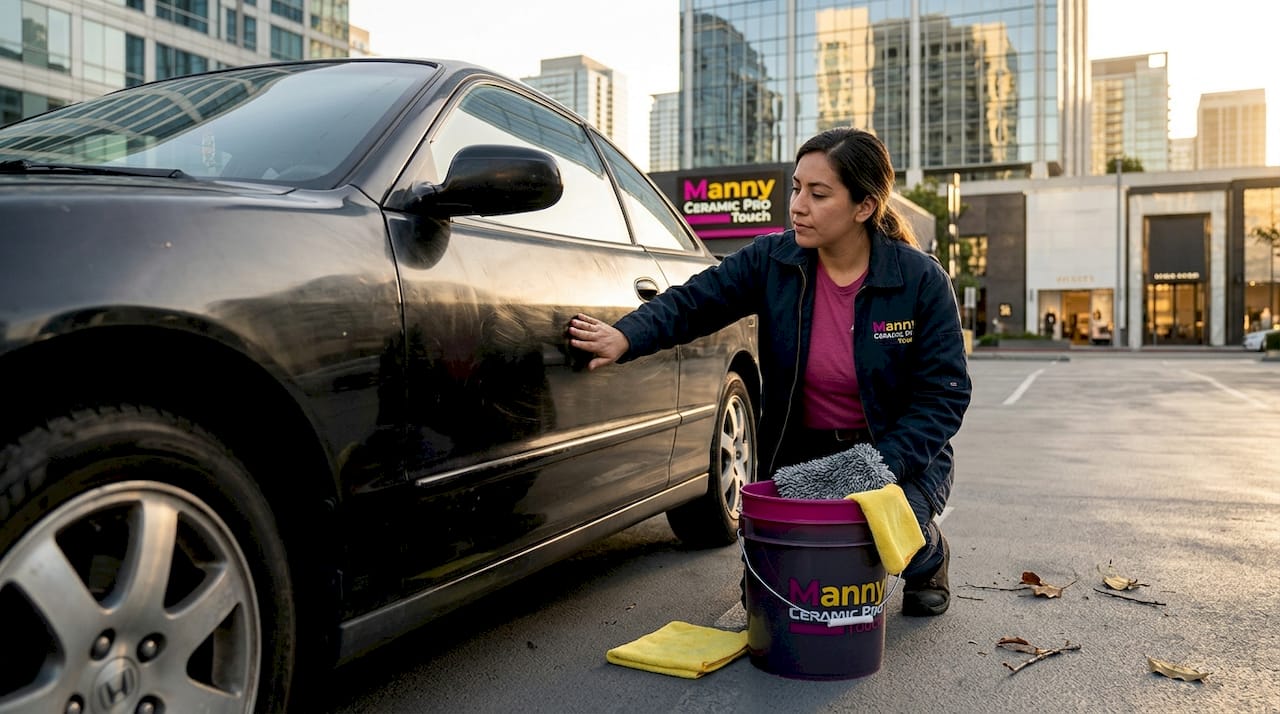
Persistent stains from bird droppings and tree sap are particularly telling. Fresh ceramic coating causes those contaminants to sit on top of the surface where they can be removed cleanly. When the coating fails, the same contaminants begin to react chemically with the clear coat within hours, especially in Fort Lauderdale’s heat. If you notice etching or staining even after prompt cleaning, your protection has already degraded.
How to approach washing a vehicle with a thinning coating:
- Use a pH-neutral wash shampoo every time. Alkaline or acidic products accelerate coating breakdown.
- Use the two-bucket wash method to minimize cross-contamination and avoid dragging abrasive particles across the surface.
- Dry with a clean microfiber towel using light, lifting motions rather than dragging.
- Apply a coating-compatible spray detailer after each wash to add a temporary layer of protection while the primary coating wears.
- Schedule a professional inspection at the first sign of increased wash difficulty.
Pro Tip: Keep a log of how long each wash takes and how much product you use. A sudden increase in either is an early indicator your coating needs attention. The luxury car maintenance guide covers the full washing protocol for coated vehicles in detail.
Comparing ceramic coating longevity and maintenance timelines
Knowing when to apply ceramic coating is as important as knowing why. Not all ceramic coatings are built the same, and the expected lifespan varies considerably by tier, application quality, and environmental conditions.
FEYNLAB Level I coatings show initial wear signs at around 18 to 24 months, with reapplication advised by the 2 to 3 year mark. Higher-tier formulations extend that window significantly, with advanced coatings like FEYNLAB Level III maintaining full performance for 4 to 5 years under proper care. Fort Lauderdale’s climate, with its year-round UV intensity and high humidity, consistently pushes vehicles toward the lower end of those durability ranges.
| Coating tier | Expected lifespan | Fort Lauderdale adjusted timeline | Signs of early wear |
|---|---|---|---|
| Entry-level | 1 to 2 years | 12 to 18 months | Sheeting water, reduced gloss |
| Mid-grade | 2 to 3 years | 18 to 24 months | Flat beading, minor swirl marks |
| Professional-grade | 3 to 5 years | 2.5 to 4 years | Subtle hydrophobicity loss |
| Advanced/premium | 4 to 5+ years | 3.5 to 5 years | Minimal change with proper care |
Planning for reapplication within 3 to 6 months after the first wear signs appear is the right approach. Waiting until the coating has failed completely means the paint is already exposed and may require correction before a new coat can be applied. Booking a consultation to review premium ceramic coating packages while some protection remains is always more cost-effective than addressing the damage after the fact.
Ceramic coating vs other paint protections: when to choose a reapplication or upgrade
Not every situation calls for a straightforward reapplication. Understanding how ceramic coating compares to alternatives like paint protection film (PPF) helps luxury owners make the right call based on their vehicle’s actual condition and use.
Ceramic coatings deliver excellent hydrophobic properties, UV resistance, and gloss enhancement. They are the right choice for preserving appearance and chemical resistance across the full vehicle. However, they offer limited protection against physical impacts like stone chips, road debris, and abrasion. That is where PPF has a clear advantage. PPF protects against physical damage while ceramic coatings guard against UV, chemical, and hydrophobic damage, and combining both methods delivers the most complete protection available.
| Feature | Ceramic coating | Paint protection film (PPF) |
|---|---|---|
| UV resistance | Excellent | Good |
| Hydrophobicity | Excellent | Moderate |
| Impact/chip resistance | Minimal | Excellent |
| Self-healing properties | None | Yes (thermally activated) |
| Gloss enhancement | High | Moderate to high |
| Lifespan | 2 to 5 years | 5 to 10 years |
For luxury owners deciding between a reapplication or a protection upgrade:
- Reapplication is appropriate when the coating has worn thin but paint correction is not needed
- Combining PPF and ceramic coating is the right move for high-impact areas like the hood, bumper, and mirrors
- Full upgrade consideration is warranted when paint damage, oxidation, or deep scratches exist under the worn coating
- Exotic and collector vehicles benefit most from a layered approach that addresses both physical and chemical threats
Understanding the full picture is covered in the PPF vs ceramic coating comparison, which walks through the decision criteria in detail.
Why early detection and professional maintenance are vital for luxury cars
Here is a perspective that most detailing content does not address directly: the threshold for acceptable coating wear is much lower on a luxury or exotic vehicle than it is on a daily driver. That is not about aesthetics alone. A Ferrari, McLaren, or Bentley carries a factory paint process and finish quality that takes years of UV exposure to degrade, but once that process begins, the resale consequences are disproportionate to the surface area involved.
Waiting for obvious visual damage before acting is a costly strategy. By the time swirl marks and oxidation are visible to a casual observer, paint correction has already entered the picture. Correction removes clear coat. Every removal cycle reduces the remaining thickness available for future protection. On a vehicle where factory paint depth is the standard against which resale value is measured, that matters considerably.
Professional inspectors work with paint depth gauges and coating-specific tests that detect thinning long before any visual or tactile sign reaches the owner’s awareness. That early window, before any paint correction is needed, is where timely reapplication delivers maximum return. A single reapplication at the right moment extends total coating life and eliminates the cost of correction entirely.
Fort Lauderdale’s climate adds another layer of urgency. Vehicles parked outdoors here accumulate UV damage faster than in most other U.S. cities. That reality demands a maintenance schedule calibrated to local conditions, not generic manufacturer timelines. The elite luxury car maintenance checklist provides a region-specific framework for keeping coating protection current.
Expert ceramic coating and paint protection services in Fort Lauderdale
If the signs described in this article match what you are observing on your vehicle, the next step is a professional evaluation from specialists who work exclusively with luxury and exotic cars.
Manny’s Ceramic Pro Touch LLC provides tailored premium ceramic coating packages engineered for the demands of South Florida’s climate and the specific finishes found on high-value vehicles. Whether your vehicle needs a straightforward reapplication, a layered approach with paint protection film services, or a full coating evaluation, the process starts with a detailed assessment of your current protection status. Certified technicians examine hydrophobicity, paint depth, and surface condition to recommend exactly what your vehicle needs, nothing more and nothing less. Mobile detailing services are also available for clients who prefer professional care without leaving their location. Schedule a consultation and keep your vehicle protected at the level it was built to maintain.
Frequently asked questions
How long does a ceramic coating typically last on a luxury car?
Most ceramic coatings last between 2 to 5 years depending on the product tier and maintenance quality, with premium-grade coatings lasting longer. FEYNLAB Level I coatings last around 18 to 24 months, while higher tiers can reach 4 to 5 years under proper care.
What is the best way to check if my ceramic coating needs reapplication?
Perform a water bead test on the hood after washing and run your hand across the panel to feel for texture or drag. Water beading that changes from tight beads to sheeting, combined with increased surface roughness, are the clearest indicators coating wear has begun.
Can I apply a new ceramic coating over an existing one?
Yes, a fresh coating can be applied over a worn but still partially intact coating following proper surface decontamination and preparation. Completely failed coatings require removal first, but reapplying over some remaining protection typically yields better results and reduces overall cost.
How does Fort Lauderdale’s climate affect ceramic coating maintenance?
The region’s intense UV exposure and year-round humidity accelerate coating degradation faster than national average timelines suggest. UV exposure and environmental contaminants speed coating breakdown particularly in sunny, humid climates, making more frequent inspections and earlier reapplications essential for vehicles in this area.