

TL;DR:
- H hardness measures a coating’s resistance to scratching with a standard pencil, not absolute durability. It equates to roughly Mohs 3–4, similar to window glass, and does not prevent damage from harder materials like quartz. Proper surface preparation and professional application are essential to achieve the coating’s full protective potential.
9H hardness is a standardized rating that defines a coating’s ability to resist scratching by a 9H-grade pencil under controlled test conditions. The term comes from the pencil hardness scale, not the Mohs mineral hardness scale, and that distinction matters more than most product labels suggest. Car owners researching ceramic coatings and paint protection film encounter this rating constantly, yet the marketing around it creates more confusion than clarity. Understanding what 9H hardness actually measures, and what it does not, gives you a real basis for evaluating any protective coating for your vehicle.
What is the pencil hardness test and how does the 9H rating work?
The pencil hardness test is an industry-standard method for measuring a coating’s scratch resistance. The formal procedure is defined by ASTM D3363, which specifies that a series of pencils ranging from 6B (the softest) to 9H (the hardest) are drawn across a coated surface at a 45-degree angle under controlled pressure. The hardest pencil that leaves no visible mark on the coating determines its hardness rating.
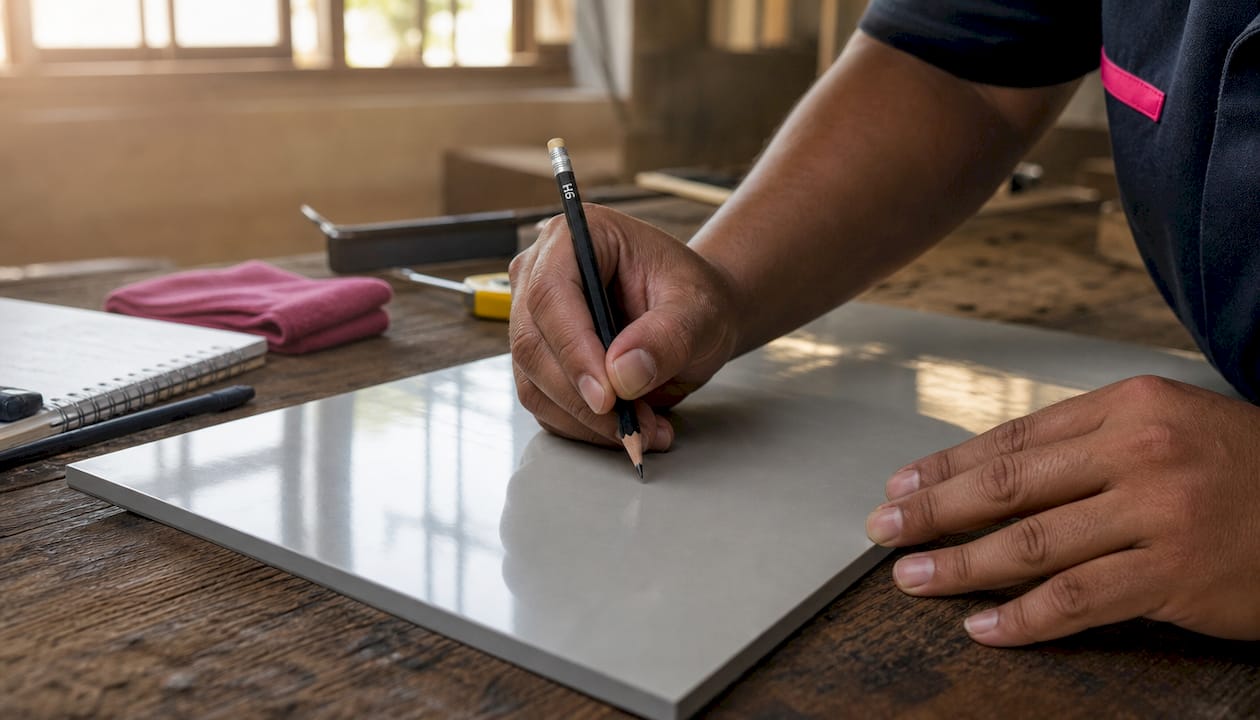
The test measures two related but distinct outcomes. Gouge hardness identifies the hardest pencil that physically cuts into the coating film. Scratch hardness identifies the hardest pencil that leaves a visible surface mark without cutting through. Both results give coating manufacturers and applicators a relative benchmark for how well a product resists surface damage under standardized conditions.
The pencil scale runs from 9B (very soft) through B, HB, F, H, and up to 9H. A 9H pencil contains the hardest graphite lead available in the standard set. When a coating earns a 9H rating, it means the coating surface withstood scratching from that hardest pencil without visible marring.
Key facts about the ASTM D3363 test:
- Testing occurs on flat, static surfaces under laboratory conditions
- Pressure applied to the pencil is controlled and consistent
- The test is qualitative and relative, not an absolute measure of durability
- Results reflect the degree of coating cure as much as raw surface hardness
- The pencil hardness test is designed as an industrial proxy for coating quality, not a field performance guarantee
Pro Tip: When evaluating a 9H-rated coating, ask the applicator which specific test method was used. ASTM D3363 and ISO 15184 are the recognized standards. Any rating not tied to one of these procedures carries no verifiable meaning.
How does 9H hardness compare to the Mohs mineral hardness scale?
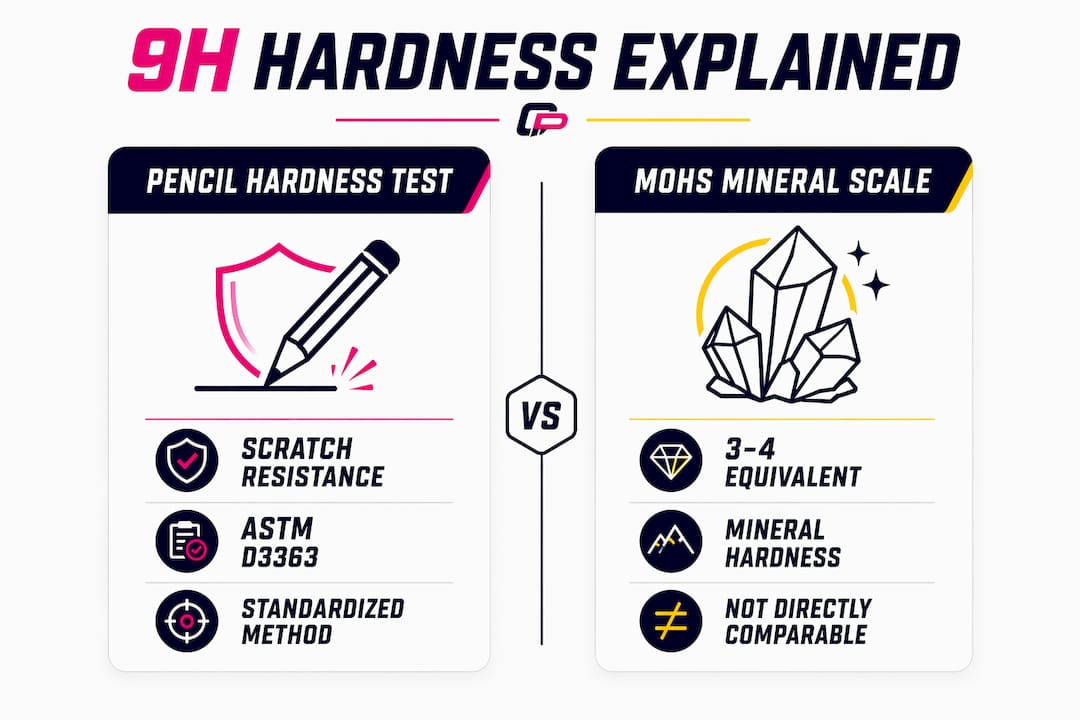
The most widespread misunderstanding about the 9H hardness definition is the assumption that it relates to the Mohs scale. The Mohs scale measures how one mineral scratches another, running from 1 (talc) to 10 (diamond). A rating of 9 on the Mohs scale means sapphire, one of the hardest natural substances on earth.
A 9H pencil hardness rating is nowhere near that level. 9H pencil hardness equates to roughly 3–4 on the Mohs scale, which is similar to window glass. That means quartz particles, which sit at Mohs 7 and are common in road dust and sand, can still scratch a 9H-rated coating. The two scales measure fundamentally different things using fundamentally different methods.
| Scale | Range | What It Measures | 9H Equivalent |
|---|---|---|---|
| Pencil Hardness (ASTM D3363) | 6B to 9H | Coating scratch resistance via pencil lead | Highest pencil rating |
| Mohs Mineral Hardness | 1 to 10 | Mineral-to-mineral scratch resistance | Approximately 3–4 |
| Mohs Reference Points | 1 (talc), 10 (diamond) | Absolute mineral hardness | Window glass = ~5.5 |
The practical implication is direct. A 9H ceramic coating on your vehicle’s paint will resist everyday contact from keys, coins, and fingernails. It will not resist a quartz-laden microfiber cloth dragged across the surface under pressure, because quartz outranks the coating on the Mohs scale. Knowing this prevents unrealistic expectations and guides smarter maintenance choices.
What does 9H hardness mean for real-world durability?
In practical terms, 9H hardness means a coating resists scratching from keys, coins, and everyday abrasions. That covers a meaningful range of daily hazards for a vehicle’s paint surface. Parking lot door dings, light contact with clothing zippers, and casual brushing against the car all fall within the protection zone of a properly applied 9H coating.
The rating does not cover everything. A 9H coating will not protect against:
- High-energy impacts from road debris or gravel
- Abrasive particles like sand or quartz-based dust under friction
- Deep gouges from sharp metal tools or aggressive scraping
- Shatter or crack damage from concentrated point impacts
- Dynamic real-world conditions that differ from the static lab test environment
Professional application and surface preparation directly affect how a 9H coating performs beyond the lab. A coating applied over contaminated or improperly polished paint will not bond correctly, reducing its effective hardness regardless of what the label states. The surface prep process before application is as important as the coating’s rated hardness.
For automotive paint, a 9H ceramic coating contributes to long-term preservation by reducing micro-scratches that accumulate over time and dull the finish. These micro-scratches are the primary cause of paint looking faded or hazy on vehicles that have not been protected. A well-applied 9H coating slows that process significantly. The scratch resistance benefits for luxury vehicles are especially meaningful because factory paint on high-end cars is often thinner and more vulnerable than paint on standard production vehicles.
Pro Tip: A 9H coating applied over a single-stage paint correction will outperform a 9H coating applied over swirl-marked paint every time. The hardness rating reflects the coating’s potential. Surface prep determines whether that potential is realized.
One more point worth understanding: 9H tempered glass used in screen protectors undergoes chemical strengthening through an ion-exchange process that creates compressive stress layers. This improves scratch resistance and adds some impact durability over standard glass. Even so, it remains vulnerable to minerals harder than itself, including quartz found in everyday dust. The same physics apply to automotive ceramic coatings.
Common myths and misunderstood facts about 9H hardness ratings
The marketing around 9H hardness has created a set of persistent myths that lead buyers to misplace their trust or spend money on products that cannot deliver what they promise.
Myth 1: 9H means scratch-proof.
A 9H rating means scratch-resistant up to a 9H pencil. Materials rated 9H remain vulnerable to abrasive particles and high-energy impacts not captured by the ASTM D3363 test. No coating is scratch-proof.
Myth 2: Ratings above 9H are better.
Claims of 10H or 12H hardness are scientifically meaningless. ASTM D3363 and ISO 15184 both end at 9H. There is no validated laboratory procedure for any rating above 9H. These numbers are invented marketing terms with no empirical backing.
Myth 3: 9H equals Mohs 9.
Consumers frequently interpret 9H as equivalent to sapphire-level hardness. The actual equivalence is approximately Mohs 3–4. This confusion is the most consequential myth because it leads people to believe their coating is nearly indestructible.
Myth 4: Hardness equals toughness.
Hardness and toughness are different material properties. A hard surface resists scratching. A tough surface resists cracking or breaking under impact. The pencil hardness test measures only hardness. A 9H coating can be brittle under the right conditions.
Myth 5: Any 9H product performs the same.
The 9H rating reflects test results under controlled conditions. Real-world performance depends on coating chemistry, film thickness, surface preparation, and application quality. Two products with identical 9H ratings can perform very differently on an actual vehicle.
Understanding professional expertise in automotive services matters here. Certified and experienced applicators understand these distinctions and apply coatings in ways that maximize the rating’s real-world value.
Key Takeaways
9H hardness is a relative scratch-resistance benchmark defined by ASTM D3363, not an absolute measure of durability, impact resistance, or mineral hardness.
| Point | Details |
|---|---|
| 9H hardness definition | Defined by ASTM D3363 as resistance to scratching by the hardest standard pencil under controlled conditions. |
| Not equivalent to Mohs 9 | 9H pencil hardness equals roughly Mohs 3–4, similar to window glass, not sapphire or diamond. |
| Scratch-resistant, not scratch-proof | Protects against keys, coins, and daily abrasions but not quartz dust, sharp impacts, or deep gouges. |
| Ratings above 9H are invalid | Claims of 10H or 12H have no scientific basis; ASTM D3363 and ISO 15184 both end at 9H. |
| Application quality determines performance | Surface preparation and professional application determine whether a 9H coating reaches its rated potential. |
What I’ve learned about 9H hardness after years of applying coatings
The 9H rating is genuinely useful. It gives you a standardized, reproducible benchmark for comparing coatings under the same test conditions. That matters when you are selecting a product for a vehicle worth protecting. But I have seen too many clients arrive expecting a 9H coating to make their paint bulletproof, and that expectation sets them up for disappointment.
The number that matters most is not the hardness rating. It is the quality of the prep work done before the coating goes on. I have applied 9H-rated coatings over perfectly decontaminated, polished paint and watched them perform beautifully for years. I have also seen the same rated products fail within months because the surface underneath was not properly prepared. The coating’s hardness cannot compensate for what is underneath it.
The other thing I tell every client: hardness and protection are not the same thing. A 9H coating will not stop a rock chip. It will not prevent a deep scratch from a careless shopping cart. What it does is reduce the accumulation of micro-scratches that slowly destroy the depth and clarity of your paint over time. That is a real, measurable benefit. It is just a narrower benefit than the marketing often implies.
My advice is to treat the 9H rating as a quality indicator, not a performance guarantee. Pair it with realistic maintenance habits, proper washing technique, and professional application, and it delivers exactly what it promises. Expect more than that, and you will be disappointed regardless of what the label says.
— Emmanuel
Advanced 9H coating protection at Mannyceramicprotouch
Mannyceramicprotouch applies premium 9H-rated ceramic coatings and Liquid PPF to luxury and high-value vehicles in Fort Lauderdale and across South Florida. Every application begins with a thorough surface decontamination and paint correction process, because the coating’s rated hardness only performs at its best on a properly prepared surface.

Clients who want the full benefit of a 9H hardness coating without the guesswork of DIY application can review Liquid PPF options in Fort Lauderdale or explore the full range of paint protection services available at Mannyceramicprotouch. Each service is built around long-term paint preservation, not a one-size-fits-all approach.
FAQ
What is 9H hardness in simple terms?
9H hardness is a rating that means a coating can resist scratching from a 9H-grade pencil, the hardest in the standard pencil set, under controlled test conditions defined by ASTM D3363. It measures scratch resistance, not impact resistance or absolute durability.
Is 9H hardness the same as Mohs 9?
No. 9H pencil hardness equates to approximately Mohs 3–4, similar to window glass. Mohs 9 refers to sapphire, which is vastly harder. The two scales measure different things using different methods.
Can a 9H coating be scratched?
Yes. A 9H coating resists scratching from keys, coins, and everyday contact, but minerals harder than Mohs 3–4, including quartz found in road dust and sand, can still scratch the surface.
What does 10H or 12H hardness mean?
Nothing scientifically valid. ASTM D3363 and ISO 15184 both end at 9H. Any hardness claim above 9H has no standardized test procedure behind it and is a marketing term without empirical support.
Does professional application affect 9H coating performance?
Yes, significantly. Surface preparation and application quality determine whether a 9H coating bonds correctly and performs at its rated level. A 9H coating applied over improperly prepared paint will underperform regardless of its lab rating.
Recommended
- Scratch Resistance for Luxury Vehicles: 2026 Guide – Many Ceramic Pro Touch
- Top Reasons for Nano Coatings on Your Vehicle – Manny’s Ceramic Pro Touch and Luxury Surface Preservation™
- Steps to Prep Your Car for Coating: Expert Guide – Many Ceramic Pro Touch
- Understanding Automotive Surface Technology in 2026 – Many Ceramic Pro Touch