

TL;DR:
- Surface contaminants, including oils, salts, dirt, and biological residues, can cause coating failure on vehicles by preventing proper adhesion. Invisible layers like skin oils and airborne hydrocarbons often go unnoticed but create weak boundary layers that lead to early coating failure. Proper surface testing, thorough decontamination, and strict process control are essential to ensure high-value vehicles are correctly prepared before applying protective coatings.
Surface contaminants are substances like oils, salts, dirt, and chemical residues that bond to a vehicle’s paint or clear coat and degrade both appearance and protective coating performance. For owners of luxury and high-value automobiles, understanding surface contamination is not optional. It is the foundation of every successful paint protection film (PPF) or ceramic coating application. A surface that looks clean to the eye can still carry invisible contaminants that cause coatings to fail within weeks of application.
What are the types of surface contaminants on vehicles?
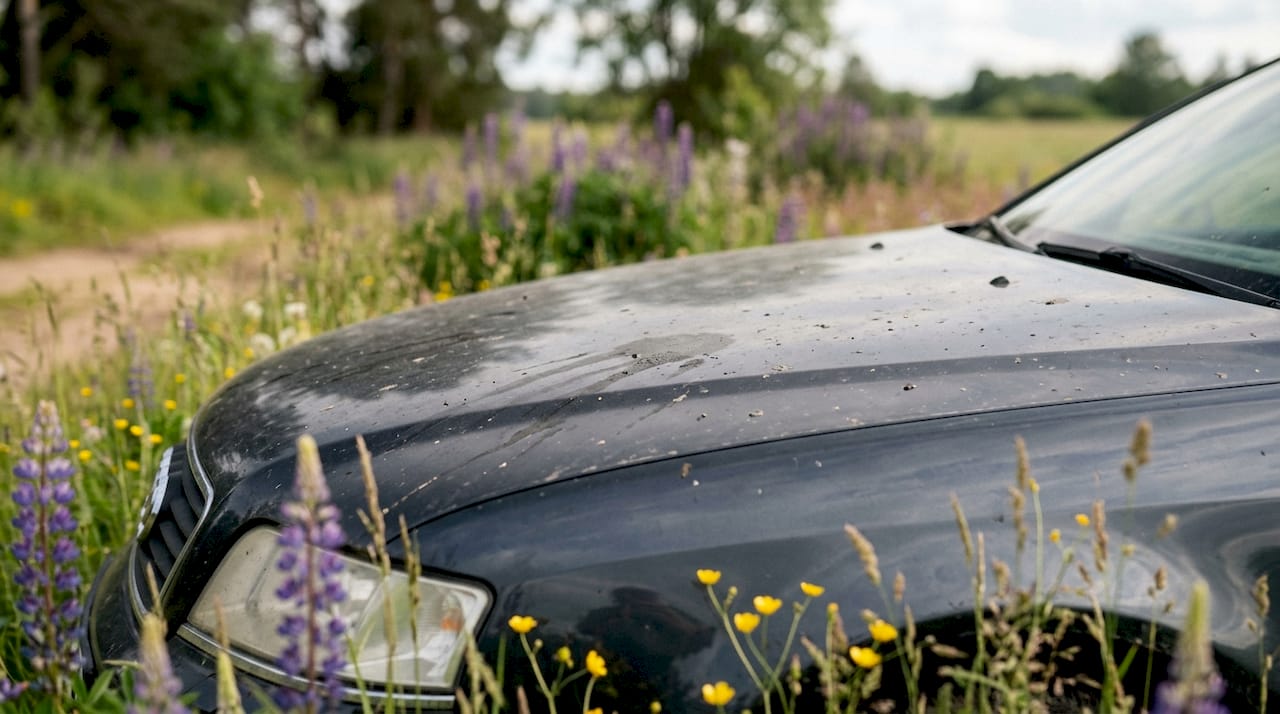
Surface contaminants fall into two categories: visible and non-visible. Visible contaminants include oils, grease, dirt, dust, and industrial fallout. Non-visible contaminants include soluble salts such as chlorides, sulfates, and nitrates. Both categories are present on nearly every vehicle that has spent time on public roads or in storage.
The distinction between visible and non-visible contamination matters because they require different removal strategies. Visible contamination is addressed through standard washing and decontamination. Non-visible soluble salts demand targeted solvent cleaning and, in some cases, professional testing.
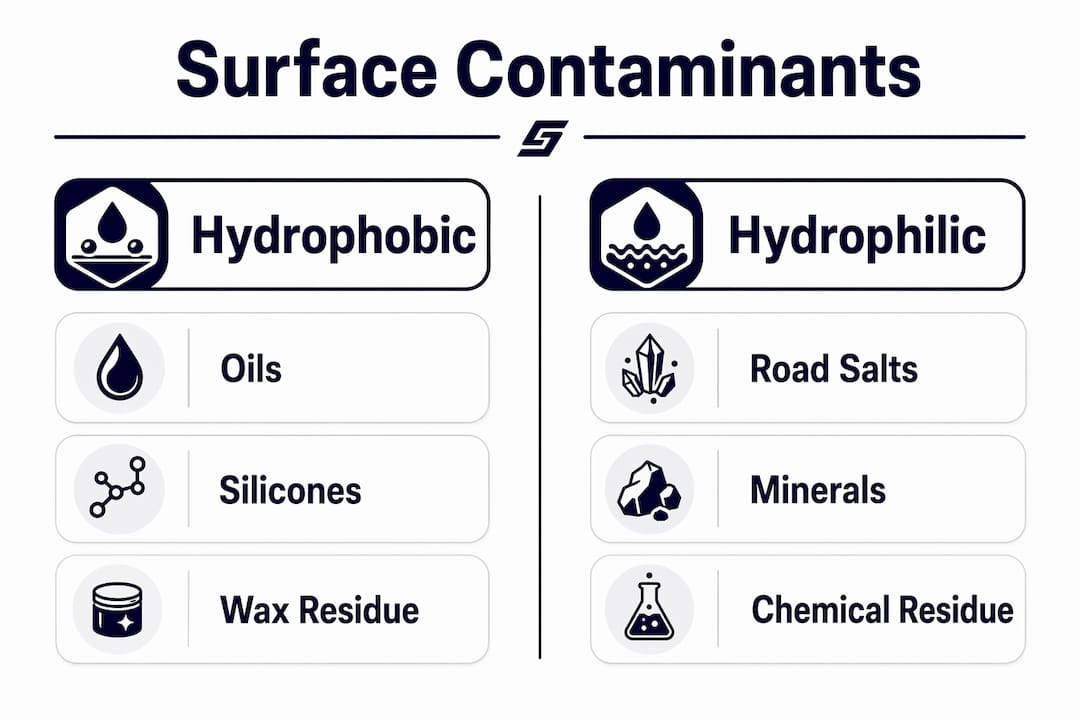
Contaminants also differ by how they interact with water and surface energy:
- Hydrophobic contaminants (oils, silicones, waxes) increase the contact angle of water on the surface. They repel water and prevent coatings from bonding properly.
- Hydrophilic contaminants (soaps, detergents, water-soluble salts) decrease the contact angle. They create a weak boundary layer that undermines adhesion even when the surface appears dry and clean.
- Particulate contaminants (brake dust, rail dust, industrial fallout) embed into the clear coat and cause oxidation and staining over time.
- Biological contaminants (bird droppings, tree sap, insect residue) are acidic and etch paint within hours in direct sunlight.
Hydrophobic and hydrophilic contaminants reduce surface energy in different ways, but both prevent the molecular bonding that ceramic coatings and PPF require to perform correctly. That is the core problem vehicle owners face.
| Type | Examples | Primary Effect |
|---|---|---|
| Hydrophobic | Oils, silicones, wax residue | Prevents coating adhesion |
| Hydrophilic | Soaps, detergents, soluble salts | Creates weak boundary layer |
| Particulate | Brake dust, rail dust, fallout | Oxidation, staining, etching |
| Biological | Bird droppings, tree sap | Acid etching of clear coat |
| Manufacturing | Mold release agents, cutting fluids | Coating delamination |
How do surface contaminants affect vehicle coatings and paint?
Coating failure almost always traces back to contamination that was present at the time of application. Premature coating failures are caused by oil, grease, soluble salts, and moisture residues that trigger blistering, osmotic delamination, and corrosion shortly after application. These are not gradual failures. They appear within weeks and are irreversible without full removal and reapplication.
The mechanism is straightforward. Contaminants create what surface scientists call a Weak Boundary Layer. This is an invisible film between the substrate and the coating that prevents true molecular adhesion. The coating bonds to the contaminant layer instead of the paint. When that contaminant layer breaks down under heat, UV exposure, or moisture, the coating separates.
Common failure symptoms and their typical timelines:
- Blistering (2–8 weeks post-application): Moisture trapped under the film expands and lifts the coating from the surface.
- Delamination (1–3 months): The coating peels away in sheets, often starting at panel edges where contamination concentrates.
- Corrosion under film (3–12 months): Soluble salts draw moisture through micro-pores in the coating, accelerating rust on metal panels.
- Discoloration and hazing (ongoing): Biological and chemical contaminants react with the coating chemistry and alter its optical clarity.
- Loss of hydrophobic performance (immediate): A contaminated surface prevents the self-cleaning effect that ceramic coatings are designed to deliver.
Invisible Weak Boundary Layers from skin oils and airborne hydrocarbons cause adhesion failure even when the surface looks perfectly clean. This is the most common and most underestimated cause of coating failure on luxury vehicles.
Pro Tip: Never touch a decontaminated panel with bare hands. Skin oils transfer immediately and create a Weak Boundary Layer that no visual inspection will catch.
How can vehicle owners identify surface contaminants?
Visual inspection alone does not confirm surface cleanliness. Contact angle measurement is far more reliable than the human eye for diagnosing surface readiness before coating. A surface can look spotless and still carry enough contamination to cause coating failure.
Practical detection methods range from simple field tests to laboratory-grade analysis:
- Water break test: Pour or spray deionized water across the surface. Clean surfaces sheet water evenly. Hydrophobic contamination causes water to bead into droplets rather than sheet. Beading on a freshly washed surface is a clear contamination signal.
- Contact angle measurement: A scientific method that quantifies surface energy. A contact angle above 90 degrees indicates hydrophobic contamination. Professional studios use this to confirm readiness before applying ceramic coatings or PPF.
- UV fluorescence test: UV light reveals oil-based contaminants that are completely invisible under standard lighting. This method is used in professional pre-coating inspection.
- Tape test: Pressing and lifting a strip of clean tape from the surface reveals particulate contamination. Residue on the tape confirms the surface is not ready for coating.
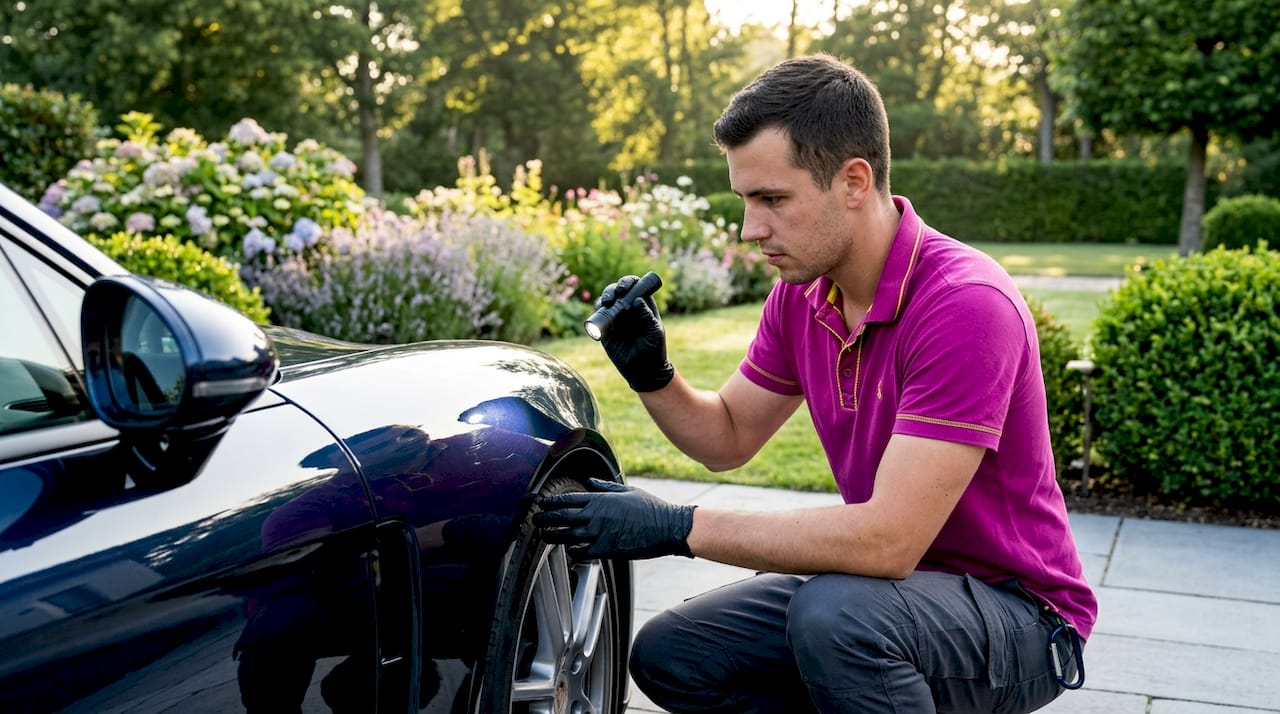
- Visual raking light inspection: A focused light source held at a low angle across the panel reveals surface texture irregularities, embedded particles, and residue patterns.
Pro Tip: Run the water break test after every decontamination step, not just at the end. It takes 30 seconds and confirms whether each stage of cleaning actually worked.
For high-value car preparation, professional contact angle testing removes all guesswork before a coating goes down. The cost of retesting is always lower than the cost of reapplication after a failure.
What are the best practices to remove and prevent surface contaminants?
Contaminant removal follows a specific sequence. Skipping steps or reversing the order reintroduces contamination and wastes every previous effort. The goal is a surface with zero boundary layer interference before any protective product touches the paint.
Effective removal and prevention practices include:
- Start with solvent cleaning. Acetone, isopropyl alcohol (IPA), and lacquer thinner each target different contaminant types. IPA removes light oils and wax residue. Acetone addresses heavier hydrocarbon contamination. Always use fresh, lint-free paper towels and wipe in one direction only. Never scrub back and forth, as this redistributes contaminants rather than removing them.
- Use clean tools at every stage. Cross-contamination from tools is one of the most common preparation errors. A clay bar, applicator pad, or polishing pad that has touched a contaminated surface will transfer that contamination to every subsequent panel.
- Avoid unfiltered compressed air. Compressed air lines without proper filtration introduce moisture and compressor oil onto freshly cleaned surfaces. Use filtered, dry air only, or avoid compressed air entirely during final preparation.
- Control the environment. Airborne dust, pollen, and industrial fallout settle on surfaces within minutes in an open environment. Prepare and coat vehicles in a clean, enclosed space with controlled airflow.
- Protect the surface immediately after cleaning. Once decontamination is complete, the coating application window is short. Delays allow airborne hydrocarbons and handling oils to recontaminate the surface. Move directly from final cleaning to coating application.
Understanding surface preparation protocols is what separates a coating that lasts years from one that fails in months. The preparation phase is where the outcome is decided, not the coating application itself.
For owners interested in how body paint services handle contamination control in professional finishing environments, the standards mirror what high-end coating studios apply to automotive surfaces.
Key Takeaways
Surface contaminants are the primary cause of coating failure on high-value vehicles, and invisible contamination is more dangerous than visible dirt because it escapes standard inspection.
| Point | Details |
|---|---|
| Two contamination categories | Visible contaminants (oils, dirt) and non-visible soluble salts both cause coating failure through different mechanisms. |
| Weak Boundary Layer risk | Invisible films from skin oils and airborne hydrocarbons prevent coating adhesion even on visually clean surfaces. |
| Water break test reliability | Water beading on a freshly washed surface confirms hydrophobic contamination and signals the surface is not ready for coating. |
| Tool and air hygiene | Cross-contaminated tools and unfiltered compressed air reintroduce contamination after cleaning and undermine preparation. |
| Preparation determines outcome | The quality of surface preparation, not the coating product, determines how long a ceramic coating or PPF performs. |
What I’ve learned about invisible contamination after years of luxury car prep
The most expensive mistake I see on high-value vehicles is not a bad coating product. It is a contaminated surface that nobody caught before application. Owners bring in cars that were “detailed last week” and assume the surface is ready. The water break test tells a different story almost every time.
Invisible contamination is the rule, not the exception. Airborne hydrocarbons settle on paint within hours of cleaning in most shop environments. A fingerprint from moving a panel leaves enough skin oil to create a Weak Boundary Layer across several square inches. These are not edge cases. They are standard conditions that every preparation protocol must account for.
The discipline required for luxury car preparation is not about using expensive products. It is about process control: clean tools, filtered air, no bare-hand contact, and objective testing at every stage. Owners who understand this protect their investment at the preparation level, before a single drop of ceramic coating or PPF touches the paint.
My honest recommendation is to treat every surface as contaminated until a water break test or contact angle measurement proves otherwise. Appearance is not evidence. A surface that sheets water cleanly and passes a UV inspection is ready. Everything else is an assumption, and assumptions fail on $200,000 cars.
— Emmanuel
How Mannyceramicprotouch protects your vehicle from surface contamination
Contamination control is built into every service at Mannyceramicprotouch. Before any ceramic coating or Liquid PPF touches a vehicle, the surface goes through a structured decontamination protocol that includes solvent cleaning, water break testing, and controlled-environment preparation.
Mannyceramicprotouch works exclusively with luxury, exotic, and high-value vehicles where preparation standards cannot be compromised. The studio’s Liquid PPF solutions are applied only after the surface passes objective cleanliness verification. Owners who want their vehicle’s finish preserved at the highest level can schedule a contamination assessment and protection consultation directly through Mannyceramicprotouch.
FAQ
What are surface contaminants in automotive care?
Surface contaminants are substances including oils, salts, grease, dust, and biological residues that adhere to vehicle paint and interfere with coating adhesion and appearance. They include both visible deposits and invisible layers that standard washing does not remove.
Can a clean-looking car still have surface contaminants?
Yes. Invisible contaminants like skin oils, airborne hydrocarbons, and soluble salts leave no visible trace but create Weak Boundary Layers that cause ceramic coatings and PPF to fail. The water break test is the most reliable field method to confirm actual surface cleanliness.
How do I know if my car’s surface is contaminated before coating?
The water break test is the standard field check: water beading on a freshly washed surface indicates hydrophobic contamination. Professional studios also use contact angle measurement and UV fluorescence testing for a complete assessment before applying any protective product.
What contaminants cause the most damage to ceramic coatings?
Soluble salts (chlorides and nitrates) and oil-based contaminants cause the most severe coating failures, including blistering, delamination, and corrosion under the film. These failures typically appear within weeks of application when the surface was not properly decontaminated.
How often should vehicle owners check for surface contamination?
Run a water break test after every wash and before any detailing product is applied. For vehicles receiving ceramic coatings or PPF, professional decontamination and objective surface testing should be completed immediately before the application session.