

TL;DR:
- Automotive preservation involves maintaining a vehicle’s original factory materials, protecting its value and authenticity over time. Preserved vehicles command higher prices and lower costs than restorations, especially when fully documented and stored safely. Active professional care and careful assessment are essential to uphold the vehicle’s survivor status and long-term investment value.
Automotive preservation is defined as the intentional maintenance and protection of a vehicle’s original factory materials, finish, and components to sustain its value and appearance over time. This discipline, formally recognized in the collector car market as “survivor car” stewardship, sits at the center of a growing investment strategy for car owners who want long-term returns. The global automotive restoration parts and services market reached $16.94 billion in 2025, reflecting the enormous economic weight behind vehicle condition decisions. Understanding why invest in automotive preservation starts with knowing what it actually protects and what it costs to ignore.
Why invest in automotive preservation: the core case
Automotive preservation delivers a measurable financial advantage over restoration. Well-preserved original classics can sell for 75–100% more than the best restored examples, particularly when the vehicle is rare and fully documented. That premium exists because the market now treats original factory paint and trim as an unrepeatable asset. Once that finish is sanded or repainted, the historical fabric of the car is gone permanently.
The collector market confirmed this shift in a dramatic way. A preserved Bugatti Type 59 Sports won Best of Show at the 73rd Pebble Beach Concours d’Elegance, the first time in the event’s history that originality outperformed a full restoration at that level. That result sent a clear signal to collectors and investors worldwide. Originality is no longer a consolation prize. It is the top prize.
Beyond prestige events, the financial logic is straightforward. Preservation typically costs far less than a full restoration, which can run into six figures for a high-value vehicle. Protecting what already exists is always cheaper than rebuilding what was lost.
What is automotive preservation and how does it differ from restoration?
Preservation and restoration are not interchangeable terms. They represent two fundamentally different philosophies with very different financial outcomes.
Preservation means protecting a vehicle’s existing original materials, including factory paint, original upholstery, chrome trim, and mechanical components, without irreversible alteration. The goal is to stabilize the car’s current condition and prevent further deterioration while keeping its authentic character intact. Collectors call these vehicles “survivors,” and the market preference for originality has been shifting decisively in their favor, with low-mileage survivors now regularly outperforming restored equivalents at auction.
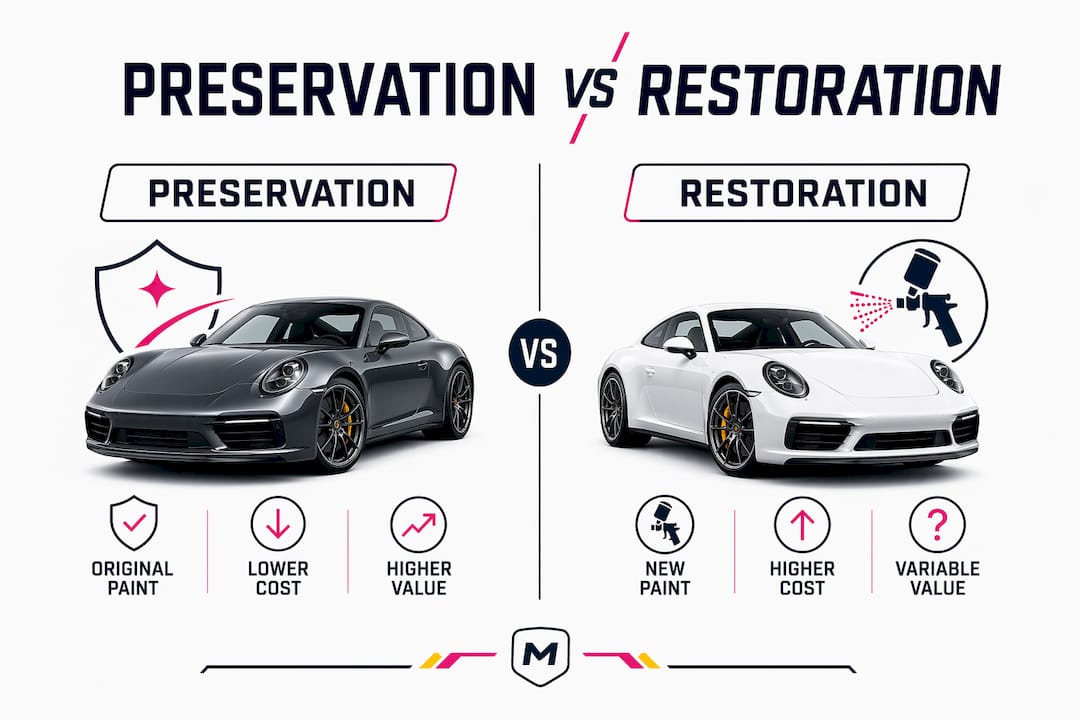
Restoration means returning a vehicle to a like-new appearance through refinishing, repainting, and replacing worn or damaged parts. A well-executed restoration can be beautiful, but it permanently removes the original factory finish. As the industry phrase goes, “you can restore later, but you can never unrestored.”
| Feature | Preservation | Restoration |
|---|---|---|
| Original factory paint | Retained | Removed and replaced |
| Patina and aging | Valued and protected | Eliminated |
| Cost level | Lower, ongoing maintenance | Higher, one-time major investment |
| Collector market appeal | Increasing, especially for rare cars | Stable, but lower ceiling for rare models |
| Reversibility | Irreversible threshold if crossed | Cannot return to original state |
Pro Tip: Before committing to any work on a classic vehicle, have a specialist assess whether the original paint is intact. That single factor determines whether preservation or restoration is the right path.
The key insight is that preservation is not passive neglect. It is an active, professional discipline. Surfaces need oxidation stabilization, protective coatings, and controlled storage environments to remain viable. Doing nothing is not preservation. It is deterioration.
Benefits and financial impacts of preserving a vehicle
The financial case for preservation is built on three pillars: price premiums, lower ongoing costs, and documentation value.

The price premium is the most compelling argument. Preserved survivors command a 75–100% price advantage over restored counterparts at auction. That gap reflects what buyers are actually paying for: proof that the car has never been compromised. For rare models with low production numbers, that premium can be even wider.
The cost advantage is equally significant. A full concours-level restoration on a collectible vehicle can cost as much as or more than the car’s market value. Preservation avoids that expense entirely by protecting what already exists. The ongoing cost of professional preservation treatments, including ceramic coatings, oxidation control, and climate-controlled storage, is a fraction of a full restoration budget.
Documentation is the third pillar, and it is often underestimated. Detailed records of storage, service history, and preservation interventions serve as proof of provenance. That proof multiplies a vehicle’s value by giving buyers confidence in what they are purchasing. A car with a complete build book and service history commands a premium that an undocumented vehicle simply cannot match.
- Price premium: Documented survivors sell for 75–100% more than restored equivalents in the collector market.
- Lower cost: Professional preservation treatments cost significantly less than full restoration work.
- Emotional and historical value: Original materials carry the authentic story of the vehicle, which buyers pay to own.
- Documentation multiplier: A curated service history and build book add significant value by verifying provenance and demonstrating careful stewardship.
- Resale flexibility: A preserved car can always be restored later. A restored car can never return to survivor status.
The long-term benefits of car maintenance extend well beyond aesthetics. They are a core component of any serious automotive investment strategy.
What challenges and considerations come with preserving a vehicle?
Preservation is not the right answer for every vehicle. Understanding when it applies and when it does not is part of making a sound investment decision.
The primary challenge is condition. A car with significant rust, structural damage, or compromised safety systems is not a preservation candidate. In those cases, restoration is necessary for the vehicle to be safe and functional. Preservation is best suited to vehicles that retain their original factory finish, have low mileage relative to their age, and show no major structural compromise.
Environmental factors present the second major challenge. Moisture and UV exposure are the two most destructive forces acting on a preserved vehicle. Coastal humidity accelerates oxidation on metal surfaces and degrades rubber and fabric components. UV light fades original paint and causes plastics to become brittle. These threats require active countermeasures, not passive storage.
Pro Tip: When evaluating a potential survivor vehicle, check the door jambs, trunk floor, and firewall for original paint. These areas are rarely touched during partial restorations and reveal whether the car’s finish is truly factory original.
A third consideration is the level of professional care required. Preservation is not a DIY project for high-value vehicles. Stabilizing oxidation on original paint, applying protective coatings without altering the surface character, and maintaining mechanical systems in original condition all require specialist knowledge. Cutting corners on professional care can permanently compromise the survivor status that creates the value premium.
- Assess structural integrity before committing to a preservation path.
- Identify whether original factory paint is present on all major panels.
- Plan for climate-controlled storage to control humidity and UV exposure.
- Budget for regular professional inspections and surface treatments.
- Build a documentation file from day one, recording every intervention.
How to apply automotive preservation strategies to protect your vehicle’s value
Effective preservation requires a structured approach. The goal is to protect original materials from deterioration while building the documentation record that maximizes resale value.
Climate-controlled storage
Climate control is the foundation of any preservation program. Temperature fluctuations cause materials to expand and contract, stressing paint, rubber seals, and metal components. Humidity above 50% accelerates corrosion on bare metal and promotes mold growth in fabric interiors. A dedicated storage space with controlled temperature and humidity is not optional for serious preservation. It is the baseline requirement.
Protecting the original finish
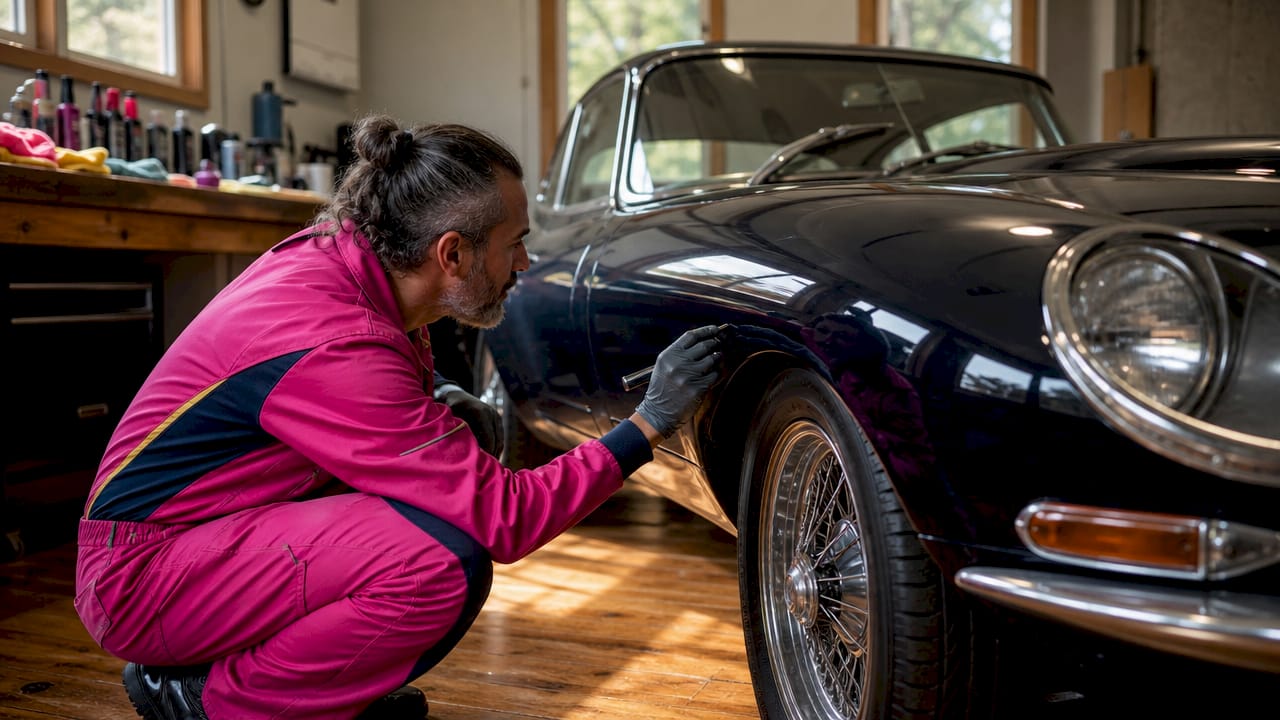
Factory finish preservation is the most technically demanding aspect of the process. Original paint must be protected from UV degradation, environmental contaminants, and physical abrasion without being polished, compounded, or refinished. Professional-grade ceramic coatings and Liquid Paint Protection Film (Liquid PPF) achieve this by creating a sacrificial barrier over the original surface. The coating takes the damage. The original paint underneath remains untouched.
Mannyceramicprotouch specializes in exactly this application. The studio’s Liquid PPF treatments are engineered to protect original factory finishes without altering their appearance or character. That distinction matters enormously for survivor vehicles where any change to the surface could affect collector status.
Documentation and service history
Documentation serves as a hidden multiplier for vehicle value. Every service record, storage log, and preservation intervention should be documented with dates, photographs, and descriptions of the work performed. A complete build book transforms a preserved vehicle from an interesting car into a verifiable asset with a traceable history.
Practical preservation steps every owner should follow:
- Store the vehicle in a climate-controlled environment with humidity control.
- Apply professional ceramic coatings or Liquid PPF to protect original paint.
- Conduct regular professional inspections to identify and stabilize early oxidation.
- Maintain all original mechanical components in working order using period-correct methods.
- Document every service, storage condition change, and preservation treatment.
- Keep all original parts, even replaced ones, as they add provenance value.
Pro Tip: Use a car preservation workflow developed by a specialist studio rather than adapting general detailing practices. The difference in outcome is significant for high-value vehicles.
Successful preservation is best understood as long-term stewardship that maintains original fabric and avoids irreversible modifications. That mindset, thinking in decades rather than years, is what separates collectors who build lasting value from those who inadvertently destroy it.
Key Takeaways
Automotive preservation protects original factory materials, commands a 75–100% price premium over restored equivalents, and requires active professional care, documentation, and climate-controlled storage to succeed.
| Point | Details |
|---|---|
| Price premium is real | Preserved survivors sell for 75–100% more than restored counterparts at auction. |
| Preservation is active, not passive | Professional coatings, oxidation control, and climate storage are required to maintain survivor status. |
| Documentation multiplies value | Complete service records and build books verify provenance and increase buyer confidence significantly. |
| Restoration is irreversible | Once original factory paint is removed, the vehicle can never return to survivor status. |
| Not every car qualifies | Structural damage or severe rust makes restoration necessary; preservation applies to structurally sound originals. |
The conservator’s mindset most owners never develop
Most car owners think about preservation in terms of the next year or two. The collectors who consistently build the most value think in decades. That difference in time horizon changes every decision you make about a vehicle.
I have seen owners spend money on cosmetic improvements that felt like upgrades but actually destroyed the survivor status of a genuinely rare car. A fresh respray on a numbers-matching vehicle with 60% original paint is not an improvement. It is a permanent reduction in value. The market does not forgive that kind of decision, and neither does the auction record.
The most common misconception I encounter is that preservation means doing nothing. Owners assume that leaving a car alone is the same as protecting it. Humidity, UV light, and oxidation do not wait for you to make a decision. They work continuously. Active preservation, meaning professional coatings, controlled storage, and regular inspections, is what actually stops the clock.
The other misconception is that restoration always adds value. For common models with high production numbers, a quality restoration can be a sound investment. For rare survivors with original paint and low mileage, restoration is almost always a value-destroying decision. Knowing which category your vehicle falls into is the most important judgment call in automotive investment strategy.
My advice is to consult a specialist before touching anything on a potential survivor. Get a condition assessment. Understand what original materials are present. Then build a preservation plan that protects those materials for the next owner, not just for today.
— Emmanuel
Advanced protection for vehicles that deserve it
Mannyceramicprotouch works with owners of luxury, exotic, and high-value vehicles who understand that preservation is an investment, not an expense.

The studio’s treatments include Liquid PPF and high-performance ceramic coatings, both applied with a quality-first process designed to protect original factory finishes without altering their character. Every vehicle receives a tailored strategy based on its condition, history, and preservation goals. For owners in South Florida, Mannyceramicprotouch offers Liquid PPF solutions in Fort Lauderdale that address the specific environmental threats of coastal humidity and intense UV exposure. If you want your vehicle’s finish protected at the level it deserves, the studio is the place to start.
FAQ
What is automotive preservation in the collector car market?
Automotive preservation is the practice of maintaining a vehicle’s original factory materials, paint, and components without irreversible alteration. Collector markets formally recognize preserved vehicles as “survivors,” and they consistently command higher prices than restored equivalents.
How much more can a preserved car sell for compared to a restored one?
Well-preserved originals can sell for 75–100% more than the best restored examples, particularly when the vehicle is rare and fully documented. That premium reflects the market’s recognition of original factory materials as an unrepeatable asset.
Does preservation require professional care or can owners do it themselves?
Preservation of high-value vehicles requires professional intervention. Stabilizing oxidation, applying protective coatings, and maintaining original surfaces without altering their character demands specialist knowledge and equipment that general detailing practices do not provide.
Why does documentation matter so much for preserved vehicles?
Detailed documentation of storage conditions, service history, and preservation treatments verifies provenance and gives buyers confidence in what they are purchasing. A complete build book is a direct multiplier of market value.
Can a restored car ever return to survivor status?
No. Once original factory paint is removed through sanding or repainting, that historical fabric is gone permanently. Preservation is an irreversible threshold, which is why the decision to restore or preserve must be made carefully and with full market awareness.