

TL;DR:
- Nano coatings are advanced protective layers that bond at the nanoscale, providing long-lasting durability against environmental damage. They offer superior scratch resistance, hydrophobic self-cleaning, and UV protection, reducing maintenance needs and preserving vehicle aesthetics. However, they do not prevent impact damages like rock chips and require professional application for optimal performance.
Nano coatings are advanced nanoscale protective layers that bond directly to a vehicle’s surface, creating a durable, invisible shield against environmental damage, UV radiation, and daily wear. The global nanocoatings market is projected to reach $106.64 billion by 2035. That figure reflects a clear shift in how vehicle owners and the automotive industry approach long-term surface protection. The top reasons for nano coatings go well beyond basic shine. They include superior scratch resistance, hydrophobic self-cleaning, corrosion protection, and cost savings that traditional waxes and polymer coatings simply cannot match. If you own a high-value vehicle and care about preserving it, understanding these benefits is the first step toward making a smarter protection decision.
1. Top reasons for nano coatings: unmatched surface durability
Nano coatings use particles sized 1–100 nm to fill microscopic pores in a vehicle’s clear coat and paint surface. These particles create a dense, continuous barrier that moisture, oxidation, and contaminants cannot penetrate easily. Traditional polymer coatings and waxes sit on top of the surface. Nano coatings bond at the molecular level, which is why their durability is in a different category entirely.
The practical result is a surface that resists abrasion, corrosion, and UV degradation far longer than conventional products. A vehicle parked outdoors in Florida or Arizona, where UV exposure is intense, benefits directly from this protection. The coating absorbs and deflects UV energy before it can break down the paint’s pigment and clear coat. That alone extends the life of a factory finish by years.
- Fills microscopic surface pores to block moisture and oxidation
- Resists abrasion and daily contact wear from washing and road debris
- Provides UV resistance that prevents paint fading and clear coat breakdown
- Creates a corrosion barrier that protects metal panels and trim
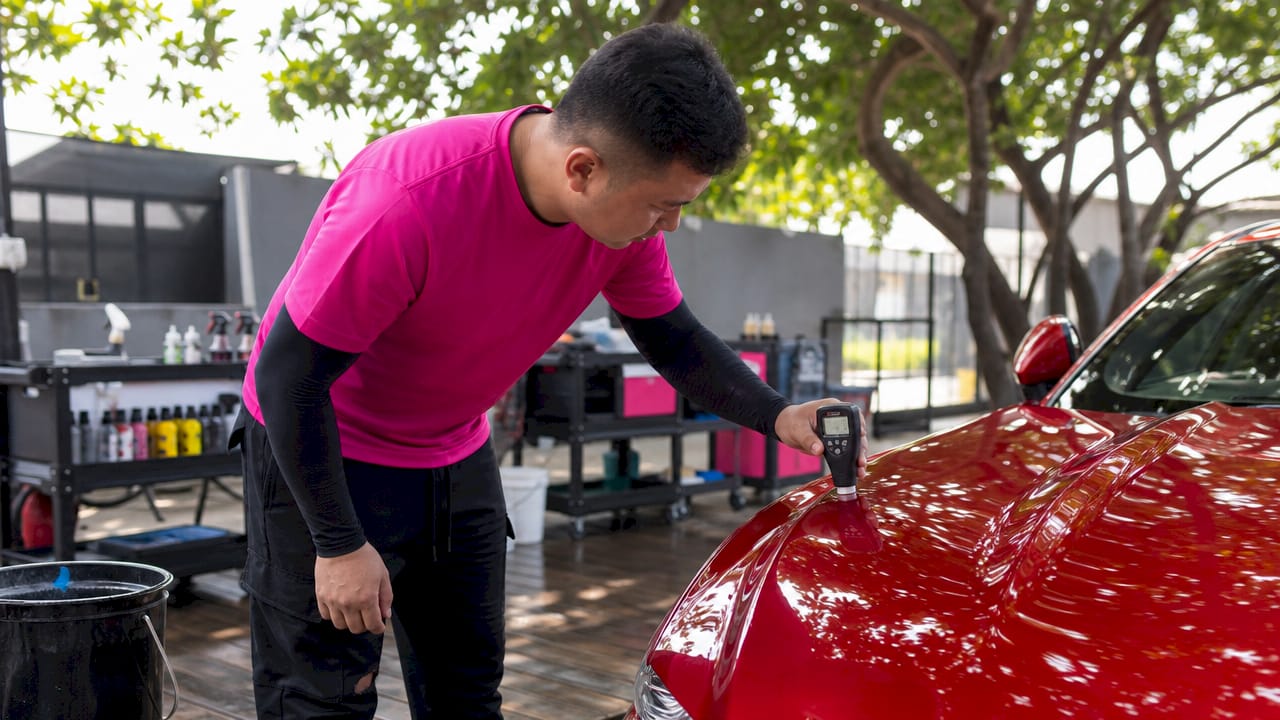
Pro Tip: Before applying any nano coating, inspect the paint under a paint thickness gauge. If the clear coat is already compromised, correction work must come first. Coating over damaged paint locks in the damage permanently.
2. Hydrophobic self-cleaning that cuts maintenance time
Nano coatings create hydrophobic surfaces that cause water and contaminants to bead and roll off rather than bond to the paint. This self-cleaning effect is not cosmetic. It directly reduces how often you need to wash the vehicle and how much effort each wash requires. Dirt, bird droppings, tree sap, and road grime have far less surface area to grip, so they release with minimal agitation.
For vehicle owners who detail their cars frequently, this translates into real time and cost savings over months and years. A vehicle with a quality nano coating applied by a professional can go longer between full washes without accumulating the kind of bonded contamination that requires clay bar treatment or paint correction. The hydrophobic protection also means less contact with the paint surface during washing, which reduces the risk of introducing swirl marks.
- Water beads and rolls off the surface, carrying loose dirt with it
- Chemical and acid resistance protects paint from bird droppings and industrial fallout
- Reduces the need for clay bar decontamination between details
- Lowers the frequency of full paint correction cycles
Pro Tip: Use a pH-neutral car shampoo on a nano-coated vehicle. Harsh alkaline or acidic soaps degrade the coating’s hydrophobic layer faster than normal weathering does.
3. Scratch resistance that protects the factory finish
Nano coatings increase coating hardness and provide resistance to acids and alkalis, which directly reduces surface wear and cracking over time. The hardness rating of a quality ceramic nano coating typically exceeds that of standard clear coat. This means light contact from brushes, fingernails, and minor road debris produces less visible damage on a coated surface than on bare paint.
This benefit matters most for luxury and exotic vehicles where the factory paint finish is part of the vehicle’s identity and resale value. A single deep swirl mark on a black BMW M5 or a Porsche 911 requires machine polishing to correct. Nano coatings reduce how often that correction is needed. For a detailed look at how this works across different vehicle types, Mannyceramicprotouch covers scratch resistance for luxury vehicles in depth.
The scratch resistance benefit also compounds over time. A vehicle that requires less correction work retains more of its original clear coat thickness. Clear coat is finite. Every polishing session removes a measurable layer. Nano coatings extend the window between correction cycles, which preserves the long-term integrity of the paint system.
4. Gloss retention and aesthetic preservation over time
Nano coatings are ultra-thin and transparent, which means they preserve the original factory finish and depth of color without altering the vehicle’s appearance. Unlike wax, which adds a temporary layer that dulls and oxidizes, nano coatings maintain a wet, deep gloss that reflects light cleanly. The coating does not change the color or texture of the paint. It enhances what is already there.
The table below compares how nano coatings perform against traditional wax on key aesthetic metrics over time.
| Aesthetic Factor | Traditional Wax | Nano Coating |
|---|---|---|
| Gloss retention | Fades within 4–8 weeks | Maintains depth for 1–5 years |
| Swirl mark resistance | None | Moderate to high |
| UV protection | Minimal | Strong |
| Surface clarity | Moderate | High |
| Reapplication frequency | Every 1–3 months | Every 1–5 years |
Swirl mark prevention is one of the most underappreciated advantages of nano coatings. Swirl marks form during washing when fine particles drag across the paint surface. A harder, smoother nano-coated surface gives those particles less friction to work with. Mannyceramicprotouch explains exactly how coatings prevent swirl marks and what that means for long-term gloss retention.
5. What nano coatings cannot do: setting realistic expectations
Nano coatings do not protect against heavy impacts or rock chips. This is the most common misconception vehicle owners carry into the decision. A nano coating is a chemical barrier, not a physical one. A stone traveling at highway speed will still chip the paint beneath a nano coating. For physical impact protection, Paint Protection Film (PPF) is the correct product.
The right approach for high-value vehicles is to use both. PPF handles rock chips, deep scratches, and direct impact zones like the front bumper and hood. Nano coatings handle chemical resistance, UV protection, hydrophobicity, and gloss across the entire vehicle. They work together, not as substitutes for each other.
- Nano coatings do not prevent rock chips or deep scratches from sharp objects
- Professional application is required for proper bonding and long-term durability
- Improper surface preparation leads to premature coating failure within months
- Cost is higher than waxing upfront, but the longer service life reduces total cost over time
Long-lasting performance depends heavily on professional application and proper surface prep. Contamination on the paint surface at the time of application reduces bonding strength and causes the coating to fail early. This is not a product you apply in a driveway with a microfiber towel and hope for the best.
6. Sustainability and environmental advantages
Nano coatings offer sustainability benefits including longer service life and lower VOC emissions compared to conventional coatings. This matters for vehicle owners who want to reduce their environmental footprint without sacrificing protection quality. Fewer reapplications mean less chemical waste over the life of the vehicle.
Traditional wax requires reapplication every one to three months. Each application involves chemical products, water usage, and disposal of used applicators and towels. A nano coating that lasts two to five years with minimal maintenance dramatically reduces that cumulative impact. For vehicle owners who detail frequently, this is a meaningful reduction in both cost and environmental output.
The low VOC profile of quality nano coatings also makes them safer to apply in enclosed spaces compared to solvent-heavy conventional products. Professional studios like Mannyceramicprotouch work with products that meet current environmental standards without compromising performance.
7. How to choose the right nano coating for your vehicle
Different chemical formulations optimize either hardness or hydrophobicity, and matching the product to your priorities directly affects satisfaction with the result. A vehicle owner who prioritizes scratch resistance needs a coating formulated for maximum hardness. An owner who prioritizes easy maintenance and water behavior needs a formulation optimized for hydrophobicity. These are not the same product.
| Coating Type | Primary Strength | Best For |
|---|---|---|
| High-hardness ceramic | Scratch and abrasion resistance | Daily drivers, high-contact surfaces |
| High-hydrophobicity ceramic | Water repellency, self-cleaning | Vehicles in wet or coastal climates |
| Hybrid ceramic/polymer | Balanced protection and gloss | Enthusiasts wanting all-around performance |
| SiO2-based spray coating | Entry-level protection, easy application | Vehicles already under PPF |
The multifunctional protection that nano coatings provide, including UV resistance, scratch resistance, and hydrophobicity in a single layer, outperforms traditional waxes across every measurable category. The key is selecting the right formulation for your specific climate, usage pattern, and performance goals.
Pro Tip: If your vehicle is garaged and driven on weekends, prioritize gloss depth and UV resistance. If it’s a daily driver exposed to highway debris and rain, prioritize hardness and hydrophobicity. Ask your applicator to match the product to your actual use case, not just the most popular option.
For vehicles in coastal environments like South Florida, where salt air and UV exposure are constant, the artisan wheel finishes and surface protection choices you make for every panel matter. Nano coatings are the baseline layer that makes every other protection decision more effective.
Key takeaways
Nano coatings deliver superior, long-term vehicle protection by bonding at the nanoscale level, outperforming traditional waxes in durability, scratch resistance, hydrophobicity, and UV defense.
| Point | Details |
|---|---|
| Nanoscale bonding | Particles sized 1–100 nm fill surface pores, creating a barrier wax cannot replicate. |
| Hydrophobic self-cleaning | Water and contaminants bead off, reducing wash frequency and paint correction cycles. |
| Scratch resistance | Increased coating hardness reduces swirl marks and surface wear over time. |
| Limitations require PPF | Nano coatings do not stop rock chips; pair with Paint Protection Film for full coverage. |
| Formulation matters | Match hardness or hydrophobicity formulation to your climate and usage pattern. |
What I’ve learned after years of working with nano coatings
Vehicle owners consistently underestimate how much a nano coating changes the ownership experience over time. The difference is not dramatic on day one. It becomes obvious at month six, when a waxed vehicle looks dull and requires correction work, and the nano-coated vehicle still looks like it just left the studio.
The biggest misconception I encounter is that nano coatings are permanent. They are not. They are durable enhancement layers that maintain peak condition and simplify maintenance. Treating them as permanent leads to neglect, which shortens their effective life. Proper care, including pH-neutral washing and periodic inspection, keeps the coating performing at its best.
Cost is the second objection I hear most often. Professional application costs more than a can of wax. But when you factor in the reduction in correction work, the extended time between reapplications, and the preservation of resale value, the math favors nano coatings clearly. A vehicle that holds its finish holds its value. That is not a cosmetic benefit. That is an asset protection decision.
The clients who get the most from nano coatings are the ones who combine professional application with proper ongoing care and realistic expectations. They understand that surface protection extends vehicle value over the long term, not just on the day of application.
— Emmanuel
Professional nano coating services at Mannyceramicprotouch
Mannyceramicprotouch specializes in advanced surface preservation for luxury, exotic, and high-value vehicles in the Fort Lauderdale area. Every vehicle receives a tailored protection strategy, not a one-size-fits-all package.

The studio applies high-performance ceramic nano coatings alongside Liquid PPF solutions, giving vehicle owners a complete protection system that addresses both chemical and physical threats. Proper surface preparation is built into every service, which is the single biggest factor in coating longevity. For vehicle owners ready to move beyond waxing and into long-term asset protection, the ceramic coating packages at Mannyceramicprotouch are the place to start. Owners who want the full picture on physical impact protection can also review the Liquid PPF options in Fort Lauderdale that pair directly with nano coating applications.
FAQ
What are nano coatings made of?
Nano coatings are typically formulated from silicon dioxide (SiO2) or titanium dioxide (TiO2) particles sized between 1 and 100 nanometers. These particles bond chemically to the vehicle’s clear coat, creating a hard, transparent protective layer.
How long do nano coatings last on a vehicle?
Quality nano coatings applied professionally last between one and five years depending on the formulation, climate, and maintenance routine. Proper surface preparation at the time of application is the primary factor in achieving the upper end of that range.
Do nano coatings replace Paint Protection Film?
Nano coatings do not replace Paint Protection Film. They protect against UV radiation, chemical contamination, and light scratches, but they do not absorb physical impacts or prevent rock chips. PPF and nano coatings serve different functions and work best when used together.
Can nano coatings be applied to any vehicle surface?
Nano coatings bond effectively to paint, glass, metal trim, and plastic surfaces. Each surface type may require a specific formulation. A professional applicator will assess the vehicle and select the appropriate product for each panel and surface material.
Are nano coatings worth the cost compared to waxing?
Nano coatings cost more upfront than waxing but deliver significantly longer protection, reduced maintenance frequency, and better preservation of resale value. For high-value vehicles, the long-term cost per year of protection favors nano coatings over repeated wax applications.