

TL;DR:
- Regular washing alone does not prevent embedded contaminants or surface degradation that can diminish a luxury vehicle’s finish and resale value. Maintenance detailing offers periodic exterior and interior cleaning that preserves the vehicle’s condition and enhances protection layers through carefully sequenced, professional techniques and products. Consistent maintenance not only saves money over costly corrections but also ensures lasting aesthetic appeal and higher resale value for high-end and exotic automobiles.
Many luxury car owners assume that regular washing keeps their vehicle in top condition. That assumption is one of the most costly mistakes in high-end automotive care. Routine washing removes surface dirt, but it does nothing to address embedded contaminants, degrading protection layers, or the slow accumulation of damage that chips away at a car’s finish and resale value. Maintenance detailing keeps a vehicle clean and protected between deeper correction and full detail services, filling the critical gap that washing alone cannot. This guide clarifies what maintenance detailing actually involves, walks through the process step by step, and explains why it matters for owners of luxury and exotic vehicles.
Table of Contents
- Defining maintenance detailing: What it really means
- The essential process: Inside a luxury maintenance detail
- Key products and tools: What professionals use
- Maintenance detailing done right: Best practices and pitfalls
- Why maintenance detailing is an investment, not a chore
- Protect your luxury investment with professional care
- Frequently asked questions
Key Takeaways
| Point | Details |
|---|---|
| Maintenance detailing definition | It is regular, professional cleaning and light protection that preserves a luxury vehicle’s finish between deep detail services. |
| Process sequencing matters | Decontamination before protection prevents damage and extends the life of coatings. |
| Specialized products required | Luxury car care uses coating-safe soaps, iron removers, and tools for optimal results. |
| Avoid common pitfalls | Never apply protective products to a dirty or contaminated surface. |
| Long-term benefits | Proper maintenance detailing maximizes resale value and minimizes restoration costs for high-end vehicles. |
Defining maintenance detailing: What it really means
Many people use the terms “detailing” and “washing” interchangeably, which leads to misplaced expectations and neglected finishes. Maintenance detailing is a distinct service category. It is not a full correction detail, and it is not a basic wash. Maintenance detailing is periodic exterior and interior cleaning for vehicles already in good condition, focused on sustaining that condition rather than correcting paint defects or removing heavy contamination.
The contrast with full detailing is important. A full detail typically involves paint decontamination, machine polishing or paint correction, potential coating application, and deep interior cleaning. It is intensive, time-consuming, and necessary when a vehicle’s finish has deteriorated. Maintenance detailing, on the other hand, assumes the vehicle is in a well-preserved state and focuses on keeping it there through structured, recurring care.
What maintenance detailing typically covers:
- Thorough exterior hand wash using coating-safe soaps
- Light iron and fallout decontamination to prevent bonded contamination
- Clay bar treatment when needed to maintain surface smoothness
- Application of a spray sealant or topper to refresh hydrophobic protection
- Interior vacuuming, surface wipe-down, and leather conditioning
- Glass cleaning and tire and trim dressing
For owners following a luxury car maintenance checklist, maintenance detailing should be a scheduled item, not a reactive measure. The goal is to prevent the conditions that require expensive correction later.
“Regularity is what separates effective maintenance detailing from occasional damage control. A well-maintained finish is always easier and less costly to preserve than one that has been left to degrade.”
For luxury and exotic vehicles specifically, this regularity matters even more. The paints on high-end vehicles, especially those with matte finishes, special-effect metallics, or multi-stage factory coatings, are more sensitive to improper cleaning techniques and product choices than standard automotive finishes. Consistent maintenance detailing, done correctly, is what keeps those finishes looking factory-fresh over years, not just weeks.
The essential process: Inside a luxury maintenance detail
Understanding what maintenance detailing covers is one thing. Knowing how it is executed, and why the sequence matters, is what separates professional-grade results from DIY attempts that can cause unintended damage.
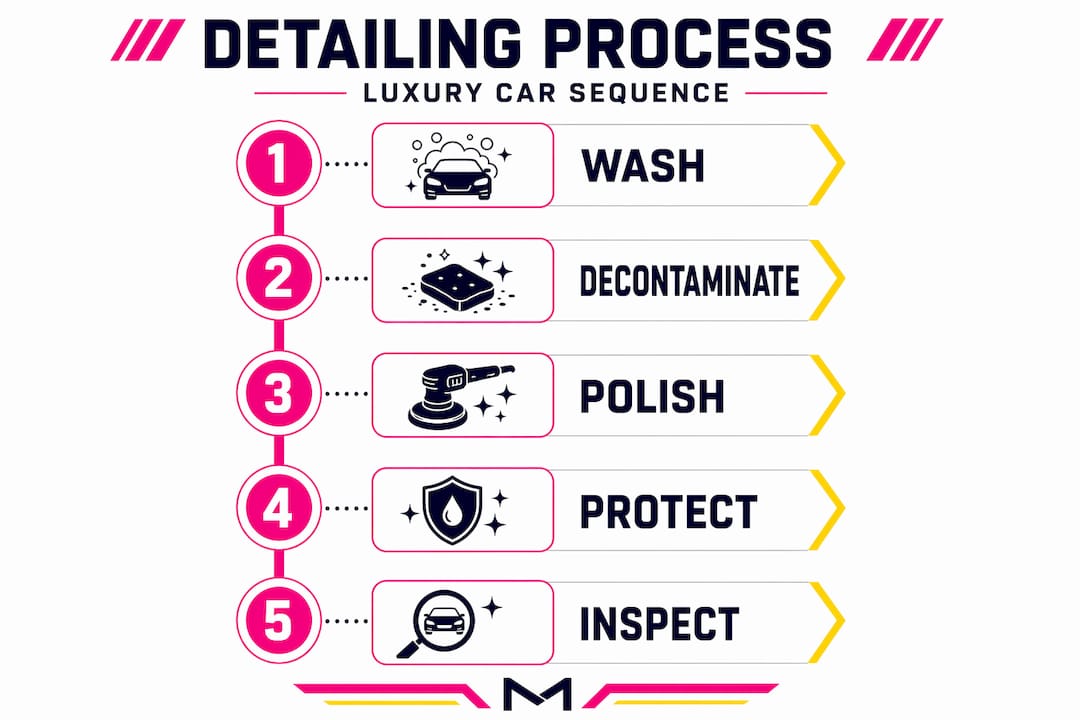
The process for a luxury vehicle maintenance detail follows a deliberate, ordered workflow:
- Pre-rinse and foam application. The vehicle is thoroughly rinsed to remove loose dirt before any contact. A pH-neutral foam is applied and allowed to dwell, loosening surface contaminants without physical agitation that could introduce scratches.
- Two-bucket hand wash. Using a soft, high-pile wash mitt and two separate buckets (one for clean soapy water, one for rinsing the mitt), the vehicle is washed panel by panel in straight, overlapping lines. Circular scrubbing is avoided.
- Rinse and drying. The vehicle is rinsed completely, then dried using clean, high-GSM microfiber towels or a forced-air blower to prevent water spotting on the clear coat.
- Iron and fallout decontamination. A pH-balanced iron remover is sprayed across painted panels and wheels. It reacts visually with iron particles (commonly from brake dust and road debris) that are bonded to the surface. This step is critical because surface decontamination must precede any protection application to avoid trapping contaminants underneath.
- Clay bar or clay mitt treatment. When the paint feels rough or gritty to the touch even after washing, a clay bar is used to mechanically remove bonded contamination. Professionals use iron removers and clay to remove deeply embedded contaminants before applying any protection.
- Protection application. A coating-safe spray topper, spray wax, or maintenance sealant is applied to refresh and boost the existing protection layer, whether that’s a ceramic coating, paint protection film (PPF), or a standalone sealant.
- Interior care. Vacuuming, surface cleaning with appropriate interior-safe products, leather conditioning on seats and panels, and glass cleaning round out the service.
Pro Tip: Never skip the decontamination step, even if the car looks clean. Contamination is often invisible to the naked eye but creates a rough surface that compromises protection adhesion and accelerates micro-scratching during future washes.
The sequence is non-negotiable. Applying a protectant over a surface that still carries iron particles or bonded fallout creates a barrier that locks those contaminants in place. That scenario leads to early coating failure, staining, and surface irregularities that require full correction to resolve. Review the full exterior detailing process and interior detailing techniques for a more thorough breakdown of each service stage.
Key products and tools: What professionals use
The right process means nothing if the wrong products are applied to a six-figure finish. Product selection is where most DIY maintenance attempts go wrong, and where professional detailers earn their value.
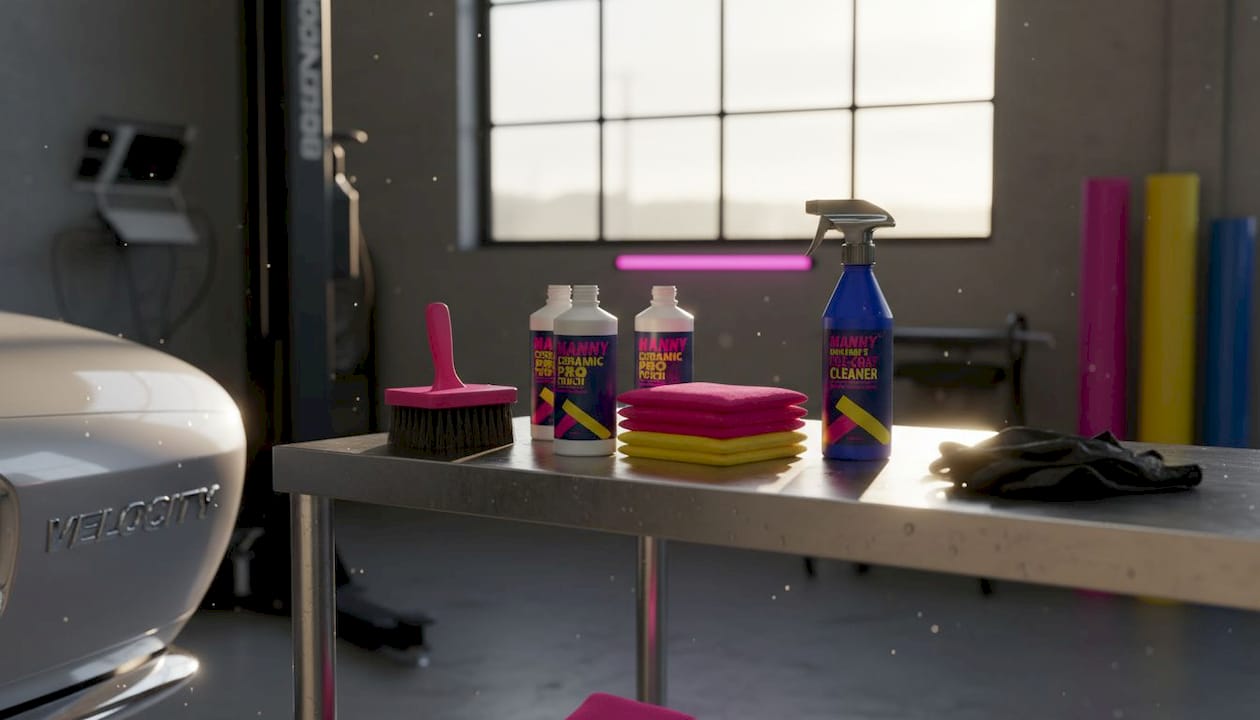
Here is a breakdown of the primary product categories used in luxury maintenance detailing:
| Product category | Purpose | Key requirement |
|---|---|---|
| pH-neutral car soap | Safe exterior washing | Must be coating-safe, free of waxes or fillers |
| Iron and fallout remover | Dissolves bonded iron contamination | pH-balanced; should not etch or stain clear coats |
| Clay bar or clay mitt | Mechanical contamination removal | Used with proper lubrication to prevent marring |
| Spray coating topper | Refreshes and boosts hydrophobic layer | Must be compatible with existing ceramic or PPF |
| Microfiber towels (high GSM) | Drying and buffing without scratching | Minimum 400 GSM; separate towels per task |
| Leather conditioner | Protects and softens interior leather | pH-appropriate; free of silicones that cause deterioration |
| Interior surface cleaner | Cleans plastics, carbon fiber, alcantara | Must be non-residue and trim-type appropriate |
Key tools used by professionals:
- Soft wash mitts made from genuine lambswool or premium microfiber
- Dual-bucket wash system with grit guards at the bottom of each bucket
- Compressed air or electric blowers for touchless drying in tight areas
- Foam cannon or foam gun for pre-wash foam application
- Detailing brushes in varying sizes for vents, emblems, and seams
Pro Tip: For vehicles with ceramic coatings, confirm that any spray topper or sealant applied during maintenance is labeled as “ceramic coating compatible.” Using a wax-based product over a ceramic coating can interfere with the coating’s hydrophobic properties and cause uneven sheeting behavior.
Generic consumer products, even those marketed as premium, often contain silicone oils, fillers, or harsh surfactants that can degrade high-performance coatings over time. There are key features for car care considerations that professionals evaluate before selecting any product for a luxury or exotic finish. A professional detailing setup, such as a mobile detailing service, carries vetted, professional-grade products specifically formulated for protected and unprotected luxury finishes.
Maintenance detailing done right: Best practices and pitfalls
Knowing the process and having the right products still leaves room for errors that can compound over time. Here are the most common mistakes made during luxury car maintenance detailing, followed by the best practices that prevent them.
Common mistakes:
- Skipping iron decontamination between washes, allowing fallout to bond progressively deeper into the clear coat
- Washing in direct sunlight, which causes soaps and water to dry too quickly and leave water spots and residue
- Using the same microfiber towel for multiple tasks (drying, applying product, and buffing), which transfers contamination across panels
- Applying spray protectants to a surface that has not been fully decontaminated, as protection before decontamination can trap contaminants and undermine coatings’ long-term performance
- Using dish soap or household cleaners, which strip ceramic coatings and sealants, leaving the paint bare and exposed
Best practices for luxury vehicle owners:
- Schedule maintenance detailing every two to four weeks, depending on driving frequency and environmental exposure
- Inspect the surface for water-beading behavior after each wash. A decrease in beading indicates the protection layer is thinning and needs a topper
- If the paint feels rough after a thorough wash, it is time for a clay bar treatment, not just another wash
- Always use two separate microfiber cloths for drying: one for the painted body and one for glass
- When in doubt about a product’s compatibility with your coating, consult a professional before applying
When to escalate to a professional:
- Paint no longer beads water even after applying a spray topper
- Surface scratches or swirl marks become visible in direct sunlight
- Interior leather shows signs of dryness, cracking, or color fading
- Wheels have heavy brake dust buildup that standard washing does not remove
Understanding professional coating benefits can help clarify when maintenance is enough and when a more intensive service is warranted.
The long-term payoff is significant. Vehicles that receive consistent, professional-grade maintenance detailing retain their finish quality over years, not just months. For exotic and collector vehicles, a well-documented maintenance history, including regular detailing records, is a tangible factor in resale valuation. Buyers and auction houses consider condition history. A car that arrives with a consistent care record commands stronger pricing than one that has been “cleaned” without structure.
Pro Tip: After every maintenance detail, photograph the vehicle in consistent lighting. This creates a visual baseline that makes it easy to detect early signs of degradation, such as fading, oxidation, or coating wear, before they become costly corrections.
Why maintenance detailing is an investment, not a chore
Here is an observation that does not get discussed enough in automotive care: the owners most resistant to scheduled maintenance detailing are often the same ones who end up paying the most for paint correction later. That pattern is predictable, and it is entirely avoidable.
There is a common perception among luxury car owners that because their vehicle receives professional detailing a few times per year, maintenance upkeep between those appointments is less critical. This thinking overlooks how cumulative damage actually works. Environmental contaminants, iron fallout, UV exposure, and road film do not wait for your next scheduled appointment. They work continuously, and without regular maintenance, they begin compromising your protection layer within weeks.
The financial logic of maintenance detailing is straightforward. A professional correction service to remove swirl marks and surface oxidation costs significantly more than a series of maintenance details performed over the same period. Preventing the damage is always less expensive than correcting it. For exotic and collector vehicles where paint correction may require careful wet sanding and multiple machine polishing stages, the cost difference between proactive maintenance and reactive correction is even more pronounced.
There is also the matter of resale and elite scratch protection. High-end vehicle buyers are discerning. A car presented with a maintained, defect-free finish commands buyer confidence and stronger pricing. The owner who treats their exotic as an appreciating asset, rather than just a possession, understands that maintenance detailing is part of the investment strategy, not an optional add-on.
Finally, there is a less-discussed benefit: ease of cleaning. A properly maintained surface with an active, refreshed protection layer requires less effort per wash, repels contamination more effectively, and is more forgiving of minor surface contact. Owners who maintain their vehicles correctly spend less time managing problems and more time enjoying their investment.
Protect your luxury investment with professional care
For owners who want to move beyond guesswork and ensure their vehicle receives the level of care it deserves, professional protection and maintenance services make a measurable difference.
At Manny’s Ceramic Pro Touch LLC, every maintenance detail is approached as part of a broader preservation strategy. Whether your vehicle is protected with liquid vs traditional PPF or a high-performance ceramic coating, the maintenance protocol is tailored to what your specific finish requires. Explore available ceramic coating packages to understand the full range of protection solutions available for your vehicle. Contact the team to schedule a consultation and establish a maintenance plan that keeps your vehicle performing and looking at its best, not just today, but over the long term.
Frequently asked questions
How often should maintenance detailing be done on a luxury car?
For most luxury cars, every two to four weeks is ideal, especially for vehicles driven frequently or exposed to environmental elements like road debris, UV, and salt air.
Can maintenance detailing replace full correction or deep detailing?
No. Maintenance detailing preserves a vehicle’s existing condition between deeper correction services but cannot address paint defects, heavy contamination, or coating failure.
What happens if I apply protection before proper decontamination?
Applying protection over a contaminated surface locks contaminants under the coating layer. As detailed in professional decontamination standards, protection before decontamination can trap contaminants and undermine the coating’s adhesion and durability.
Are all soaps and sprays safe for ceramic coatings?
No. Only coating-safe soaps specifically formulated for ceramic finishes should be used, as they refresh hydrophobic properties without stripping or degrading the protective layer.