TL;DR:
- Traditional PPF provides impact absorption and long-lasting physical barrier protection.
- Liquid PPF offers seamless coverage with improved hydrophobic properties and easier installation on complex surfaces.
- Proper application and vehicle-specific assessment are crucial for maximizing protection and appearance.
Not all paint protection films are created equal, and assuming otherwise is one of the most common mistakes luxury car owners make. Liquid PPF and traditional paint protection film may share the same goal of shielding your vehicle’s paint, but they differ significantly in materials, application, performance, and long-term results. For owners of high-value vehicles in Fort Lauderdale, where intense UV exposure, salt air, and year-round driving create persistent threats to a pristine finish, choosing the right protection is a critical decision. This guide breaks down both technologies clearly, so you can make the choice that fits your vehicle, your habits, and your standards.
Table of Contents
- Understanding paint protection film technology
- Comparing Liquid PPF and traditional PPF: Performance and durability
- Application and appearance: What luxury car owners need to know
- Cost, maintenance, and long-term value
- Our expert perspective: What most luxury car owners miss when choosing PPF
- Upgrade your car’s protection with trusted experts in Fort Lauderdale
- Frequently asked questions
Key Takeaways
| Point | Details |
|---|---|
| Distinct protection methods | Liquid PPF and traditional PPF offer different advantages based on application and coverage. |
| Performance varies by climate | Durability and appearance are affected by Fort Lauderdale’s unique weather conditions. |
| Professional installation essential | Expert application is the key to achieving maximum protection and value, especially for luxury cars. |
| Maintenance impacts longevity | Routine care and proper maintenance help preserve both Liquid and traditional PPF for years. |
| ROI depends on vehicle use | Choosing the right PPF option increases resale value and maintains aesthetic appeal depending on your driving habits. |
Understanding paint protection film technology
Paint protection film, commonly known as PPF, is a transparent or semi-transparent layer applied to a vehicle’s exterior surfaces to guard against rock chips, scratches, chemical contaminants, UV degradation, and general road debris. Originally developed for military and aerospace applications, PPF has evolved into one of the most effective tools available for preserving automotive finishes. The paint protection film overview at Manny’s Ceramic Pro Touch covers the range of technologies currently used to protect car paint, from traditional films to more advanced liquid-based solutions.
Traditional PPF is a urethane-based film that comes in pre-cut or custom-trimmed sheets. These sheets are applied directly to the vehicle’s painted surface using an adhesive backing. The physical film creates a measurable barrier between the paint and external hazards. It has been the industry standard for decades, and for good reason. It provides robust, tangible protection against impact damage that liquid-based products cannot fully replicate.
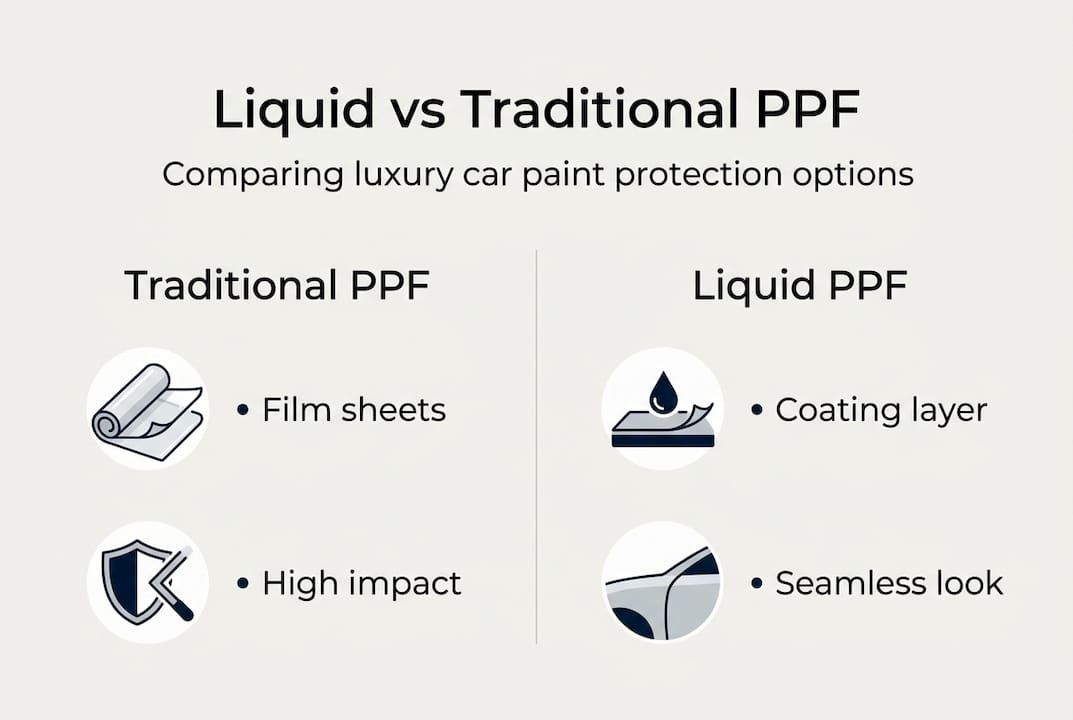
Liquid PPF, by contrast, is a sprayable or wipe-on protective coating. It uses advanced polymer chemistry to bond directly with the paint surface, creating a hardened protective layer without the seams or edges associated with film sheets. Some liquid formulations also incorporate self-healing polymers and hydrophobic properties that repel water and contaminants.
Here are the core differences between the two technologies:
- Traditional PPF: Thermoplastic urethane sheets, adhesive-backed, physical barrier protection, visible edges on complex curves, self-healing with heat on premium grades
- Liquid PPF: Polymer-based sprayable coating, bonds at the molecular level, seamless coverage, no edge lifting, chemical resistance, hydrophobic surface layer
- Traditional PPF strengths: Superior impact absorption, excellent chip resistance, repairable sections, established track record
- Liquid PPF strengths: Seamless finish, full-vehicle coverage including tight body lines, easier application on complex geometry, no film edges
Each option suits different vehicle types. Traditional PPF excels on flat hood panels, bumpers, and mirror caps where high-impact protection is the priority. Liquid PPF works particularly well on vehicles with aggressive body lines, carbon fiber elements, or areas where film edges would be visually disruptive. Many owners of exotic and custom-built vehicles find that liquid formulations give them the coverage they need without compromising the visual integrity of the finish.
Pro Tip: Before committing to either option, have your paint inspected for existing defects. Applying any protective coating over compromised paint seals in the damage permanently. Reviewing paint correction options before your protection installation ensures the final result looks flawless, not just protected. If you are also considering a ceramic coating packages as a top layer, the combination with either PPF type can significantly extend the performance of both products.
Comparing Liquid PPF and traditional PPF: Performance and durability
With a clear understanding of the core technologies, let’s see how Liquid and traditional PPF stack up in real-world performance, especially under Florida’s demanding climate conditions.
| Feature | Traditional PPF | Liquid PPF |
|---|---|---|
| Impact resistance | High | Moderate |
| Self-healing | Yes (heat-activated, premium grades) | Yes (some formulations) |
| UV resistance | Excellent | Excellent |
| Hydrophobic properties | Moderate | High |
| Edge lifting risk | Present over time | None |
| Coverage on complex curves | Limited | Seamless |
| Typical lifespan | 7 to 10 years | 2 to 5 years |
| Repair approach | Panel replacement or section re-film | Reapplication or spot treatment |
Fort Lauderdale’s climate presents specific challenges. Intense UV radiation, salt air from coastal proximity, frequent rain, and high ambient humidity all accelerate paint degradation. Traditional PPF has a proven track record of withstanding these conditions when properly installed and maintained. However, the adhesive layer can weaken over time in extreme heat, especially when film is applied to areas that trap heat like lower door sills or roof panels on dark-colored vehicles.
Liquid PPF performs well in UV-heavy environments due to its full surface bond, which eliminates the risk of film edges curling or trapping moisture underneath. Liquid PPF in Fort Lauderdale has become an increasingly attractive option for owners who want seamless protection without the maintenance concerns associated with film edge management.
Key performance comparisons worth knowing:
- Self-healing: High-grade traditional PPF heals minor surface swirls and light scratches when exposed to heat, such as sunlight or warm water. Some liquid PPF formulations offer similar benefits, though the depth of self-healing varies by product.
- Durability range: Traditional PPF from premium manufacturers typically lasts 7 to 10 years with proper care. Liquid PPF generally provides 2 to 5 years of strong performance, making it a better fit for owners who update their protection schedule regularly.
- Cost efficiency: Liquid PPF generally costs less upfront per vehicle, making it accessible for owners who want comprehensive coverage. Traditional PPF installation costs more due to the labor-intensive trimming and fitting process.
For owners debating which product works best for their specific vehicle, reviewing the PPF vs ceramic coating guide offers additional context on how each protection type compares across multiple performance categories. Understanding the full protection spectrum helps you make a layered decision, not just a binary one.
Application and appearance: What luxury car owners need to know
Performance is only half the story. Appearance and installation quality matter deeply for luxury vehicles, and both PPF types produce distinctly different visual results.
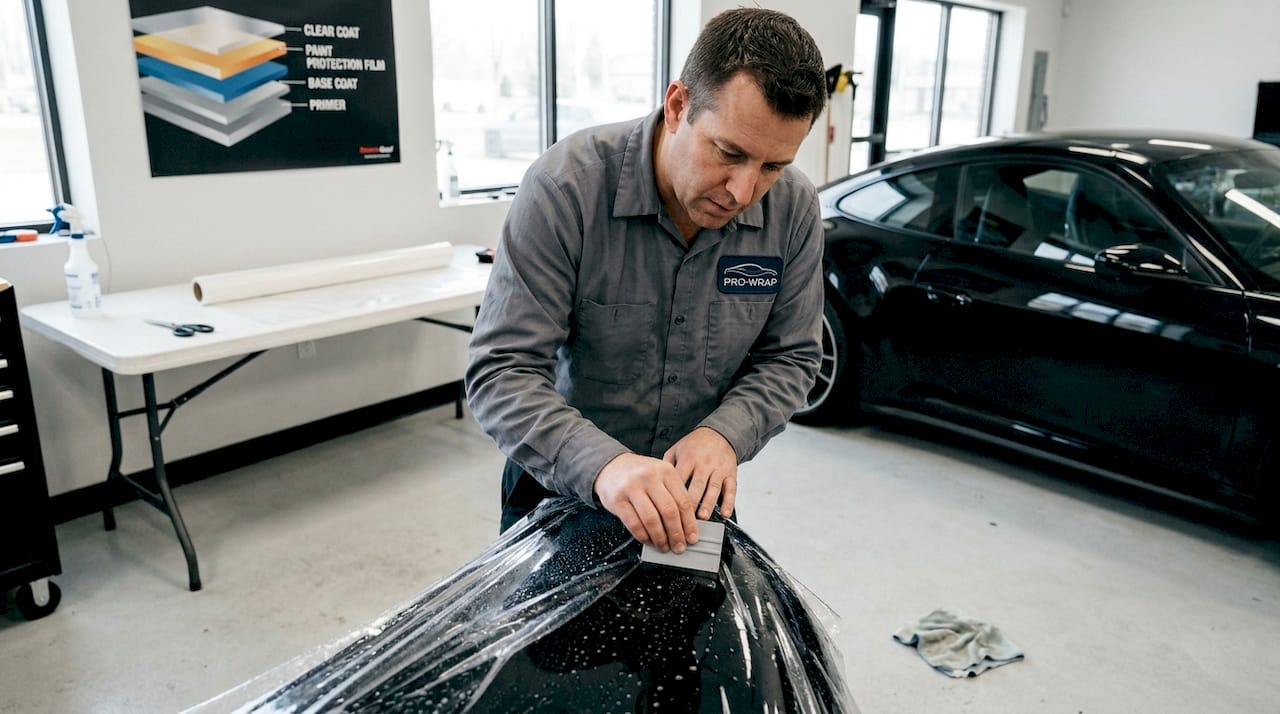
Traditional PPF, when installed by an experienced technician, is virtually invisible on flat panels. However, the film’s physical edges are detectable on areas with tight curves, body kit components, or textured surfaces. On a flat hood or bumper, the result can be seamless. On a vehicle with complex sculpted body lines, film edges may catch light and become visible over time, particularly as the adhesive ages.
Liquid PPF produces a smooth, uniform finish across all surfaces including recessed areas, vents, pillars, and trim pieces that film cannot easily cover. There are no edges, no seam lines, and no risk of bubbling at the perimeter. For matte and satin finishes, which are increasingly common on modern luxury vehicles, liquid formulations are often the preferred solution because traditional film can be difficult to source in matching matte grades.
The installation process for each type follows a distinct path:
- Paint decontamination and correction: Both methods require a clean, defect-free surface before application.
- Surface preparation: Traditional PPF requires careful panel masking and edge preparation. Liquid PPF requires thorough cleaning and chemical preparation to promote bonding.
- Application: Traditional film is wet-applied and squeegeed into position, then trimmed to fit. Liquid PPF is applied in thin, even coats using spray equipment or professional-grade applicators.
- Curing: Traditional PPF cures through heat and pressure over 24 to 72 hours. Liquid PPF cures chemically and may require controlled temperature environments for optimal hardness.
- Final inspection: Both types require a detailed quality check under controlled lighting to identify any imperfections before delivery.
On exotic and ultra-luxury vehicles, every millimeter of finish matters. A poorly fitted film edge or an uneven liquid coat can compromise thousands of dollars in factory paintwork. Professional application is not optional for vehicles of this caliber.
| Appearance factor | Traditional PPF | Liquid PPF |
|---|---|---|
| Gloss enhancement | Neutral to slight enhancement | Noticeable gloss depth |
| Matte finish compatibility | Limited | Excellent |
| Edge visibility | Possible on complex surfaces | None |
| Transparency | High | High |
Pro Tip: For owners considering mobile ceramic coating as a complementary layer, Liquid PPF provides an ideal base surface because its uniform chemistry bonds well with ceramic topcoats. This stacking approach delivers maximum gloss, hydrophobic performance, and UV resistance in a single protection system.
The ceramic coating services at Manny’s reinforce why professional application of any protective product makes a measurable difference in both appearance and longevity for high-value vehicles.
Cost, maintenance, and long-term value
To make an informed decision, luxury car owners need clear facts about ongoing costs and real-world value across the full ownership timeline.
Traditional PPF installation for a full vehicle typically ranges from $3,000 to $7,000 or more depending on vehicle size, complexity, and film brand. Partial coverage, such as a front-end or high-impact zone package, ranges from $900 to $2,500. Liquid PPF full-vehicle application generally costs between $800 and $2,500, making it more accessible while still delivering meaningful protection.
Annual maintenance costs for either type are relatively modest when the basics are followed consistently. Following paint care after PPF guidelines is the most effective way to extend the service life of your investment. Owners who skip routine maintenance often face premature degradation regardless of which product they chose.
Routine care tips for preserving either type of PPF:
- Wash regularly with pH-neutral car shampoo to prevent contaminant buildup that accelerates surface wear
- Avoid automatic car washes with abrasive brushes, which can damage both film surfaces and liquid coatings
- Apply a spray detailer or protective topper every 3 to 6 months to maintain hydrophobic performance
- Inspect edges on traditional PPF every 6 months for signs of lifting, especially around bumper edges and mirror caps
- Keep vehicles parked in shaded or covered areas when possible to reduce UV stress and thermal cycling
- Address paint chips or film damage promptly before moisture intrudes beneath the film layer or contaminants bond to exposed paint
From a resale perspective, vehicles with documented paint protection history consistently command stronger resale values. Buyers in the luxury segment recognize and value a well-preserved exterior finish. A clean, chip-free paint surface protected by professionally applied PPF signals responsible ownership and reduces negotiation leverage for buyers pointing to cosmetic defects.
The long-term ROI calculation favors traditional PPF for owners keeping a vehicle 5 years or more, given its extended service life. For owners who rotate vehicles every 2 to 3 years or want comprehensive coverage on a new model, Liquid PPF delivers strong value at a lower initial investment while maintaining the vehicle’s appearance for the ownership window that matters most.
Our expert perspective: What most luxury car owners miss when choosing PPF
After years of protecting high-value vehicles in Fort Lauderdale, the pattern we see most often is this: owners focus on the product name rather than the application strategy. They ask “which is better, liquid or traditional?” when the more important question is “which fits how I actually use and store this vehicle?”
A traditional PPF on a vehicle that sits outdoors daily in South Florida heat requires more active edge maintenance than most owners anticipate. A Liquid PPF on a vehicle driven aggressively on highways offers less impact resistance than the driver needs. Neither product fails in these scenarios, but neither performs at its potential either.
We also see owners overvalue marketing terms like “nano-ceramic infused” or “self-healing nano-polymer” without asking what independent testing supports those claims. The expert paint protection advice we provide always starts with a vehicle assessment and a driving habits conversation, not a product pitch.
The most future-proof protection choice is the one calibrated to your specific vehicle geometry, your parking conditions, your annual mileage, and your resale timeline. That requires honest evaluation, not brand loyalty. When those factors align with the right product and a skilled installer, the results speak for themselves in ways that last for years.
Upgrade your car’s protection with trusted experts in Fort Lauderdale
Choosing the right paint protection starts with understanding your options and working with installers who treat your vehicle as the asset it is.
At Manny’s Ceramic Pro Touch, every protection project begins with a detailed assessment. Whether you are exploring paint protection film services for a new acquisition or looking for Liquid PPF specialists who understand the nuances of exotic finishes, our team builds a strategy around your vehicle and your standards. Not sure which solution fits best? Our compare PPF vs ceramic resource walks you through the decision with clarity. Contact us to schedule a consultation and get a protection plan built specifically for your vehicle.
Frequently asked questions
What is the main difference between liquid PPF and traditional PPF?
Liquid PPF is applied as a coating and offers seamless coverage with no edges, while traditional PPF comes in sheets and is adhered to the surface for physical barrier protection against rock chips and impacts.
Does Liquid PPF last as long as traditional PPF?
Traditional PPF typically lasts 7 to 10 years, while Liquid PPF generally provides 2 to 5 years of strong protection, making lifespan one of the key factors in choosing between them based on your ownership timeline.
What does maintenance involve after PPF application?
Maintenance after either type of PPF involves gentle pH-neutral washing, avoiding abrasive car washes, periodic inspection for damage, and applying protective toppers every few months to preserve hydrophobic performance.
Is professional installation necessary for Liquid PPF?
Yes, professional application ensures even coverage, proper surface bonding, and optimal curing conditions that DIY methods cannot reliably achieve, particularly on luxury and exotic vehicles where finish quality is non-negotiable.