

TL;DR:
- Hydrophobic coatings cause water to bead and roll off, protecting vehicle paint from environmental damage.
- They work through silane-based chemistry and nano-structuring to create durable, water-repelling surfaces.
- Proper protection combines coatings with other solutions like paint protection films for comprehensive vehicle care.
Most luxury car owners assume that a glossy finish means the paint is protected. It is not. A mirror-like shine can exist on bare, completely unprotected paint. The real question is whether your vehicle has a surface that actively repels water, contaminants, and the kind of environmental damage that quietly erodes both appearance and resale value. Hydrophobic coatings answer that question with chemistry, not cosmetics. This guide breaks down what hydrophobic coating actually means, how it works at a molecular level, and what it means practically for owners of Porsches, Ferraris, Lamborghinis, and other high-value vehicles.
Table of Contents
- What does hydrophobic really mean?
- The science behind hydrophobic coatings: How they work
- Hydrophobic coatings vs. other protective solutions
- Practical benefits and maintenance tips for luxury car owners
- Why hydrophobic isn’t everything: The overlooked elements in luxury car protection
- Protect your luxury investment with the best hydrophobic solutions
- Frequently asked questions
Key Takeaways
| Point | Details |
|---|---|
| True hydrophobicity defined | Hydrophobic coatings repel water using science-backed surface chemistry, making them ideal for luxury car protection. |
| Advanced coatings outperform wax | Nano-engineered hydrophobic formulas provide longer-lasting, more effective water repellency than traditional waxes. |
| Comprehensive protection matters | For luxury vehicles, hydrophobicity is just one aspect—optical clarity and durability are also key. |
| Maintenance sustains benefits | Regular gentle car care maximizes the longevity and effectiveness of any hydrophobic coating. |
| Expert application recommended | Professional service ensures your high-value car receives the most advanced protection available. |
What does hydrophobic really mean?
The word “hydrophobic” comes from the Greek words for water (hydro) and fear (phobos). In automotive surface science, it describes a coating that causes water to bead up and roll off rather than spread across and bond to the paint surface. That distinction matters far more than most people realize.
The key measurement used to evaluate hydrophobic performance is the water contact angle (WCA). When a water droplet lands on a surface, the angle formed between the droplet’s edge and the surface itself tells you exactly how water-repelling that surface is. A surface with a WCA above 90 degrees is considered hydrophobic. One with a WCA above 150 degrees is classified as superhydrophobic. As evaluated in automotive applications, hydrophobic performance is measured precisely via WCA, making it an objective, quantifiable standard rather than a marketing claim.
Here is why this matters for luxury vehicles specifically:
- Contaminant resistance: Water that beads and rolls takes road grime, bird droppings, and industrial fallout with it. A hydrophilic (water-attracting) surface holds those contaminants in contact with the paint, accelerating chemical etching.
- Reduced cleaning frequency: Fewer contaminants bonding to the surface means less aggressive washing, which directly reduces the risk of swirl marks on soft luxury paint finishes.
- Optical depth preservation: A properly hydrophobic surface maintains the depth and clarity of your paint’s finish, which is critical for dark-colored cars such as black or midnight blue.
- Resale value protection: Paintwork in pristine condition commands significantly higher resale values at auction and private sale.
By comparison, standard carnauba wax creates only modest water repellency, with WCA values typically in the 80 to 95 degree range. It breaks down within weeks under UV exposure and washing. A quality hydrophobic ceramic or paint protection film solution operates in an entirely different performance category.
“Hydrophobic performance in automotive paint protection is not just about aesthetics. It is a measurable, engineering-grade property that determines how well a surface resists long-term environmental degradation.”
The leap from wax to a true hydrophobic coating is not incremental. It is a complete change in protective strategy.
The science behind hydrophobic coatings: How they work
Not all coatings that claim to be hydrophobic are built the same way. The difference lies in chemistry and surface architecture, two factors that determine whether a coating genuinely protects your vehicle or just looks good for a few weeks.
Hydrophobic behavior is directly tied to surface energy. Low surface energy materials repel water. High surface energy materials attract it. Traditional waxes lower surface energy slightly, but they degrade fast. Advanced coatings take a different approach by using silane-based chemistry to chemically bond low-energy molecules directly to the paint substrate. This creates a permanent or semi-permanent molecular layer rather than a film sitting on top of the paint. Modifying surface energy via silanes combined with micro or nanoscale surface structuring produces significantly higher and more durable water repellency than traditional coating methods.
The nanoscale structure is equally important. At the microscopic level, advanced coatings create a texture that traps air beneath water droplets. This is similar in principle to how lotus leaves work, though automotive coatings achieve this through engineered chemistry rather than natural biology. The trapped air layer prevents the water from fully contacting the surface, dramatically increasing the WCA and the self-cleaning behavior.
Here is how water contact angle varies by coating type:
| Coating type | Typical WCA | Durability | Bonding method |
|---|---|---|---|
| Carnauba wax | 80 to 95° | 4 to 8 weeks | Surface adhesion |
| Polymer sealant | 90 to 100° | 3 to 6 months | Surface adhesion |
| Consumer ceramic spray | 100 to 110° | 6 to 12 months | Partial chemical bond |
| Professional ceramic coating | 110 to 120°+ | 2 to 5 years | Full chemical bond |
| Superhydrophobic nano-coating | 150°+ | Variable | Chemical and structural |
Professional-grade ceramic coating packages consistently deliver WCA values above 110 degrees, with high-tier formulations pushing past 120 degrees. The chemical bond formed during the curing process means the coating becomes part of the surface rather than resting on top of it.
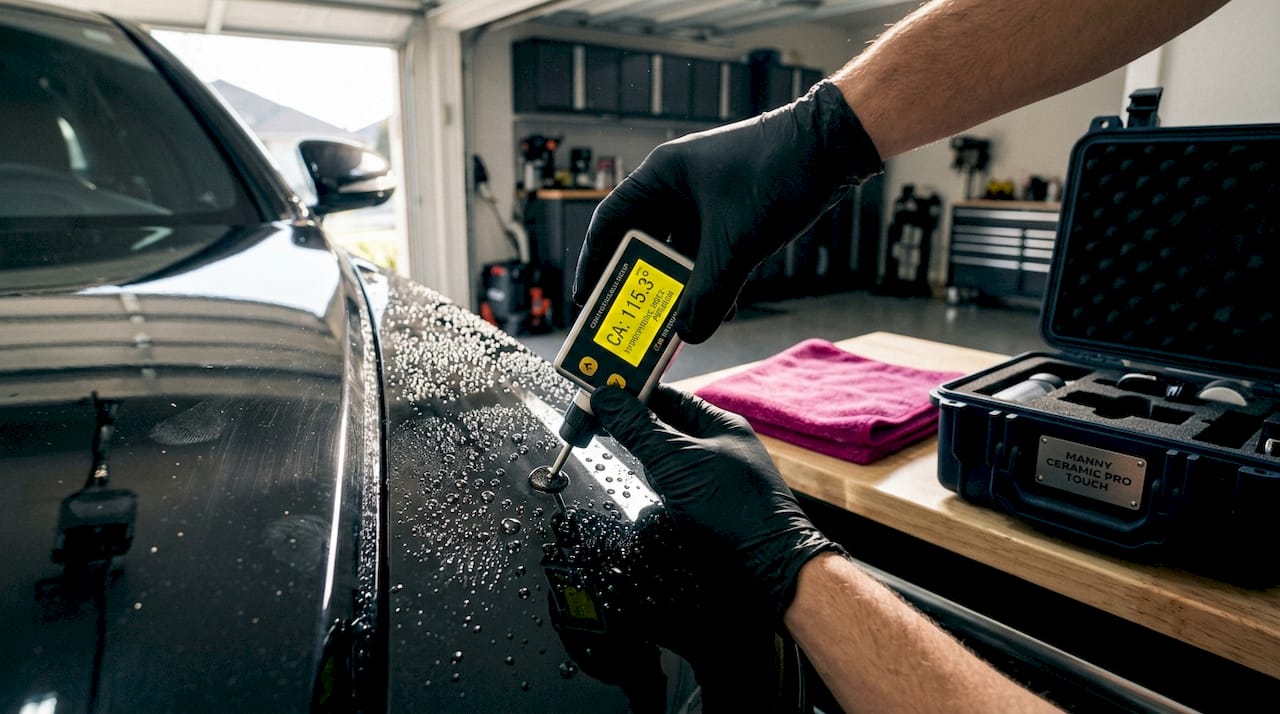
Pro Tip: Always ask your coating provider for the specific WCA rating of the product they use. A reputable professional will have this data. If they cannot provide it, that tells you something important about the quality of the product.
What makes this relevant to enhanced vehicle appearance is not just the water-beading effect. The silica-rich chemistry in professional ceramic coatings also adds measurable hardness to the surface, resistance to minor abrasion, and enhanced optical clarity that makes paint colors appear richer and more saturated. These properties work together, not in isolation.
Hydrophobic coatings vs. other protective solutions
Understanding the science behind hydrophobic coatings makes it easier to evaluate where they fit within the broader landscape of protection options. Luxury car owners frequently encounter decisions between wax, ceramic coatings, and paint protection film. Each has a different role.
| Feature | Wax | Hydrophobic ceramic | Paint protection film (PPF) |
|---|---|---|---|
| Water contact angle | Low (80 to 95°) | High (110 to 120°+) | Moderate (varies by product) |
| Scratch resistance | Minimal | Moderate hardness | Excellent physical barrier |
| UV protection | Minimal | Good | Excellent |
| Self-healing | No | No | Yes (many PPF products) |
| Durability | Weeks | Years | 5 to 10 years |
| Clarity | Good initially | Excellent | Excellent |
| Application complexity | Low | High | Very high |
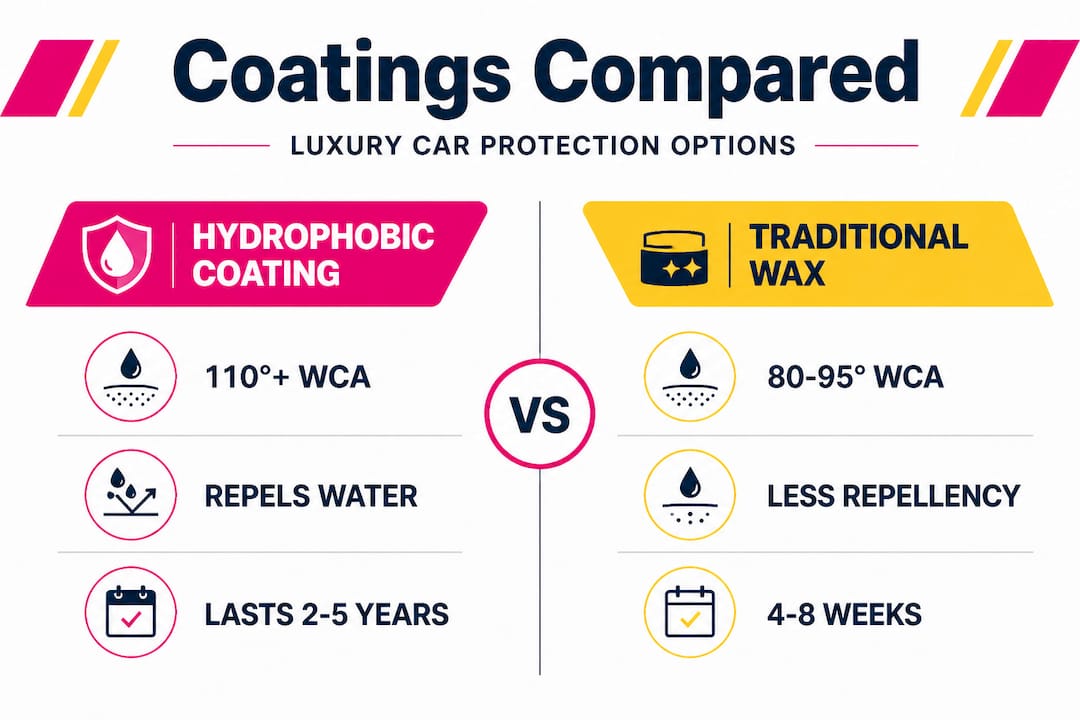
The comparison reveals something critical: hydrophobicity alone is not always sufficient. High-value vehicles face a range of threats beyond water. Rock chips, key scratches, UV-induced paint fade, and chemical etching from bird droppings all require different types of protection. Automotive coatings in demanding environments require optical clarity, scratch resistance, UV durability, and easy-clean performance, not just water repellency. A coating that checks only one box leaves your vehicle exposed in others.
This is why many luxury car owners and collectors pair solutions. A strong hydrophobic ceramic coating handles chemical resistance, gloss enhancement, and light contamination shedding. PPF handles physical impact protection on vulnerable panels like the hood, front bumper, fenders, and mirror caps. For a detailed breakdown of how these solutions differ, the PPF vs ceramic coating comparison explains each scenario clearly.
Key considerations when choosing your protection strategy:
- Daily driver luxury vehicle: Ceramic coating plus PPF on high-impact zones is the most practical and complete approach.
- Weekend or track car: Full-front PPF with a ceramic topcoat maximizes physical and chemical protection.
- Garage queen or show car: High-grade ceramic alone may be sufficient if the vehicle rarely encounters road debris.
- Freshly purchased exotic: Immediate application before any contamination occurs preserves the factory finish permanently.
If scheduling or location is a concern, mobile ceramic coating services bring professional-grade application directly to your location, eliminating the inconvenience of transporting a low-clearance or high-value vehicle.
Practical benefits and maintenance tips for luxury car owners
The scientific performance of a hydrophobic coating translates into very real, everyday benefits for how you experience and maintain your luxury vehicle. Here is what changes after a professional-grade coating is applied.
What you will notice immediately:
Water behaves differently. After a rain shower, water will bead into tight spheres and roll off the paint, carrying surface dust with it. After highway driving, insects and light grime release more easily during washing. The paint surface feels noticeably slicker to the touch. Washing the car becomes faster and requires less agitation, which directly reduces the risk of introducing swirl marks into your paint.
How to maintain maximum hydrophobic performance:
- Wash with pH-neutral shampoo only. Harsh alkaline or acidic cleaners strip the coating’s surface chemistry faster than anything else. Use products specifically rated as coating-safe.
- Avoid automatic car washes with brushes. Even soft-touch car washes introduce swirl marks over time. Touchless washes are acceptable in a pinch, but hand washing remains the gold standard.
- Dry with a clean microfiber towel or air blower. Aggressive drying with low-quality towels introduces micro-scratches that degrade optical clarity.
- Apply a ceramic maintenance spray every 3 to 4 months. These products refresh the hydrophobic layer without compromising the base coating underneath. Think of them as a light maintenance cycle.
- Keep the vehicle away from prolonged tree sap or industrial fallout exposure. Even the best hydrophobic coating has limits when contaminants sit long enough to harden.
Effective hydrophobic coatings are evaluated with static WCA measurements of around 115 degrees after full curing, and maintaining that performance over time requires consistent, correct care habits.
How to check if your coating is still working:
Pour a small stream of water over a horizontal panel like the hood or roof. If the water beads tightly and rolls off in discrete droplets, the coating is performing. If the water sheets flat across the surface or clings without movement, performance has degraded and reapplication or a maintenance detail is warranted.
Pro Tip: Do not wait until the coating fails completely before addressing it. A maintenance detail at 12 to 18 months is far less expensive than a full paint correction followed by recoating.
Pairing professional paint protection with a disciplined maintenance routine ensures that the investment you make today continues to return value years down the road. The coating does the heavy lifting. Your job is to not work against it.
Why hydrophobic isn’t everything: The overlooked elements in luxury car protection
Here is an opinion that might be uncomfortable: the automotive detailing industry has oversold water beading as the primary indicator of coating quality. Walk through any car show and you will hear owners describe their coating’s performance entirely in terms of how dramatically water rolls off the paint. That obsession is understandable. It is visually satisfying. But it is also incomplete.
Water beading is a symptom of good hydrophobicity. It is not a measure of total protection. A coating can produce exceptional WCA values while offering poor UV resistance, marginal hardness, or inconsistent adhesion. If your coating excels at water repellency but fades under prolonged sun exposure or chips away at high-impact zones, the visual result over two years will still disappoint you.
Real-world automotive environments demand more than water repellency. Optical clarity, scratch resistance, and ease of maintenance are equally critical properties, particularly for vehicles that operate in diverse climates or on poorly maintained roads.
The most common mistake we see from luxury car owners is selecting a coating based on a single metric, usually the “strongest” hydrophobic performance or the highest hardness rating, without considering how all the protection properties work together as a system. A 9H hardness ceramic sounds impressive on paper, but if it is applied over poorly prepared paint, it locks in contamination and surface defects permanently. If it is not UV-stable, it will begin to yellow or cloud within 18 months in a sun-intensive climate.
True luxury vehicle protection means building a strategy. That strategy accounts for appearance-enhancing coatings, physical impact barriers, UV stability, maintenance frequency, and the specific risks your vehicle faces based on where and how you drive. Hydrophobicity is one essential component of that system. It is not the whole answer.
The vehicles that hold their finish and value over five or ten years are not the ones with the most dramatic water beading on the day of application. They are the ones whose owners invested in the right combination of protection, applied correctly, and maintained with discipline.
Protect your luxury investment with the best hydrophobic solutions
Understanding the science and strategy behind hydrophobic coatings is the first step. Executing it on a vehicle worth six or seven figures requires a different level of expertise and precision.
At Manny’s Ceramic Pro Touch LLC, every vehicle is assessed individually before any product is applied. Paint condition, existing swirl marks, climate exposure, and the owner’s maintenance habits all factor into the protection strategy we recommend. Our ceramic coating packages are engineered for luxury, exotic, and high-value vehicles where getting it right the first time is not optional. For clients who also need physical impact protection, our professional paint protection film service addresses the full range of real-world threats. We also offer mobile car detailing for clients who prefer service delivered with discretion and convenience. If your vehicle deserves elite-level care, we are ready to provide it.
Frequently asked questions
How long does a hydrophobic coating last on a luxury car?
A properly applied professional-grade hydrophobic ceramic coating typically lasts two to five years depending on the product tier, application quality, and how consistently the vehicle is maintained. Consumer-grade products last considerably less.
Does a hydrophobic coating protect against scratches or just water?
Hydrophobic coatings primarily resist water and airborne contaminants, though professional ceramic formulations add a degree of hardness that helps resist light surface abrasion. For true scratch protection, coatings require additional properties like scratch resistance and UV durability beyond water repellency alone.
Can I apply a hydrophobic coating myself to my luxury car?
DIY consumer products are available, but professional application ensures thorough paint preparation, correct product selection, and precise curing conditions that are very difficult to replicate at home, especially on high-value paintwork where mistakes are costly.
How do I check if my car’s hydrophobic coating is still effective?
Pour water over a flat panel and observe how it behaves. An effective coating produces tight water beads that roll off freely. Effective coatings show WCA values near 115 degrees or higher, and when performance drops noticeably, reapplication or a maintenance service is needed.